The Municipality of Carrillo—a local government in Costa Rica located in the Carrillo canton, district of Filadelfia—completed the process for transitioning and deploying the IPv6 protocol in its Information and Communications Technology infrastructure in mid-2023, adopting a dual-stack model. The goal was to address the problem of IPv4 exhaustion in the region and to comply with the regulatory framework established by the Ministry of Innovation, Science, Technology, and Telecommunications (MICITT) for central government institutions, ensuring the continuity of internal and external communication services (internal institutional network and various Internet connections).
Given that this migration process brings a series of advantages and benefits that enhance the State’s technological infrastructure, it also strengthens the public value chain through the portfolio of services offered to both internal and external clients. At the same time, it allows attaining a high level of maturity with respect to global trends in connectivity and digitalization.
Strategies and Phases of the Implementation Process
Strategically, these types of projects can be planned in phases, following a ‘divide and conquer’ methodology to systematize the IPv4 to IPv6 transition process gradually and assertively. It is extremely important to emphasize the recommendation to acquire IPv6 addresses directly from the Regional Internet Registry (RIR).
(Free access, no subscription required)
This avoids being locked in with a local Internet Service Provider (ISP) who might otherwise provide the IPv6 addresses to be configured (both internally and externally). Thus, this strategic action allows the organization to achieve autonomy in managing their address block. The ISPs the organization wishes to work with will only need to handle the BGP announcement. Furthermore, terminating a contract with an ISP does not involve or require changing the addressing on devices or configuring elements at internal and external network infrastructure level.
A description of each phase completed for deploying IPv6 in the municipality is presented below, along with recommendations for achieving a successful transition process:
Phase #1: Knowledge Transfer.
Regardless of whether the project is carried out by the organization’s internal technical staff or through outsourced implementation or consulting services, a ‘Knowledge Transfer’ process is extremely important and key to its success. This process should cover the following topics:
This avoids being locked in with a local Internet Service Provider (ISP) who might otherwise provide the IPv6 addresses to be configured (both internally and externally). Thus, this strategic action allows the organization to achieve autonomy in managing their address block. The ISPs the organization wishes to work with will only need to handle the BGP announcement. Furthermore, terminating a contract with an ISP does not involve or require changing the addressing on devices or configuring elements at internal and external network infrastructure level.
A description of each phase completed for deploying IPv6 in the municipality is presented below, along with recommendations for achieving a successful transition process:
Phase #1: Knowledge Transfer.
Regardless of whether the project is carried out by the organization’s internal technical staff or through outsourced implementation or consulting services, a ‘Knowledge Transfer’ process is extremely important and key to its success. This process should cover the following topics:
Fundamentals of IPv6
IPv6 addressing
IPv6 routing
Configuration of critical ICT infrastructure services
A comparison of IPv4 and IPv6
Basic IPv6 configuration for end devices
The goal is to empower the organization’s technical staff by equipping them with sufficient knowledge to make informed decisions during the deployment, as well as to develop skills related to IPv6 configuration, support, and maintenance once the transition process is complete.
Phase #2: Diagnosis and Planning.
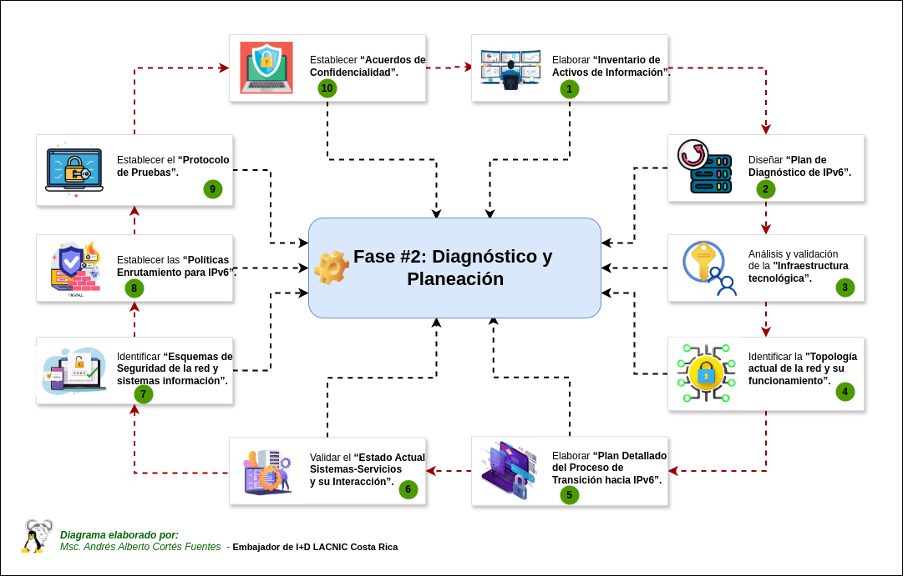
The diagnosis and planning phase conducted in the municipality included the activities described in the chart, which resulted in the detailed Implementation Plan that was realized in the next phase of the project.
Phase #3: Implementation.
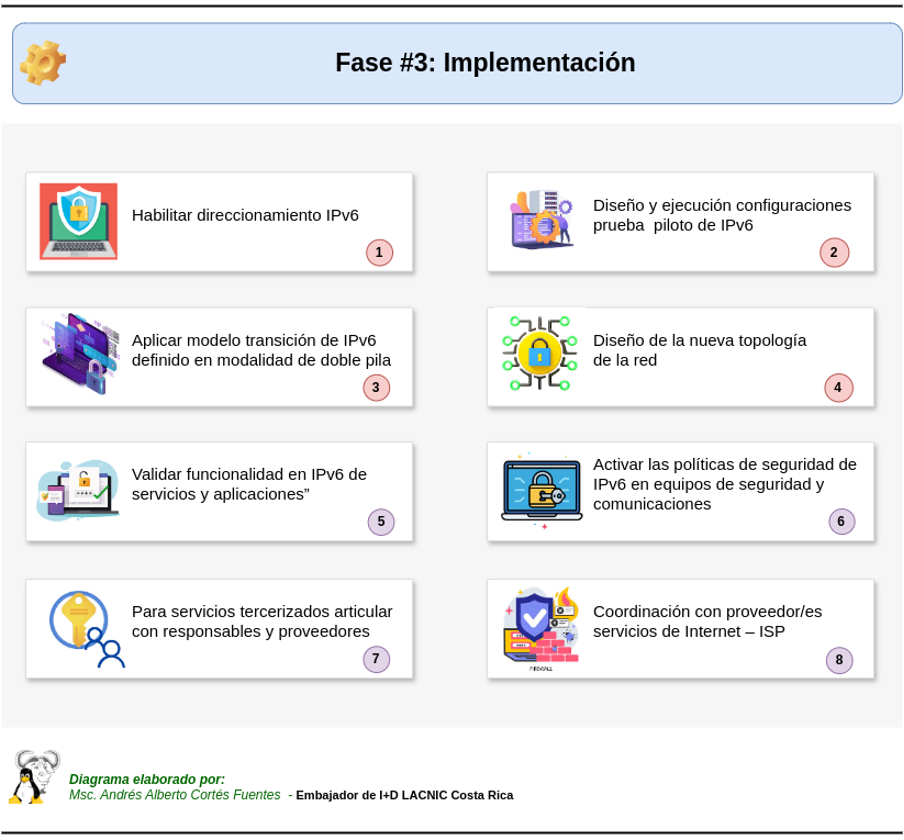
The implementation phase included the activities described in the graph above. These resulted in a technical document detailing all configurations made at the hardware, software, services, and configuration element levels, ensuring that the organization operates fully under the IPv6 protocol while considering the security and functionality standards defined by the municipality.
Key factors identified for a successful implementation include:
Having active maintenance and support contracts with critical infrastructure providers.
Effective response times from critical infrastructure providers based on SLAs.
Effective support from Internet Service Providers (ISPs).
Expert advice and guidance. In this case, a specialized company was hired to lead the transition process.
Skilled, trained, and committed internal technical staff actively involved throughout the project.
Awareness and a positive attitude among the internal technical staff, as adopting the dual-stack model requires adjusting processes, applying two configurations for the devices, and performing diagnostics on both protocols, all of which increases the support and maintenance workload.
Designing and conducting a pilot test in a controlled environment on selected network segments with representative users, to evaluate the normal operation of services and applications, both internally and externally, under the IPv6-only model.
Enabling IPv6-specific security policies across all key configuration elements, such as firewalls, servers, virtualization environments, and others, to avoid exposing vulnerabilities.
Phase #4: Testing and Monitoring.
Once the previous phases were successfully completed, the final step in the municipality’s IPv6 protocol implementation process involved validating, optimizing, and documenting the configurations and services under the new protocol. During this phase, IPv6 functionality was tested and monitored to verify that information systems, storage devices, communications equipment, and services were operating correctly and allowing IPv6 traffic to and from the Internet.
IPv6 protocol functionality tests were then conducted in relation to the agreed perimeter security policies, including servers, services, and communications devices, with the goal of identifying vulnerabilities and documenting the results.
This phase allowed us to fine-tune the configurations made at the hardware, software, services, and configuration element levels, adjusting the parameters needed to optimize performance and ensure the stability of the devices and platforms.
Finally, a key outcome of this last phase was an updated inventory of services, physical devices, applications, and communication systems, which reflects the final status of information assets within the IPv6 model.
Conclusion
Implementing the IPv4 to IPv6 transition process in public Costa Rican institutions is extremely important to ensure:
Scalability: IPv6 solves the problem of IPv4 exhaustion by providing a virtually unlimited number of IP addresses, allowing the transparent integration of new devices into state networks.
Resilience: IPv6 provides more efficient mechanisms to enhance the continuity, efficiency, and modernization of technological services in the public sector.
Security: IPv6 enhances the protection of the data transmitted over the network. It also includes native security features and allows the use of a set of communication rules or protocols to establish secure connections over a network.
Operational efficiency: IPv6 significantly enhances network traffic management with advanced auto-configuration features and more efficient routing.
A futuristic outlook: By adopting IPv6, government institutions will have the technical resources needed to deploy emerging technologies such as the Internet of Things (IoT) and smart city systems.
For these reasons, transitioning to the IPv6 protocol in organizations that are part of the Costa Rican state is not only a technical necessity, but rather a strategic decision for fostering technological sovereignty and neutrality, improving the quality of public services, and ensuring the country’s participation in the global digital economy. This process promotes innovation, ensures the state’s technological sustainability, and consolidates Costa Rica and other Latin American and Caribbean countries as regional leaders in technological modernization.