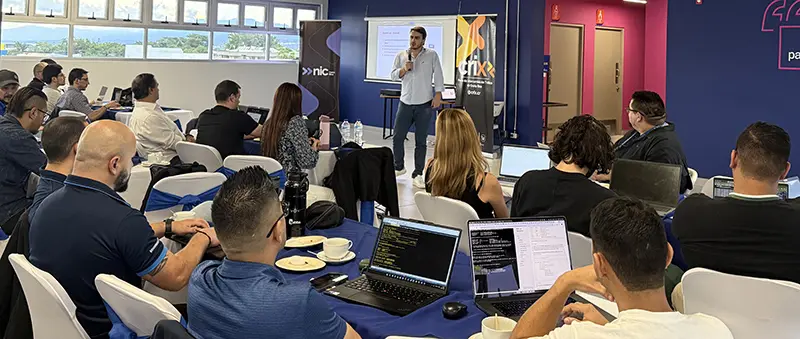
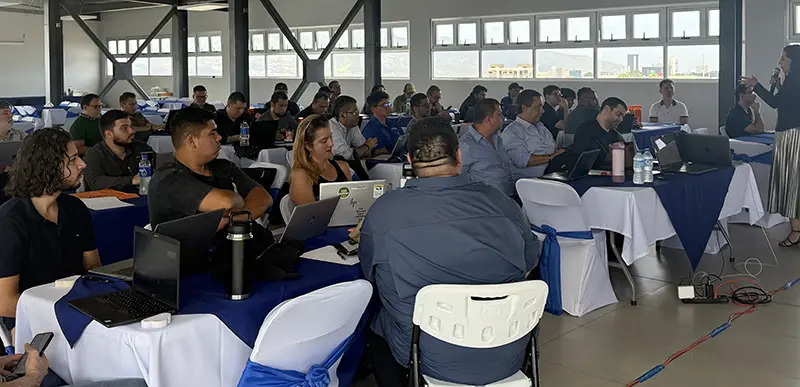
During two days of intensive technical exchange, 70 network operators, Internet infrastructure specialists, and members of the Costa Rican technical community participated in the workshop “DNS, Interconnection, and Secure Network Operation.” The event was jointly organized by NIC Costa Rica, LACNIC, LACNOG, and ICANN, and took place at Fidélitas University in San José, Costa Rica, on June 23 and 24.
The workshop brought together professionals seeking to strengthen their capabilities in key areas related to Internet stability and security, combining theoretical sessions with hands-on labs focused on real-world network operations. It is worth noting that 25% of Costa Rica’s autonomous systems were represented, along with more than 50% of the ASNs connected to CRIX.
This meeting is part of the strategy that LACNIC, LACNOG, and ICANN have been promoting for several years to support the development of Network Operator Groups (NOGs) in Latin America and the Caribbean by fostering training opportunities, collaboration, and the construction of a technical community. These initiatives help bring specialized knowledge to local operators and create spaces for discussing the challenges faced daily by those who keep the Internet running across the region.
Hands-On Training for Today’s Internet Challenges
The program covered some of the most relevant topics in secure network operation. On the first day, participants focused on DNS and DNSSEC, exploring mechanisms to strengthen the integrity and authenticity of information in the Domain Name System.
(Free access, no subscription required)
The workshop included hands-on labs where participants configured recursive DNS servers and worked with tools designed to enhance security and promote operational best practices. ICANN’s KINDNS program was also presented, an initiative that promotes the adoption of standards and recommendations for a more secure DNS operation. This first session was led by Nicolas Antoniello, Technical Engagement Manager at ICANN.
The program also included a session on regional Internet policies and LACNIC’s Policy Development Process (PDP). Led by Franco Cabrera, this session showed participants how they can help shape the policies that govern the management of Internet number resources in the region.
Interconnection and Routing Security at the Heart of the Discussion
The second day also featured the participation of Mauricio Oviedo, representative of NOG Costa Rica, who, along with Erika Vega of LACNOG, began the session sharing an overview of the institution’s activities.
The workshop included hands-on labs where participants configured recursive DNS servers and worked with tools designed to enhance security and promote operational best practices. ICANN’s KINDNS program was also presented, an initiative that promotes the adoption of standards and recommendations for a more secure DNS operation. This first session was led by Nicolas Antoniello, Technical Engagement Manager at ICANN.
The program also included a session on regional Internet policies and LACNIC’s Policy Development Process (PDP). Led by Franco Cabrera, this session showed participants how they can help shape the policies that govern the management of Internet number resources in the region.
Interconnection and Routing Security at the Heart of the Discussion
The second day also featured the participation of Mauricio Oviedo, representative of NOG Costa Rica, who, along with Erika Vega of LACNOG, began the session sharing an overview of the institution’s activities.
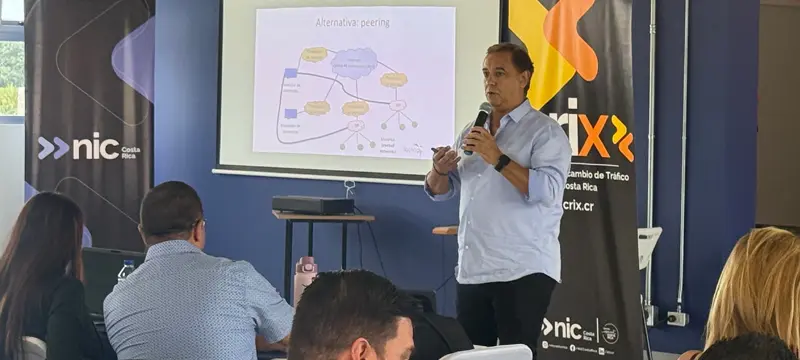
Guillermo Cicileo of LACNIC then kicked off the day’s highlight: a session that focused on interconnection, peering, and routing security. Attendees explored key concepts related to the exchange of traffic between different networks and the role Internet Exchange Points (IXPs) play in the development of the local ecosystem. Discussions also examined common routing incidents observed in the region, their most frequent causes, and measures that can be implemented to mitigate their impact.
One of the topics that generated greatest interest was BGP security and the adoption of mechanisms such as RPKI, which are now considered essential for preventing route hijacking and other issues associated with global routing. The workshop concluded with a hands-on lab in which participants configured RPKI servers and applied route validation and filtering in BGP environments, putting into practice the concepts they had learned in specific operational scenarios.
The Value of Strengthening NOG Communities
In addition to technical content, the workshop provided a new opportunity to strengthen ties among Costa Rican network operators and reinforce collaboration within the local community.
NOGs play a key role in the Internet ecosystem by facilitating the exchange of experiences, collaborative problem-solving, and the dissemination of best practices. Through these communities, operators can learn from real-world experiences shared by their peers and build trusted networks that are essential when dealing with incidents or operational challenges.
The experience in Costa Rica reaffirms the value of these in-person gatherings as a complement to regional meetings and virtual activities. Direct contact between operators, technical organizations, and international specialists allows a deeper understanding of local needs and adapting content to the reality of each community.
Through initiatives such as this one, LACNIC, LACNOG, ICANN, and national NOGs continue to strengthen technical capabilities across the region, convinced that a more stable, secure, and resilient Internet is built on shared knowledge and collaboration among those who operate it on a daily basis.