Back in Curaçao, Building the Caribbean’s Digital Core
October 13, 2026
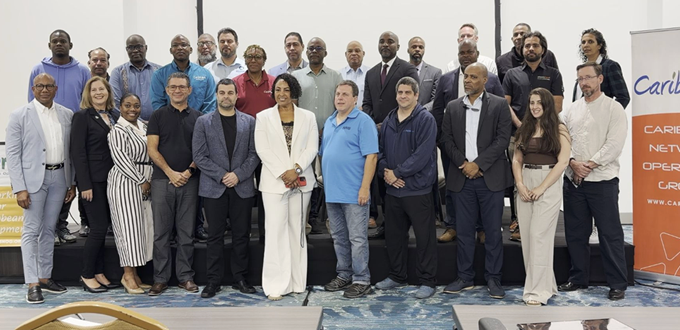
When the Caribbean Network Operators Group (CaribNOG) met in Willemstad, Curaçao, from 7 to 9 October 2026, LACNIC was on familiar ground. Curaçao is in LACNIC’s service region, and the island has a long history with both organisations.
Under the theme “Resilience Ready: Strengthening the Caribbean Digital Core,” CaribNOG 32 brought together a mix of public and private sector stakeholders, including network operators, industry regulators, diplomatic agencies, IT managers and datacenter technicians, giving LACNIC a valuable opportunity to work directly with a wide cross-section of the ecosystem that keeps Caribbean networks connected and secure.
On the opening day, Alejandro Acosta presented on several aspects of LACNIC’s services, including IPv6 adoption across the Caribbean, IPv4 waiting-list requests, the addition of ASPA to MiLACNIC, LACNIC Campus course updates, and an invitation to participate in LACNIC 46 LACNOG 2026 in Mendoza, Argentina, from October 19 to 22, 2026. As always, the presentation was made collaboratively alongside representatives of ARIN and ICANN as part of the iOrg update.
On the final day, Acosta and Nicolás Antoniello, Technical Engagement Manager for Latin America and the Caribbean at ICANN, took the room from concepts to router configuration, building on a primer from Mark Kosters, ARIN’s Chief Technology Officer. Acosta tailored the material to the challenges Caribbean networks face: vulnerable submarine cables, hurricanes, seismic and volcanic activity, and the economic cost of every outage. His recommendations included:
(Free access, no subscription required)
- Fibre first. Caribbean ISPs should connect to at least one submarine cable, and preferably more, with a satellite link in reserve.
- Satellite as back-up. Low-earth-orbit (LEO) satellites cut latency to 25–40 milliseconds, compared with 500–700 for geostationary satellites. However, a single LEO link cannot carry the traffic of many ISPs.
- Multihoming across fibre and LEO. Operators should take the full routing table over fibre for traffic engineering and accept only a default route over LEO, so the satellite carries traffic only when the cable fails.
- RPKI route origin validation lets a router check every prefix it learns against registry data and discard invalid announcements.
- BGP roles apply route-leak filtering automatically once each side declares itself provider or customer.
- BFD cuts failure detection from around 90 seconds to milliseconds, and many providers will enable it on request at no cost.
- Path MTU discovery depends on operators allowing ICMPv6 through their filters, an issue reported to be common in the region.
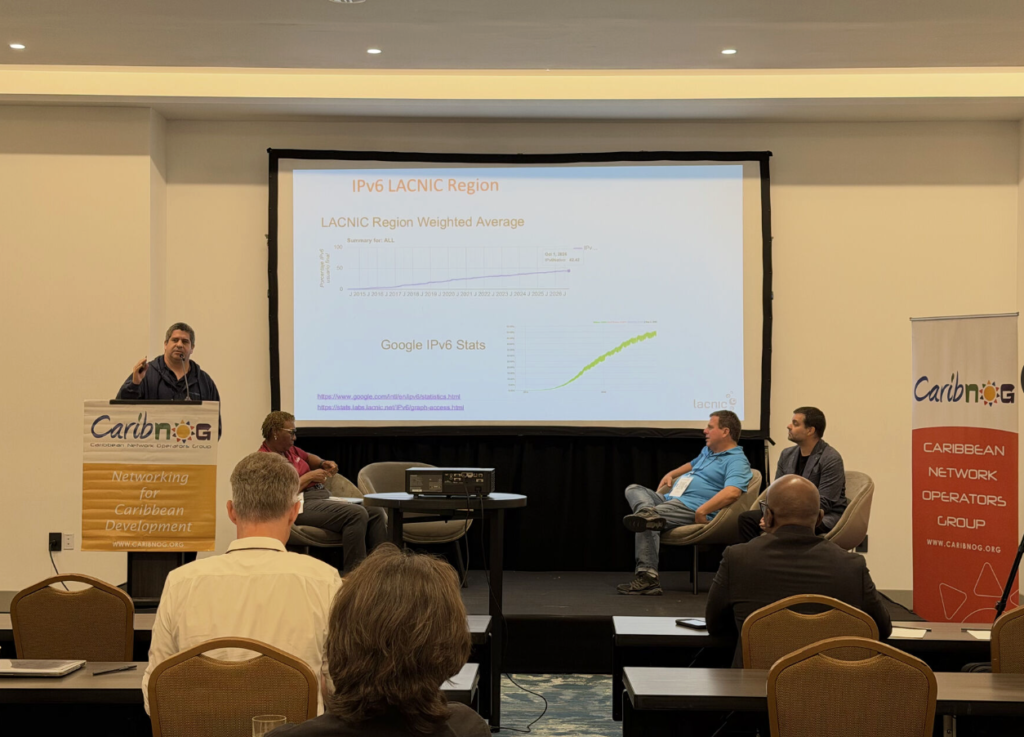
In the afternoon, participants put the morning’s concepts into practice in hands-on labs, building DNSSEC-validating DNS resolvers and configuring RPKI route origin validation.
Underneath it all was a familiar LACNIC message.
“Get your own IP addresses and ASN,” Acosta said. “They make multihoming and private peering possible, and they spare you renumbering when you change providers. They are also what content providers check when deciding whether to place a cache in your network.”