An Opportunity to Deploy IPv6 in an Academic Network
February 27, 2020
IPv6 deployment and configuration on the University’s network and other services allowed Salvadoran University Francisco Gavidia to win the second prize in the IPv6 Challenge, the competition organized by LACNIC to promote the deployment of the latest Internet Protocol within the region.
The challenge allowed the institution to carry out trials and tests to consolidate IPv6 deployment in the Salvadoran academic network. Mario Rafael Ruiz Vargas, responsible for the project, noted that IPv4 address exhaustion encouraged Francisco Gavidia University to invest in a /44 IPv6 prefix and to start its implementation in 2018. “LACNIC’s IPv6 Challenge was an opportunity to document and disseminate the work being done at the institutional level,” he said.
What lessons would you highlight from the whole process of participating in this competition promoted by LACNIC?
The ability to work in coordination with national and international Internet Service Providers (ISPs) represented a learning experience for our technical team and a challenge for IPv6 deployment in the University’s internal network.
(Free access, no subscription required)
What was the initiative that took the second prize at LACNIC32? What results did you achieve throughout this process?
The UFG took second place in the sixth IPv6 Challenge organized by LACNIC. During the awards ceremony held during LACNIC 32, the organization mentioned the difficulties they had had in deciding who would be named the winner and the runner up, so we believe the UFG presented very good documentation on its IPv6 deployment. The team responsible for IPv6 deployment was made up of the personnel of the Technology and Systems Division, in coordination with Internet service providers and with the unconditional support of the UFG’s rector. IPv6 adoption addresses the shortcomings of IPv4 address exhaustion. Moreover, this new protocol favors security, accelerates Internet traffic and communication, increases packet routing efficient and provides self-configuration alternatives. In addition, there is no shortage of IPv6 addresses, so students can conduct lab tests with the Internet of Things (IoT), an emerging technology that is part of the 4.0 industry.
How has this IPv6 deployment project evolved since your participation in the Challenge last year?
What was the initiative that took the second prize at LACNIC32? What results did you achieve throughout this process?
The UFG took second place in the sixth IPv6 Challenge organized by LACNIC. During the awards ceremony held during LACNIC 32, the organization mentioned the difficulties they had had in deciding who would be named the winner and the runner up, so we believe the UFG presented very good documentation on its IPv6 deployment. The team responsible for IPv6 deployment was made up of the personnel of the Technology and Systems Division, in coordination with Internet service providers and with the unconditional support of the UFG’s rector. IPv6 adoption addresses the shortcomings of IPv4 address exhaustion. Moreover, this new protocol favors security, accelerates Internet traffic and communication, increases packet routing efficient and provides self-configuration alternatives. In addition, there is no shortage of IPv6 addresses, so students can conduct lab tests with the Internet of Things (IoT), an emerging technology that is part of the 4.0 industry.
How has this IPv6 deployment project evolved since your participation in the Challenge last year?
Following the IPv6 implementation in our internal network, further work has been done towards IPv6 deployment in the wireless network and the servers hosted in the University’s private cloud. Furthermore, we will continue promoting the benefits of implementing IPv6 among our students in non-technical areas.
What response did you obtain when offering IPv6 to organizations that were not part of the academic community?
We were congratulated by the Salvadoran Advanced Research, Science and Education Network (RAICES), which expressed their interest in having UFG take the lead in IPv6 implementation in the higher education institutions that are members of this association.
In addition, we received positive reactions from Internet service providers regarding the use of the new IPv6 protocol. Engineer Rafael Ibarra, President of SVnet, congratulated us for having implemented the new protocol and for being the only educational institution representing El Salvador in the competition. Likewise, we were interviewed by Radio Punto 105 and articles were published in the country’s two main print media, as well as in the Business magazine published by the Chamber of Commerce and Industry of El Salvador.
What are the main administrative and technical difficulties faced by IPv6 deployment at Francisco Gavidia University?
While deploying IPv6 at UFG, we found some difficulties that we were able to overcome at an administrative level, for example, local Internet service providers were not prepared to implement the new protocol, so we hope they included this project in their work plans. Another difficulty was the response time of international Internet providers to deploy IPv6 traffic. From a technical point of view, it was necessary to update the software of the internal network’s main devices so that they would support the IPv6 protocol. In addition, the IPv4 block assigned to the UFG was not enough to complete the deployment with all the ISPs.
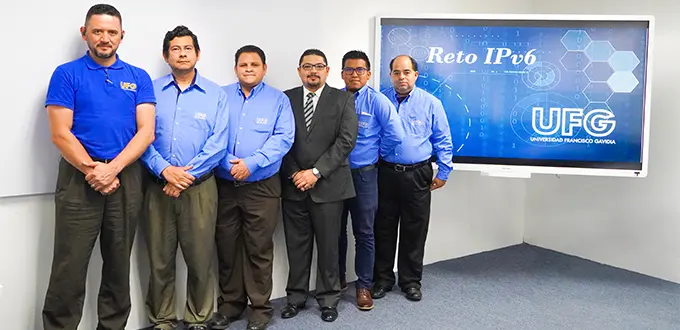
 IPv6 deployment and configuration on the University’s network and other services allowed Salvadoran University Francisco Gavidia to win the second prize in the IPv6 Challenge, the competition organized by LACNIC to promote the deployment of the latest Internet Protocol within the region.