On 24 June 2026, the ground shook beneath our feet after two powerful earthquakes struck, one off the coast of Venezuela and the other near the center of the country. Those first few minutes were pure instinct: hugging my loved ones, seeking their gaze, and confirming, with a sigh of relief, that my immediate family was safe. But as soon as the initial shock subsided, my anxiety took a different form. With my heart still pounding and news trickling in, my mind turned to telecommunications in the disaster zone. From my position in academia, I could not help but wonder what had happened to the country’s Internet infrastructure and what this lack of connectivity meant for thousands of families who, in the midst of chaos, desperately needed to hear from their loved ones.
The technical reality confirmed my worst fears. In the hardest-hit areas, the collapse and structural damage to buildings took down rooftop cell towers, leaving entire communities offline. The situation was particularly critical in La Guaira, where the high water table and proximity to the sea require residents to rely on aerial fiber optic cables, which were severely damaged.
The greatest devastation was concentrated in La Guaira and Yaracuy, where the force of the earthquake directly impacted critical infrastructure. The tremor also affected neighboring states such as Miranda, Carabobo, and Aragua due to their proximity to the epicenters. However, as is often the case in these emergencies, rural areas bore the brunt of the impact: in the days that followed, communities already struggling daily with weak, high-latency, and intermittent connectivity were plunged into an even deeper digital blackout.
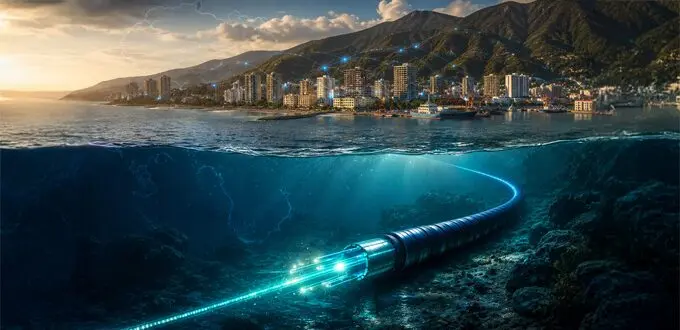
But the most critical blow to the country’s connectivity occurred at sea. Just 1.8 kilometers from the coast, very close to where the second 7.5 magnitude earthquake originated, the South American Crossing (SAC) submarine cable was cut.
This was no ordinary cable, as nearly 50% of Venezuela’s international bandwidth flows through this underwater artery. This damage immediately affected the daily lives of millions, in the form of latency spikes, slowdowns, and severe congestion during peak hours, reported by users and providers across the nation.
In the weeks that followed, I lost count of how many times I was asked the same question, sometimes in frustration and almost always with impatience: Why does it take so long to repair a submarine cable? The answer is not simple, as nothing is simple under the sea. Repairing a deep-sea fracture requires specialized vessels, technical personnel, suitable conditions for cable access, and the corresponding regulatory authorizations. While the ships at sea worked against the clock, alternative routes were activated on land: overland routes to Colombia were set up, which helped mitigate the digital disruption and gradually recover some bandwidth. It was not until 24 July that final relief arrived with the confirmation that the SAC cable was fully repaired.
Connectivity as Emergency Infrastructure
If anything became clear during those first few hours, it was that in an emergency, connectivity is no longer simply a service: it becomes a critical tool for requesting help, coordinating action, and keeping the population informed.
With cell towers out of service and problems with cellular networks in the hardest-hit areas, operators requested support to enable emergency alternatives. These initiatives included Starlink’s direct-to-device (D2D) service, activated with a special authorization from CONATEL, which enabled basic communications in the affected areas with the country’s three mobile phone operators.
Meanwhile, emergency Wi-Fi networks began to be deployed using satellite equipment, batteries, and solar panels. Civil society organizations such as Conexión Segura y Libre, Reconecta Venezuela, Redes Ayuda, and Internet Society Venezuela played a particularly important role in this effort, collectively installing more than 200 free connectivity points in the most affected areas. International organizations such as Telecom Sans Frontières, Colnodo, and SpaceX also became important allies in coordinating these deployments for emergency response and subsequent support to displaced communities.
This experience taught us a key lesson: resilience does not depend on a single technology or a single actor. During the most critical moments, connectivity was maintained thanks to a combination of satellite networks, Wi-Fi solutions, alternative energy sources, and the ability of various actors to coordinate and rapidly deploy their responses.
Even so, some areas remained cut off for several days. The lack of electricity and the collapse of cellular networks also made it difficult to coordinate the various rescue teams. In the first few hours, some information about what was happening began to arrive through people who managed to leave the affected areas and reach places where service was still available.
What This Crisis Has Taught Us
Once the submarine cable was repaired, the main international connectivity issues were overcome. But that does not mean that everything has been solved. In the most affected areas, efforts are still underway to repair fiber optic cables and radio base stations. Some areas also remain without electricity or have unreliable power, leading to continued Internet outages.
At the University of Los Andes, we are conducting a study using RIPE Atlas probes to accurately measure how the submarine cable cut affected national latency and response times. This data will allow us to better understand the impact of the events and draw lessons that can help strengthen the network’s resilience to future events.
This crisis has also brought back into focus the need to strengthen the Internet exchange point infrastructure in Venezuela. Having more IXPs does not replace international connectivity, but it does allow a greater portion of traffic with its origin and destination within the country to remain local, thus reducing unnecessary dependencies and contributing to a more efficient and resilient network. Having nap.ve was essential for saving local traffic. However, it became clear that we need more IXPs in our country to strengthen the resilience of our Internet.
Finally, I believe this experience confirms something we already suspected: satellite networks should be part of the emergency connectivity plans of a country with seismic risk such as ours and may be particularly relevant in remote and rural areas. That said, technology alone is not enough. It is also essential that civil associations, operators, the private sector, and institutions have the equipment, protocols, and coordination mechanisms ready to be activated in the event of a disaster.
The coordination between CONATEL, business chambers like CASETEL and CANAEMTE, private operators, and civil society worked, but it largely had to be developed on the go. That is perhaps one of the most important lessons this crisis has taught us: resilience does not begin when an emergency occurs. It must be built earlier, by diversifying infrastructure, preparing alternatives and strengthening the various actors’ ability to respond in a coordinated manner when they are needed the most.
As part of the LACNIC 46 LACNOG 2026 event taking place in Mendoza, Argentina, from October 19 to 22, the author of the article will give a presentation on the response and recovery of connectivity in Venezuela following the earthquakes.
The presentation will be streamed live and feature simultaneous interpretation into Spanish, English, and Portuguese. You can register to participate here.