As a result of IPv4 exhaustion and the continued growth of the number of Internet connections for new devices and subscribers, during the webinar titled “Who Should Participate in IPv6 Deployment?” organized by LACNIC, companies and experts agreed on the need to accelerate IPv6 adoption as well as on the need for the entire ecosystem to be involved with strategy and training plans.
LACNIC CEO Oscar Robles noted that the potential exhaustion of IPv4 addresses was initially identified in the 1990s and actually occurred in 2011. Given the growth of trends such as the Internet of Things (IoT), Smart Cities, and Industry 4.0 which will add millions of devices to the network, Robles pointed out that IPv6 is the only mechanism that enables their connectivity.
(Free access, no subscription required)
“We don’t have enough addresses, not only for devices, but also for people. There are 200 million people in the region who lack connectivity, but there is no more IPv4 address space, so any project in the region that intends to connect the unconnected must include IPv6. Otherwise, the project will come to nothing,” he warned.
Another benefit of IPv6 is that it is the only protocol capable of offering transaction traceability, which will be useful to prevent and prosecute cybercrime, and thus restore user trust.
It is estimated that IPv6 deployment currentlyrepresents about 30% of Internet traffic. However, in some countries of the region IPv6 adoption is quite advanced [e.g., Uruguay (55%), and Mexico and Brazil (45% each], while in others IPv6 deployment rates are very low [e.g., Chile (10%), Panama (2%), and Costa Rica (8%].
“We don’t have enough addresses, not only for devices, but also for people. There are 200 million people in the region who lack connectivity, but there is no more IPv4 address space, so any project in the region that intends to connect the unconnected must include IPv6. Otherwise, the project will come to nothing,” he warned.
Another benefit of IPv6 is that it is the only protocol capable of offering transaction traceability, which will be useful to prevent and prosecute cybercrime, and thus restore user trust.
It is estimated that IPv6 deployment currentlyrepresents about 30% of Internet traffic. However, in some countries of the region IPv6 adoption is quite advanced [e.g., Uruguay (55%), and Mexico and Brazil (45% each], while in others IPv6 deployment rates are very low [e.g., Chile (10%), Panama (2%), and Costa Rica (8%].
Sergio Bustamante, network transformation manager at Telecom Argentina, participated in the webinar and noted that IPv6 adoption is important to ensure “business sustainability”. He also agreed that the scarcity of IPv4 addresses limits the development of technologies such as 5G, which enable greater device connectivity.
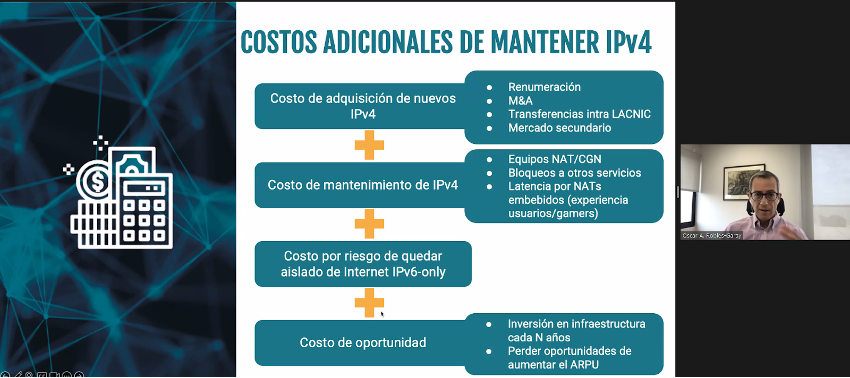
Both Robles and Bustamante mentioned that IPv6 adoption helps to reduce network maintenance costs and the cost of acquiring technology for both the legacy IPv4 infrastructure as well as for the equipment required to keep both protocols running.
In order for a company to successfully transition to the new protocol, he recommended that the first steps should be to clearly define which business areas will be migrated, to train their staff in these areas, to understand the advantages and differences with respect to IPv4, and to address the new security challenges.
Awareness-building and strategy at the government level
Robles also stressed the important role of governments and academia in promoting IPv6 adoption. He pointed out that governments can boost adoption because it is a major buyer of technology, while the academic sector is responsible for preparing the professionals required for the transition.
Zueline Aguilar of the Panamanian National Authority for Government Innovation stressed that IPv6 adoption is important for her country because it allows them to be prepared for the digital transformation of the economy, tomodernize public entities, and to address the future demand for connectivity. IPv6 penetration in Panama is currently close to 2%.
Aguilar advised that entities wishing to adopt IPv6 should begin by learning about the experience of other governments, raising awareness regarding the benefits and security that IPv6 offers, and taking an approach towards adoption that is based on benefits rather than on mandates.
She recounted Panama’s experience in promoting the adoption of IPv6 addressing, including the creation of a guide and a strategy for its implementation, working closely with other government entities, promoting the use of IPv6 in the National Multiservice Network, and working with telecommunications operators to only provide IPv6 to public entities.
In turn, Henri Alves of Brazil’s Campinas State University (UNICAMP) highlighted the responsibility of the academic institution, both in training talent to accelerate the adoption of the new protocol as well as in its implementation within university facilities to serve more than 60,000 students and other devices.
Likewise, Alves shared the university’s challenges in adopting a dual-stack model that allows working simultaneously with IPv4 and IPv6 as the transition is implemented. However, he warned that this model cannot be maintained forever, and work must be done to retire IPv4 infrastructure without affecting legacy applications that may still need it.
The views expressed by the authors of this blog are their own and do not necessarily reflect the views of LACNIC.