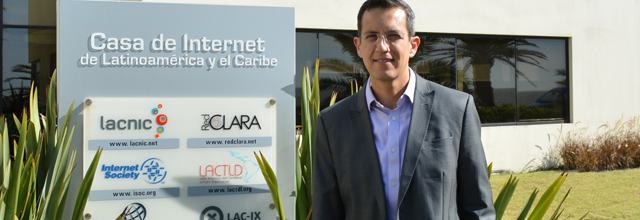
Oscar Robles, LACNIC’s recently-appointed CEO, notes that the Internet is experiencing one of the most significant milestones in the history of its organizations –the IANA Stewardship Transition process. When speaking of the future of the Internet, Robles is optimistic about regaining “the openness that the Internet has lost, (and) what we’ve lost in terms of its capacity to enable human and civil rights.”
Below is our interview with LACNIC’s new CEO.
Just like any other organization, LACNIC faces both internal and external challenges. The responsibility of offering a service that will meet the expectations of our members has been affected now that the main resource we offer –IPv4– has entered its final exhaustion phase, and, while it is true that our organization is financially sound and exhibits an enviable working environment, it is also true that we must work daily to maintain these indicators. In addition, we must always keep up with technology, as only a reliable and secure infrastructure will help us achieve our goals.
On the external front, we are going through the IANA Stewardship Transition, one of the most significant milestones in the history of Internet organizations. Above all else, we must make sure that the transition process respects the multistakeholder model and participatory processes that have always characterized our community. At the same time, we must continue to promote IPv6 deployment, attempting to reach decision makers within the region’s key organizations so that they can help us through this process.
What do you think will be your main lines of action?
Although it is somewhat premature to set a specific strategy, I want to make sure that all our efforts in relation to any of the challenges I mentioned earlier or to any new challenges that may arise will be sustainable.
The Internet is considered to be one of the greatest tools for the democratization of information. Nevertheless, attempts to curtail online freedoms citing security issues continue to grow. What is your opinion on this matter?
It is unfortunate to see how a tool that governments might use to improve their governance processes and empower civil rights can be used quite poorly for these purposes yet much more effectively against human rights. While LACNIC has no specific role in the defense of these rights, I believe we have the opportunity to promote discussions among relevant regional stakeholders to allow the adoption of more sensible solutions to governments’ security concerns. We actively engage in various forums, organized by our organization or by others, that are attended by government officials, and will continue to use these opportunities to defend the Internet’s fundamental principles.
What is the status of Internet development in Latin America and the Caribbean?
Development levels vary greatly: while a few countries have quite acceptable levels of Internet and broadband penetration, the vast majority have Internet penetration rates below 50% or limited bandwidth. What’s even worse is that in certain other countries access is very limited not only in terms of penetration but also in terms of quality, which results in a limited offering of online services.
Was the region prepared for IPv4 exhaustion? What is your assessment of current IPv6 deployment in Latin America and the Caribbean?
Again, I think the region is not uniformly prepared for effective IPv6 deployment. While IPv4’s days are numbered, the fact that certain technologies exist that can help mitigate this situation have provided operators with a false sense of security. In some countries of the LAC region, a significant percentage of networks (ASNs) support IPv6 and are currently ready to handle IPv6 traffic. To a large degree, major operators have made sure that their key infrastructure supports IPv6, major content generators are already using dual-stack technology in their networks and servers, and end-user devices also (mostly) support the new protocol. Important challenges remain, however, as regards modems, cable modems and other devices that are not yet ready for IPv6 and that these operators are still planning to replace. That’s one of the weakest links.
The region’s other weak link is the thousands of corporate applications ranging from robust ERPs to collaborative applications (planners, calendars, Internet messaging apps, etc.) that might have trouble using libraries that support IPv6. In this sense, LACNIC has developed an application certification methodology (CERTIv6) which we are interested in disseminating as much as possible to contribute to proper IPv6 deployment throughout the region.
The transition of the IANA functions’ stewardship to the RIR community is underway. What are the things we should be paying attention to?
While this transition is one of the most significant milestones in the history of Internet organizations, it is also true that we must be particularly mindful about observing the process to make sure that the qualities that have characterized our policy development processes are maintained under all circumstances: discussions that are open to any community member interested in participating and a public record of those discussions. This requirement was established by the US government through the NTIA’s call for proposals a little more than a year ago. This means that we must remain attentive and mindful of the process.
The past 20 years have been essential for the Internet. What will the Internet look like in 2035?
I don’t know what it will look like, but I do know how we should imagine the future of the Internet: we must win back the openness that the Internet has lost and what we’ve lost in terms of its capacity to enable human and civil rights. I can’t imagine the Internet as a single website, limited to JUST ONE of the nearly 300 million pages available on the Internet. I can’t imagine it as a tool for mass surveillance. The Internet must remain an essential element for social, cultural, economic and human development. There is much work to be done.