LACNIC, LAC-IX, and ISOC have planned and executed important activities for the purpose of strengthening #IXPs in the region. This article shows some of the results achieved thanks to the dedication and commitment of those who are part of this collaborative effort.
Earlier this year, my colleague, Olaf Kolkman, summarized an Internet Society project that sought to understand whether the “classic” Internet is still relevant. The premise of the research was that the evolution of edge services has reshaped the way data flows through the Internet.
(Free access, no subscription required)
A portion of this transformation is linked to the decline in transit services, which is linked to the expansion of the peering network sought by several network operators that join Internet Exchange Points (IXPs). A similar trend is happening in relation to how Content Delivery Networks (CDNs) are expanding their peering relations also by partnering with IXPs.
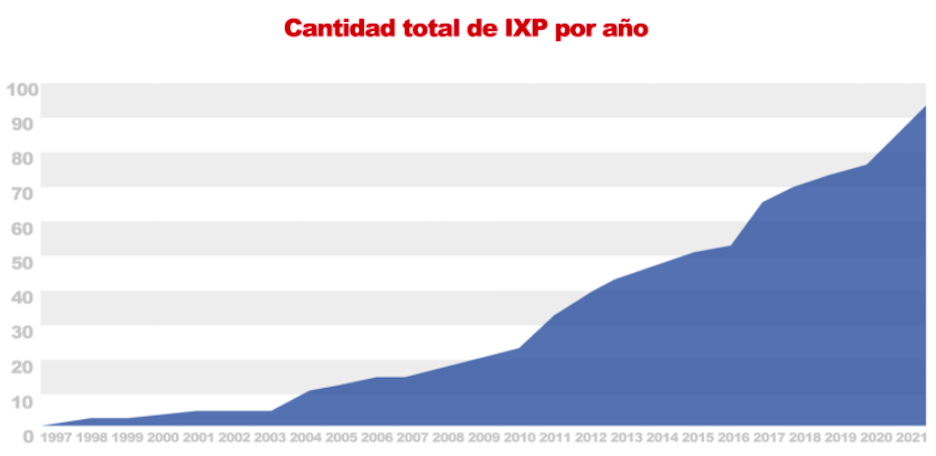
Figure 1 — Total number of IXPs in the LAC region (1997-2021). Source: LAC-IX
LAC-IX has played a major role in not only establishing and supporting the growth of IXPs in the region but also facilitating the exchange of experiences and best practices among members. One example of this is a business case it recently developed for CABASE, the organization in charge of the IXPs in Argentina and one of LAC-IX’s biggest members, which offered insights on why IXPs matter beyond peering exchanges, such as routing security.
A portion of this transformation is linked to the decline in transit services, which is linked to the expansion of the peering network sought by several network operators that join Internet Exchange Points (IXPs). A similar trend is happening in relation to how Content Delivery Networks (CDNs) are expanding their peering relations also by partnering with IXPs.
Figure 1 — Total number of IXPs in the LAC region (1997-2021). Source: LAC-IX
LAC-IX has played a major role in not only establishing and supporting the growth of IXPs in the region but also facilitating the exchange of experiences and best practices among members. One example of this is a business case it recently developed for CABASE, the organization in charge of the IXPs in Argentina and one of LAC-IX’s biggest members, which offered insights on why IXPs matter beyond peering exchanges, such as routing security.
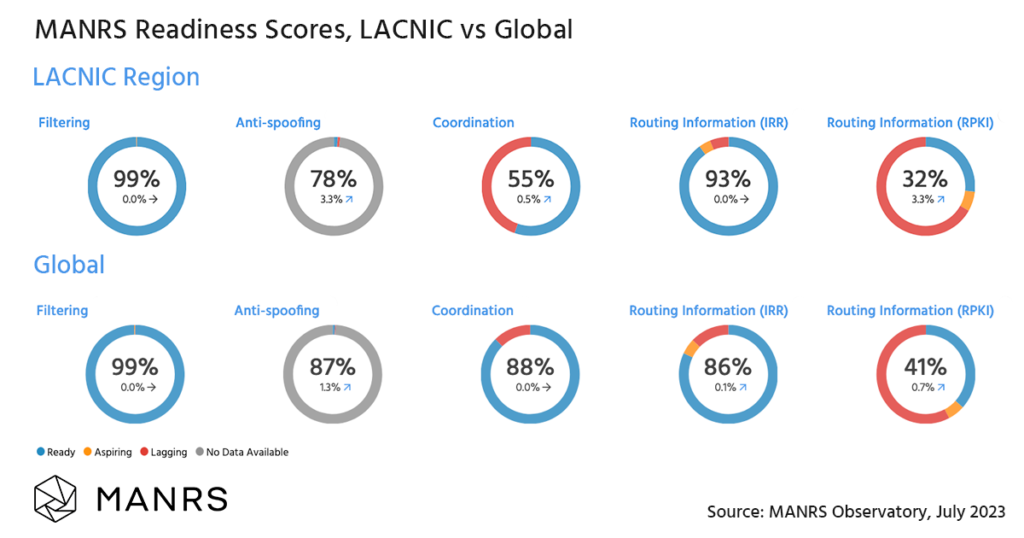
For instance, 50% of IXPs in the LAC region have enabled RPKI validation and IRR filtering, key components for any IXP willing to join the MANRS initiative. What is more, out of 25 current LAC-IX members, almost 70% of them are ready to join or have already joined the MANRS IXP Program.
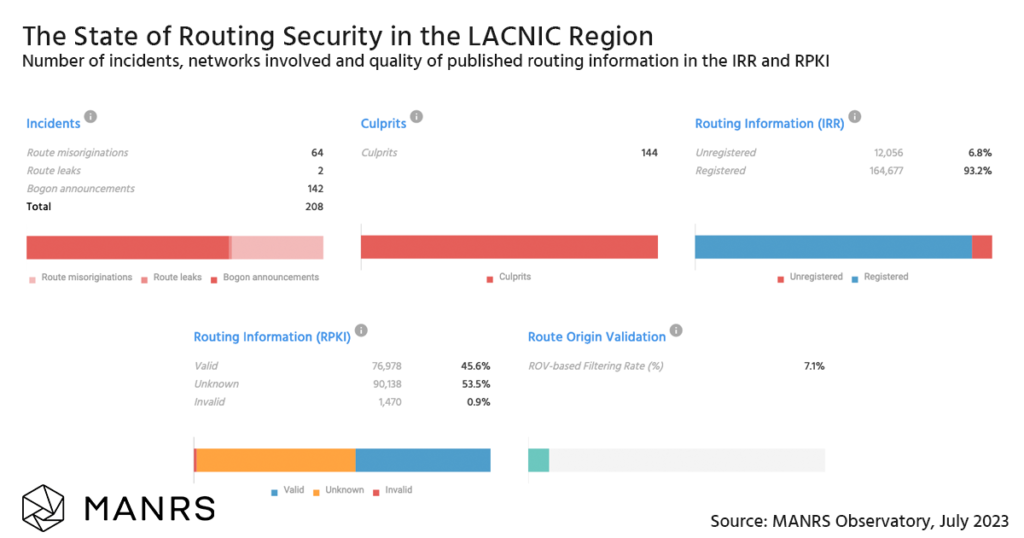
Figure 2 — The state of routing security in the LACNIC region for July 2023. Source: MANRS Observatory.Figure 3 — A comparison of the MANRS Readiness Scores between the LACNIC region and globally. MANRS readiness indicates the level a network implements MANRS Actions.
A conversation with Mauricio Oviedo, LAC-IX Technical Manager, and a 2022 MANRS Ambassador, reveals that the numbers are not a coincidence. “Having routing security in mind when you’re planning to build an IXP makes it easier to implement MANRS actions once the IXP is fully operative,” said Oviedo.
The Costa Rica-based engineer also explains how a technical group within LAC-IX has paved the way for their members’ readiness. “By building a successful and replicable model, IXPs are better positioned to join MANRS and identify the actions needed to fill real or perceived gaps,” said Oviedo. “This approach has allowed them to adhere to best practices in routing security and other topics.”
If the average of six new IXPs per year is maintained in the LAC region, designing all of them with a MANRS-readiness perspective will be crucial at a time when routing security is at the top of policymakers’ and regulators’ priorities. There’s no better time to lead by example.
The views expressed by the authors of this blog are their own and do not necessarily reflect the views of LACNIC.