This blog post is written entirely from a technical perspective. It will only examine the impact on the Internet in the country.
Context
Last Saturday, 3 January, at approximately 1:50 am local time (5:50 UTC), an attack occurred in Venezuela that affected several locations, primarily military areas. The attack lasted less than two hours; however, power outages persisted in some regions. One of the sites targeted by the attack was “Cerro El Volcán,” where dozens of telecommunications companies operate.
It should be noted that the attack focused on the north-central part of the country, where the majority of the population resides.
(Free access, no subscription required)
About RIPE ATLAS
What is RIPE Atlas? RIPE Atlas is a global Internet measurement platform that relies on the Internet community to host probes on their networks and thus contribute to Internet visibility. The platform allows users to monitor and troubleshoot their own networks, as well as to measure various aspects of Internet performance. RIPE Atlas data is publicly available, and measurements can be customized to meet the needs of probe hosts.
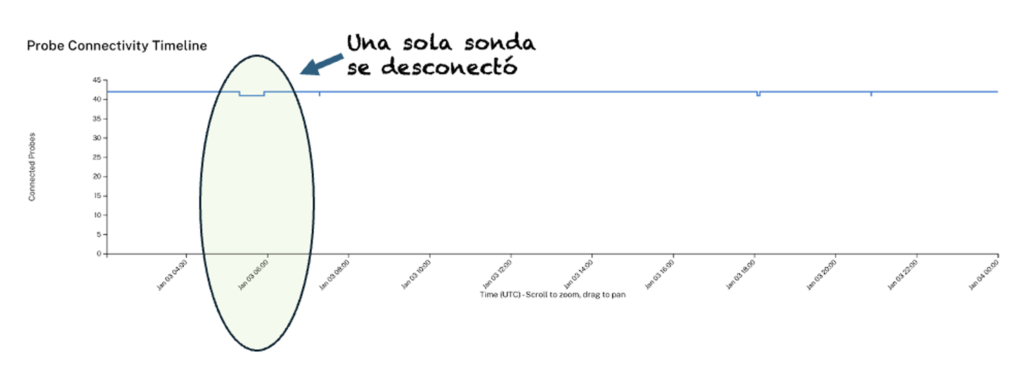
On 3 January, 42 RIPE Atlas probes were connected in Venezuela. Only one probe was affected by the attack, experiencing a brief disconnection, as shown in the image below:
About NAP VE
NAP VE is Venezuela’s first Internet Exchange Point (IXP), a neutral and open platform that allows Internet Service Providers (ISPs), networks, and content providers to exchange data locally. By keeping traffic within the country, NAP VE improves the speed and efficiency of national connectivity, reducing latency and costs, and strengthening the Venezuelan digital ecosystem.
About RIPE ATLAS
What is RIPE Atlas? RIPE Atlas is a global Internet measurement platform that relies on the Internet community to host probes on their networks and thus contribute to Internet visibility. The platform allows users to monitor and troubleshoot their own networks, as well as to measure various aspects of Internet performance. RIPE Atlas data is publicly available, and measurements can be customized to meet the needs of probe hosts.
On 3 January, 42 RIPE Atlas probes were connected in Venezuela. Only one probe was affected by the attack, experiencing a brief disconnection, as shown in the image below:
About NAP VE
NAP VE is Venezuela’s first Internet Exchange Point (IXP), a neutral and open platform that allows Internet Service Providers (ISPs), networks, and content providers to exchange data locally. By keeping traffic within the country, NAP VE improves the speed and efficiency of national connectivity, reducing latency and costs, and strengthening the Venezuelan digital ecosystem.
NAP VE BGP Collector
3 January at 00:00
77 unique AS’s
790 unique IPv4
117 unique IPv6
3 January at 06:00
77 unique AS’s
789 unique IPv4
116 unique IPv6
Resource Visibility
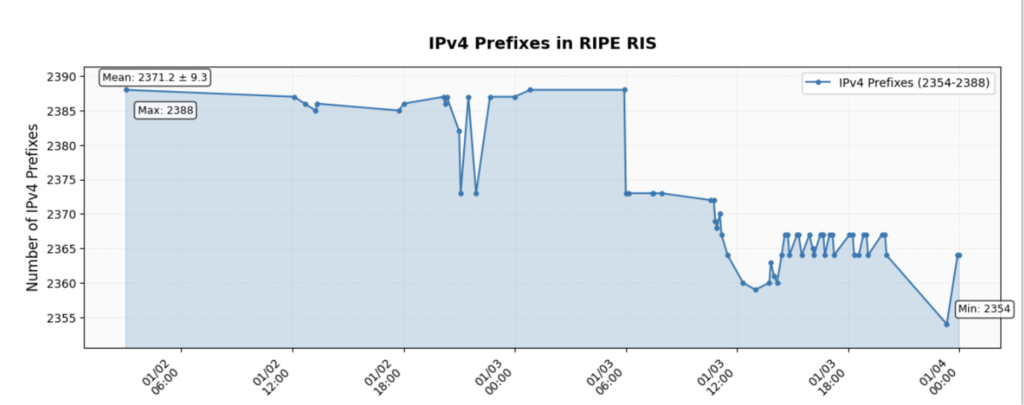
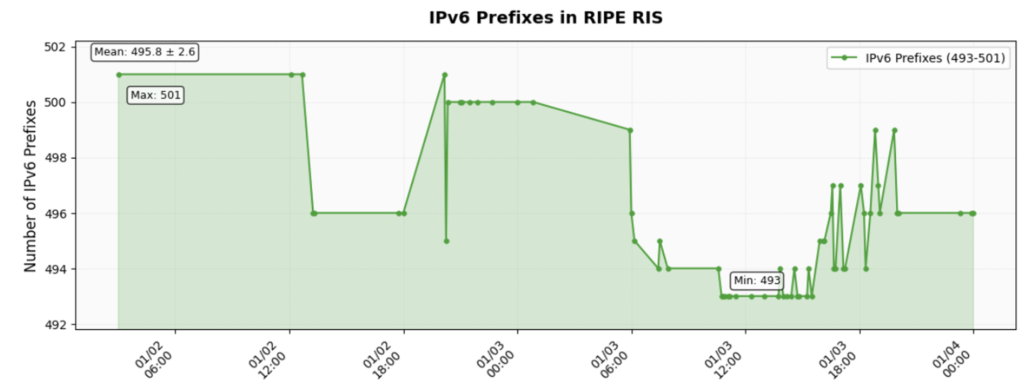
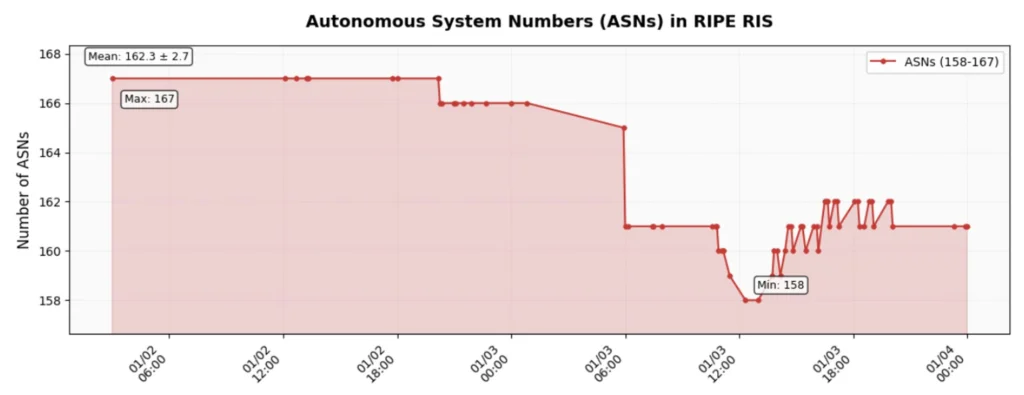
The following graph was generated using data from the RIPE NCC API (https://stat.ripe.net/docs/02.data-api/country-resource-stats.html), which returns statistics on Internet resources for a country (ASN, IPv4, and IPv6). For this analysis, the RIPE NCC API was queried for data related to Venezuela covering the period from 1 January to 3 January (23:55 UTC), with a specific focus on resource visibility.
Minimal impact was observed on the resources seen in the global routing tables, which can be summarized as a decrease across all resources. Visibility reached its lowest point on 3 January at 3:20 pm, when, among others, only 2,357 Venezuelan IPv4 prefixes were visible in the DFZ.
1st January
3 January at 3:20 pm
6 January
IPv4 Prefixes
2388
2354 (-1.47%)
2,387
IPv6 prefixes
501
496 (-1%)
500
ASN
167
161 (-3.6,%)
165
Traffic Analysis at NAP VE IXP (Caracas, Maracaibo, and Valencia)
CaracasMaracaiboValencia
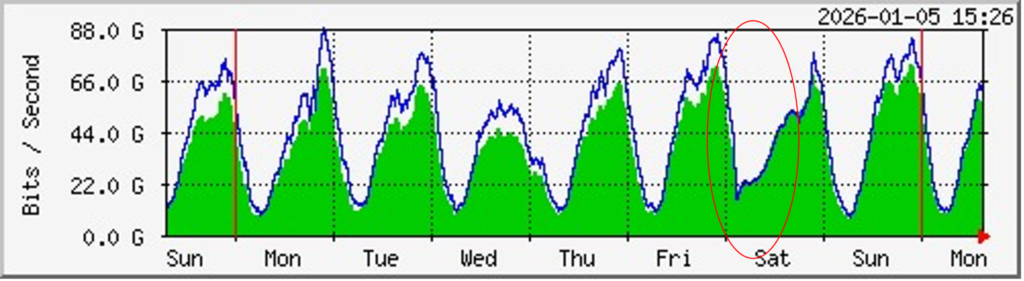
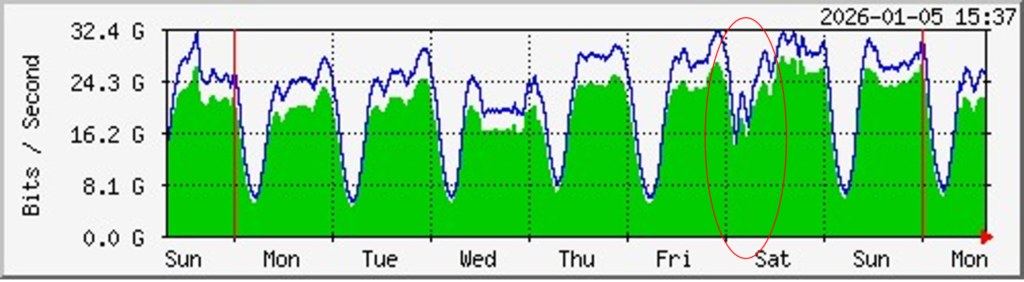
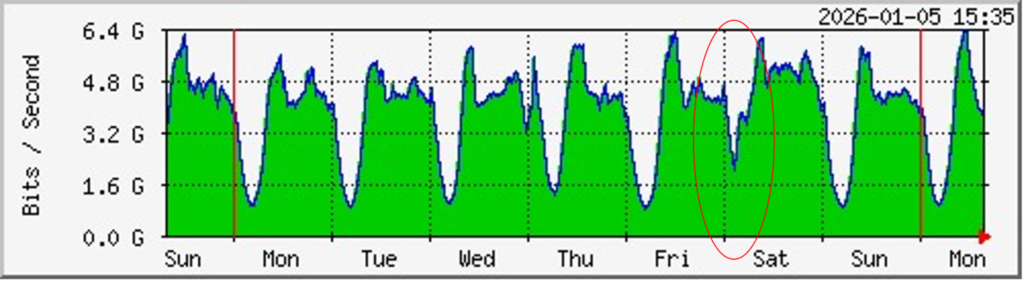
Finding No. 1: Maracaibo and Valencia show ‘nighttime peaks’ during off-peak hours
Under normal conditions, IXPs exhibit a fairly stable pattern:
Daytime peaks (human and corporate activity).
Nighttime valleys (reduced demand).
However, at both the Maracaibo and the Valencia IXPs, an unusual increase in traffic was observed at the time of the event, which occurred during a typically off-peak period. The surge broke the expected cycle. This behavior is an important technical indicator, as it suggests activity not correlated with typical utilization.
Finding No. 2: Caracas shows the opposite effect due to CDN service degradation
In contrast, the pattern observed at the Caracas IXP is less traffic during the event window, associated with a specific factor: the failure of one of the international links, which affected the delivery of services ‘dispatched’ from CDNs.
The graphs do not point to a single national effect, but rather two distinct technical signatures during the event of 3 January 2026:
In Maracaibo and Valencia, the most notable observation is the increase in traffic during off-peak hours, which suggests irregular consumption and/or automated or atypically rerouted traffic.
In Caracas, the pattern points to a decrease in traffic due to the degradation of services supported by CDNs attributable to the failure of an international link, which reduces the ‘real’ volume transferred.
Together, these signals are consistent with an event that simultaneously affected the availability of international content/services and caused anomalous activity or unusual network behavior within the country.
Conclusions
Analysis of the data showed a slight decrease (1%-4%) in the visibility of the various Internet resources during the events, which was recovered within a few days. Likewise, we believe it is positive that only one out of 42 probes went offline. Finally, IXP traffic showed an increase that coincided with the timing of the events, a behavior we consider normal.