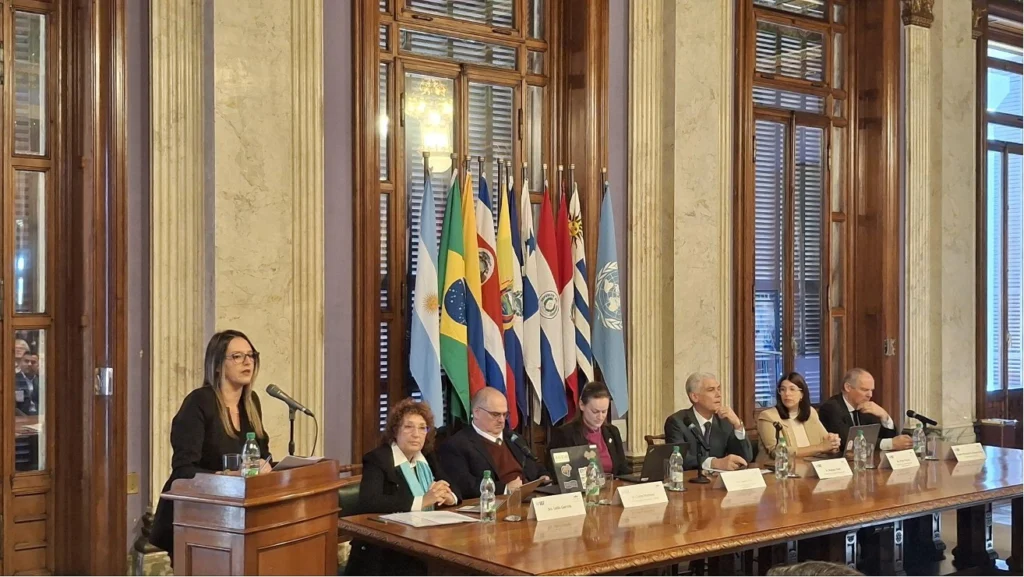
The Regional IGF Parliamentary Summit held on March 24 in Montevideo made one thing clear: effective digital environment regulation requires more than simply reacting to new technologies. It demands understanding how the Internet works, as well as spaces for dialogue between legislators and those of us who are closely involved with its technical dimension.
Today, digital issues are increasingly prominent on public agendas. Artificial intelligence, platforms, data, cybersecurity, and infrastructure are no longer limited to the technical realm. They permeate our daily lives, the economy, education, and the how our societies function. This is why it is essential that they also be addressed by legislators, parliamentarians, and regulators.
LACNIC has been working steadily in this direction, both through our Policy Fellows program and our involvement in organizing, along with ECLAC, CETIC.br, and CAF, the School of Digital Transformation and Innovation in Latin America and the Caribbean. We believe we can make a valuable contribution to this process, not by deciding what should be regulated, but by ensuring that regulations are developed based on a better understanding of how the Internet works, the potential technical impacts of certain measures, and the practical viability of their proposals. Our goal as a neutral, technical organization is to serve as a point of consultation to help enrich these conversations.
(Free access, no subscription required)
This was a central theme of the fourth IGF Regional Parliamentary Summit, which brought together more than 90 parliamentarians, specialists, and various stakeholders to reflect on how they can anticipate changes in the digital environment.
During the welcome remarks, Rodrigo Goñi (president of the Uruguayan Chamber of Deputies) and Chengetai Masango (head of the United Nations Secretariat for the IGF) both stressed the need for parliaments to engage more deeply in digital governance debates.
One of the most valuable moments of the day was the first working session, moderated by Lydia Garrido. The discussion centered on a simple yet necessary proposal: making visible the often-invisible digital layer to bridge the gap between technology and politics. When regulations are imposed on the Internet without understanding its foundations, there is a risk of creating incomplete solutions.
This was a central theme of the fourth IGF Regional Parliamentary Summit, which brought together more than 90 parliamentarians, specialists, and various stakeholders to reflect on how they can anticipate changes in the digital environment.
During the welcome remarks, Rodrigo Goñi (president of the Uruguayan Chamber of Deputies) and Chengetai Masango (head of the United Nations Secretariat for the IGF) both stressed the need for parliaments to engage more deeply in digital governance debates.
One of the most valuable moments of the day was the first working session, moderated by Lydia Garrido. The discussion centered on a simple yet necessary proposal: making visible the often-invisible digital layer to bridge the gap between technology and politics. When regulations are imposed on the Internet without understanding its foundations, there is a risk of creating incomplete solutions.
As part of this introduction to the digital ecosystem, Celine Bal reviewed the history of the IGF and the evolution of the Parliamentary Track as a space designed to bring these discussions closer to those with legislative responsibilities. Andy Richardson shared the work of the Inter-Parliamentary Union in raising awareness and training, particularly on artificial intelligence. Lilian Chamorro presented the role of LACIGF and how to participate in this regional forum. From LACNIC, in representation of the Multi-Stakeholder Committee, we emphasized the importance of adding more voices and content to these regional processes, so that the conversation remains open, multistakeholder, and grounded in the realities of Latin America and the Caribbean.
Another highlight of the morning was an explanation of how the Internet works presented by Ernesto Majó and Carlos Martínez. Bringing this perspective to parliamentarians is very important for LACNIC, as in order to discuss laws or regulations on digital issues, one should first understand how the Internet works. Ernesto Majó highlighted the role we can play in helping bridge the divide between political debate and the technical perspective. Carlos Martínez then offered a clear explanation of the various layers of the Internet and how they are interconnected. This was a concrete way of showing that behind the digital world lies a complex structure that should be understood before decisions are made.
The rest of the day featured panel discussions and case studies on digital regulation in the region, emerging technologies, and their impact on the economy. More information is available at the following link.
At the end of the day, together with the organizations that are part of the technical community at Casa de Internet, we hosted a cocktail reception for parliamentarians and speakers, providing a space to strengthen networks and encourage ongoing dialogue.
We firmly believe these meetings are essential for bridging the gap between technical and political perspectives, and for advancing toward more informed, inclusive, and sustainable public policies for Internet development across Latin America and the Caribbean.
The views expressed by the authors of this blog are their own and do not necessarily reflect the views of LACNIC.