By Guillermo Cicileo, Head of Internet Infrastructure Research and Development at LACNIC, and María Gayo, Communications Manager at LACNIC.
At the end of 2023, we can analyze specific data regarding both international and regional connectivity: the evolution of traffic trends, network behavior, the growth of submarine cables, among others. We invite you to take a brief overview of the data gathered by TeleGeography regarding the current status of connectivity.
Bandwidth Growth
International Internet bandwidth nearly tripled between 2019 and 2023, reaching 1,217 Tbps (1.2 Pbps). While 2020 experienced a surge in annual growth due to the pandemic, data from 2021 to 2023 show a slow but noticeable and consistent decline, as annual global growth rates fall well below 30%, similar to pre-pandemic levels.
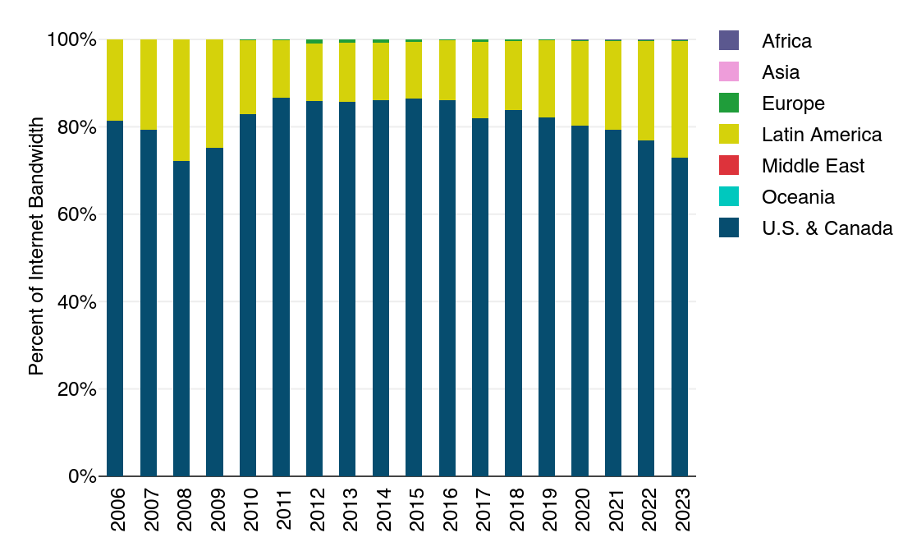
International Internet Bandwidth proportion for Latin America by Region (Source: Telegeography)
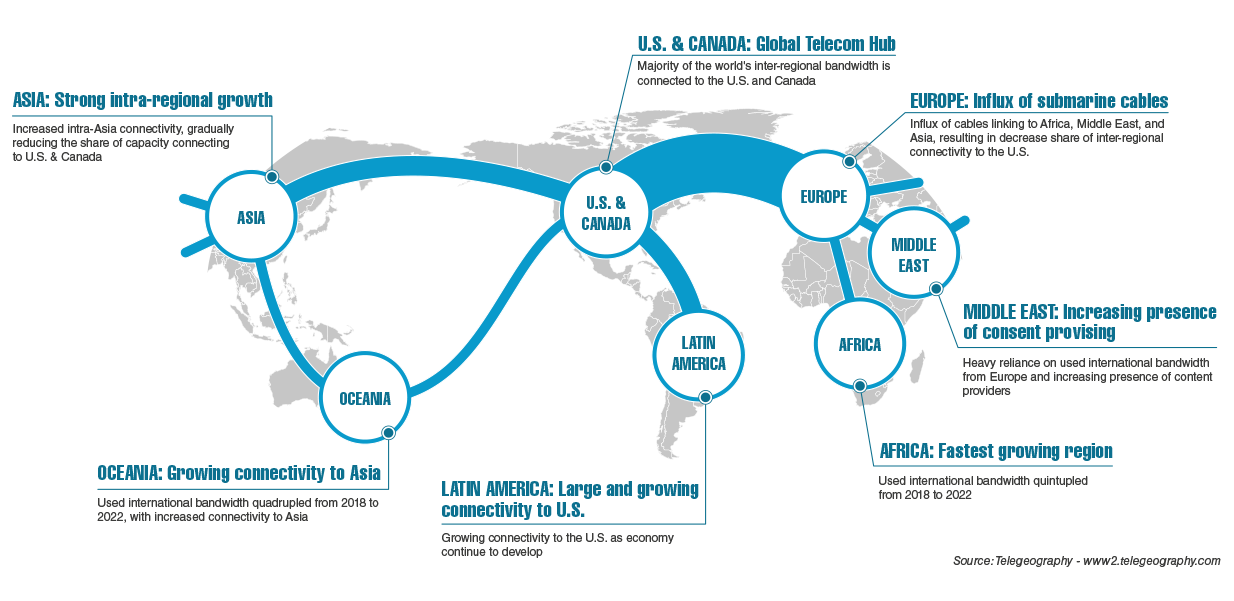
The inter-regional route with the highest international Internet bandwidth in Latin America extends to the United States and Canada. This can be attributed to two key factors: 1. International Internet bandwidth in Latin America is almost entirely connected to the United States and Canada. 2. Major content providers have deployed massive transatlantic and transpacific links.
(Free access, no subscription required)
Do we expect these trends to persist in the future?
The Impact of Submarine Cable Evolution in the Region
This year, the Google submarine cable, Firmina, is expected to be completed. The cable will establish connections between the United States, Brazil, Uruguay, and Argentina. Google, along with the Chilean state entity Desarrollo País, and the Office of Posts and Telecommunications of French Polynesia (OPT) have announced plans for the Humboldt cable system, which aims to connect South America with the Asia-Pacific region. As currently planned, the system will connect Chile, French Polynesia, and Australia. Details regarding landing sites and the initiation date have not yet been announced.
Various providers also intend to construct submarine cables between the United States and Latin America. America Móvil and Telxius are jointly developing the AMX-3/Tikal cable, which will connect the United States with Guatemala and Mexico. Also, there is potential for an additional landing point in Colombia. The cable is expected to have a capacity of 190 Tbps and become operational by 2026. Gold Data and Liberty Networks are working to develop a submarine cable with two segments, scheduled for completion in 2026. The first segment, Gold Data-1, will link Veracruz and Cancun in Mexico to Florida in the United States. The second segment, Liberty Networks-1, will provide a connection between Panama and Colombia to a branching unit on GD-1. Other significant projects between Latin America and the United States include TAM-1 and the Carnival Submarine Network (CSN-1). These two cables are expected to be ready by 2025.
Do we expect these trends to persist in the future?
The Impact of Submarine Cable Evolution in the Region
This year, the Google submarine cable, Firmina, is expected to be completed. The cable will establish connections between the United States, Brazil, Uruguay, and Argentina. Google, along with the Chilean state entity Desarrollo País, and the Office of Posts and Telecommunications of French Polynesia (OPT) have announced plans for the Humboldt cable system, which aims to connect South America with the Asia-Pacific region. As currently planned, the system will connect Chile, French Polynesia, and Australia. Details regarding landing sites and the initiation date have not yet been announced.
Various providers also intend to construct submarine cables between the United States and Latin America. America Móvil and Telxius are jointly developing the AMX-3/Tikal cable, which will connect the United States with Guatemala and Mexico. Also, there is potential for an additional landing point in Colombia. The cable is expected to have a capacity of 190 Tbps and become operational by 2026. Gold Data and Liberty Networks are working to develop a submarine cable with two segments, scheduled for completion in 2026. The first segment, Gold Data-1, will link Veracruz and Cancun in Mexico to Florida in the United States. The second segment, Liberty Networks-1, will provide a connection between Panama and Colombia to a branching unit on GD-1. Other significant projects between Latin America and the United States include TAM-1 and the Carnival Submarine Network (CSN-1). These two cables are expected to be ready by 2025.
As we’ve seen over the past few years, content providers continue to build fiber networks connecting their data centers across different regions.
Growth in Capacity and Traffic
The bandwidth and traffic data represent the combined volume of Internet backbone networks worldwide. This data provides a broad perspective on the global evolution of the Internet. Some long-term trends may seem quite obvious, such as the rapid growth of bandwidth in emerging markets. However, other factors like the growing influence of content provider networks can lead to unexpected annual fluctuations in capacity and traffic levels.
In Latin America, international bandwidth reached 157 Tbps in 2023, growing at a rate of 34%, which exceeded the growth rates observed in previous years.
Similar to the global context, despite traffic growth in 2020, growth trends have reverted to pre-pandemic rates. The average traffic, which saw a 58% increase in 2020, only grew by 23% in 2023.
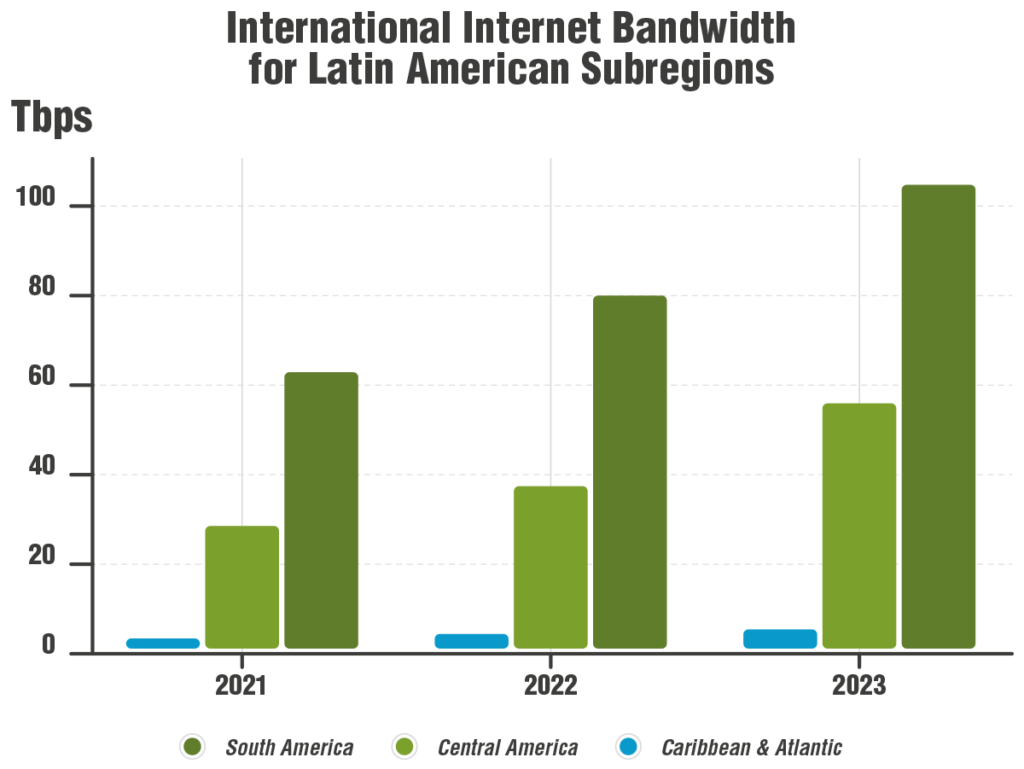
Another observed trend is the uneven distribution of international capacity across subregions within Latin America.Internet capacity remains highly concentrated in South America. In 2023, South America is expected to account for approximately 64% of the total capacity of the region. Central America continues to be the subregion with the highest growth. In 2023, the bandwidth in the subregion grew by 47%, reaching 55 Tbps. Meanwhile, international capacity in the Caribbean remains notably lower than that of Central and South America.
At the national level, Brazil continues to lead in terms of international Internet capacity. In 2023, the country’s 45 Tbps of international bandwidth represent nearly one-third of the region’s total capacity. Mexico also continues to operate a substantial portion of international Internet capacity, with approximately 35 Tbps in 2023. Central America experienced the highest growth rate last year. Costa Rica and Panama experienced growth rates exceeding 40% in 2023.
Content Provider Networks
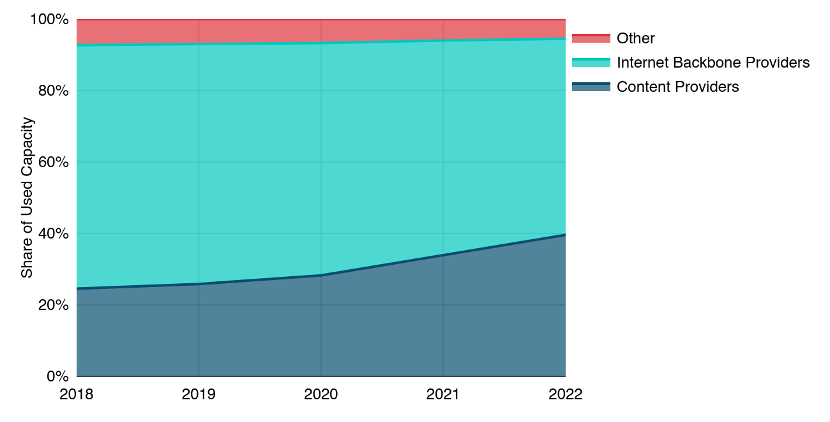
Capacity utilized between the United States and Latin America by provider type (Source: Telegeography)
Content provider networks play a crucial role in determining where and at what pace backbone network operators deploy new capacity. In recent years, content providers have expanded their networks into Latin America by establishing data centers and submarine cables.
Similarly, CDN operators are extending their reach in the region by establishing hubs in key markets such as Bogota, Buenos Aires, Santiago, and São Paulo.
The graph reveals an interesting shift, as transit backbone providers have seen a decrease in their traffic share compared to content providers, which have increased from 20% in 2018 to 40% in 2022. This is a result of the strategy pursued by large content providers like Google, Facebook, among others, which have implemented their own international cable deployments.
Regional operators have been working for years to increase intraregional capacity. While the United States continues to serve as the primary interconnection hub for Latin America, the ongoing efforts of these local operators are beginning to show results gradually. Two intraregional routes (Argentina-Chile and Argentina-Brazil) account for 11% of all international Internet bandwidth in the region in 2023, reflecting a slight increase from 8% in 2019. We are also witnessing rapid growth in other intraregional routes, such as Chile-Peru.
Conclusion of 2023
In Latin America, as well as globally, the demand for bandwidth continues to grow. While telecommunications companies still hold the largest share of demand, content providers are growing at a faster pace.
In the future, it is expected that bandwidth will continue to grow with the introduction of additional cables and further infrastructure from content providers. We can also anticipate the expansion of edge content, which will strengthen local data centers and promote content decentralization initiatives.
Special thanks to Telegeography for their invaluable contributions to this article.Clickhereto explore more detailed graphs illustrating the previously discussed data.
The views expressed by the authors of this blog are their own and do not necessarily reflect the views of LACNIC.