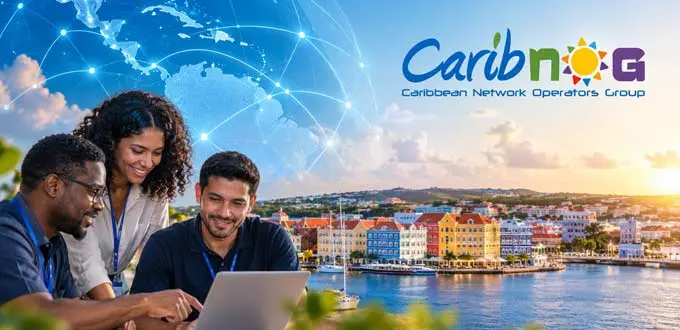
CaribNOG 32, held in Curaçao, showed us once again the importance of collaboration among organizations to drive technological development in our region and enable initiatives of great value to our community.
In this spirit, three key organizations that are part of the global and regional Internet ecosystem—ICANN, ARIN, and LACNIC—joined forces to design and deliver an intensive training course: Operating the Digital Core.
A Program Designed for Caribbean Resilience
The contents of the course could have been addressed generically. Instead, they were specifically tailored to meet the unique needs of the Caribbean. The Internet’s digital core depends not only on fiber and silicon infrastructure, but also on qualified experts, best operational practices, and robust security standards.
(Free access, no subscription required)
During this event, we addressed key topics for the region’s network operators, engineers, and regulators, including:
Border Gateway Protocol (BGP) and secure routing: An in-depth look at global routing stability.
Resource Public Key Infrastructure (RPKI): How cryptography and route origin validation are transforming how we defend Internet traffic against prefix hijacking.
Mutually Agreed Norms for Routing Security (MANRS): Best practices for strengthening routing security.
Low Earth Orbit (LEO) satellites: Their strategic impact on the resilience of emergency communications and island connectivity.
The Security, Optimization, Automation, and Provisioning (SOAP) framework: Presented as a set of best operational practices promoted by CaribNOG to incorporate resilience into daily operations.
Far from a traditional lecture, the session was structured as a dynamic environment for learning, technical exchange, and open dialogue among those who build and maintain the Caribbean’s Internet infrastructure. There was a great deal of interaction between the instructors and the participants, who were able to ask questions and share experiences in a close and personalized manner.
The Value of Shared Perspectives
Each participating organization contributed its own unique experience and specialized perspective, enriching the training proposal and allowing participants to address challenges from different angles:
ARIN contributed its expertise in managing Internet number resources and the basics of secure routing.
LACNIC and ICANN guided participants through hands-on technical labs on route validation with RPKI and optimization. They also discussed the use of AI in network administration.
Beyond the sharing of technical knowledge, this collaboration provided an invaluable opportunity to hear directly from the community about its needs, discuss local challenges, and strengthen ties among those contributing to technological development in the Caribbean.
From Planning to New Collaboration Opportunities
Developing this course also proved to be a deeply enriching experience for the organizing teams. By coordinating our efforts, combining teaching methodologies, and developing a unified training approach, we were able to learn along the way and lay the groundwork for future collaborations.
The outcome was very positive: not only did we deliver an activity that reflects our shared commitment to supporting the community’s professional growth and development, but we also developed a modular course that we can continue to offer in the future.
We are particularly excited about this, as it means that what we learned and developed at CaribNOG 32 will be able to reach a growing number of experts through upcoming regional training events.
Acknowledgments
We would like to thank all the individuals, institutions, and technical teams that made this initiative possible, especially to those who actively participated in the sessions by contributing questions, raising concerns, presenting case studies, and sharing their extensive experience. Your enthusiasm and commitment are essential to bringing these spaces to life.
This experience has taught us an important lesson: when we share common goals and work together, we multiply the opportunities to learn, innovate, and strengthen the Internet ecosystem.
Would you like to revisit the event or learn more about the topics that were discussed?
Check out the detailed event program: The full Day 3 program and technical sessions are available in the official CaribNOG 32 program.