The sustained growth of LACNIC’s membership base, which now comprises over 13,000 member organizations, reflects the evolution of the Internet ecosystem in our region. Of this total, more than 1,600 organizations operate exclusively with IPv6, highlighting a structural shift: the availability of IPv4 addresses is increasingly limited, and networks must be planned for an IPv6-based future.
Current Scenario: The Reality of IPv4 Exhaustion
Since 19 August 2020, LACNIC’s IPv4 address pool has been formally exhausted. Currently, assignments are only possible from addresses that are returned or recovered, and are managed through a waiting list. The projected wait time for new requests exceeds 10 years, so this option is not an immediate solution for organizations requiring IPv4 addresses today.
Three Possible Ways to Obtain IPv4 Addresses in LAC
Despite their exhaustion, there are still three possible ways to obtain IPv4 addresses in the region, each with its own peculiarities:
(Free access, no subscription required)
1. LACNIC’s Waiting List
We recommend that organizations register despite the long wait times. Think of this option like starting to pay off a mortgage: the process takes time, but you eventually obtain your own stable resources without the risks associated with depending on third parties.
2. IPv4 Address Transfers
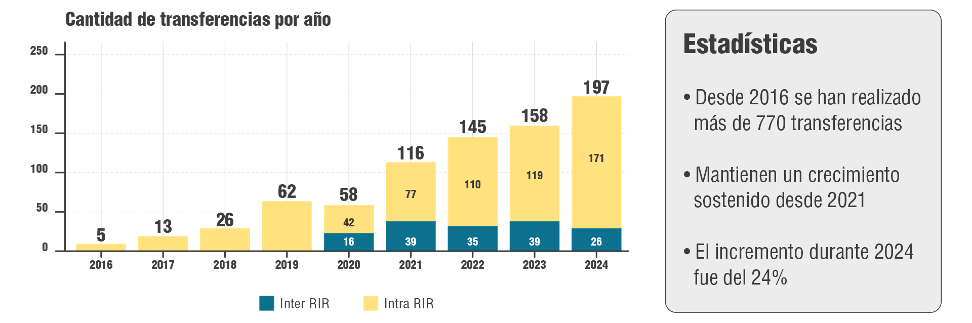
Whether through purchases, mergers, or acquisitions, transfers have become an increasingly common alternative. In the past year alone, nearly 200 transfer operations were completed in our region. However, this option is often expensive, with the smallest block available on the market costing approximately USD 8,000, which many organizations cannot afford.
3. IPv4 Address Leasing
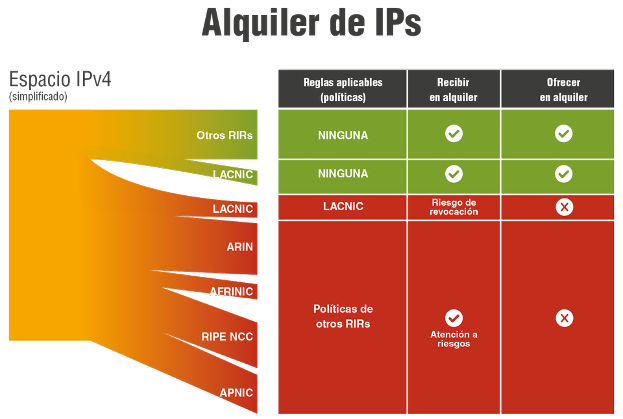
Leasing IPv4 addresses assigned by LACNIC is currently not allowed. Using this option could result in revocation of the resource due to policy violations.
1. LACNIC’s Waiting List
We recommend that organizations register despite the long wait times. Think of this option like starting to pay off a mortgage: the process takes time, but you eventually obtain your own stable resources without the risks associated with depending on third parties.
2. IPv4 Address Transfers
Whether through purchases, mergers, or acquisitions, transfers have become an increasingly common alternative. In the past year alone, nearly 200 transfer operations were completed in our region. However, this option is often expensive, with the smallest block available on the market costing approximately USD 8,000, which many organizations cannot afford.
3. IPv4 Address Leasing
Leasing IPv4 addresses assigned by LACNIC is currently not allowed. Using this option could result in revocation of the resource due to policy violations.
Some organizations choose to lease blocks from outside the region, but this often entails significant operational difficulties such as geolocation errors, a lack of traceability and support in the event of incidents, and even the inability to manage the resources through MiLACNIC.
This scenario has led to an increasingly active debate within the LACNIC community regarding the potential regulation of IPv4 address leasing. It’s an open, complex, and evolving conversation involving technical stakeholders, operators, and other key regional players. At LACNIC, we encourage all interested organizations and individuals to participate in the policy development process, share their experiences, and contribute their vision to collectively define clear rules aligned with our community’s operational reality.
IPv6-Mostly: The Key to Network Sustainability
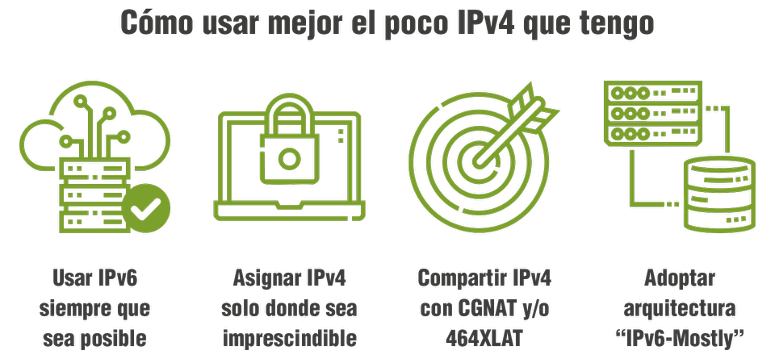
In short, the possibilities of obtaining new IPv4 addresses are now extremely limited. Organizations must learn to operate with few IPv4 blocks while making the most of the IPv6 space available today, immediately and without restrictions.
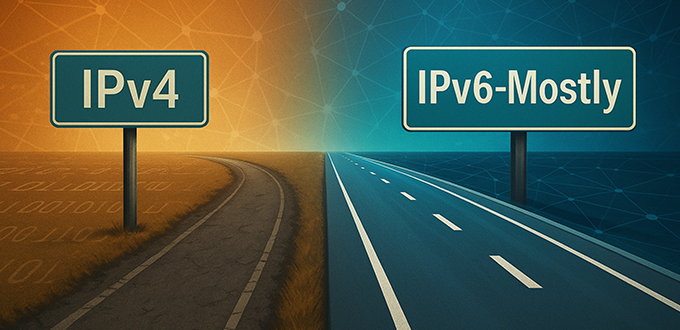
Faced with this scenario, the IPv6-Mostly approach is becoming increasingly consolidated as a key operational strategy to ensure network continuity, scalability, and sustainability in our region.
Transitioning to an IPv6-Mostly network means operating primarily over IPv6, maintaining IPv4 as a complementary service only when needed. This architecture simplifies the network, lowers the costs associated with CGNAT, and optimizes the overall user experience. This approach is documented in an IETF draft currently under discussion that defines best practices and guidelines for its implementation.
In an IPv6-Mostly network, IPv6-only devices, dual-stack devices (IPv6 + IPv4), and in some cases, even IPv4-only devices coexist.
Recommendations for Migrating to IPv6-Mostly
Below are some recommended strategies to advance toward this operating model:
Deploy dual-stack networks that integrate IPv6 with IPv4 and use CGNAT as a temporary solution to handle IPv4 exhaustion.
Implement transition mechanisms such as 464XLAT, which are particularly useful in mobile networks.
Prioritize IPv6 traffic, establishing it as the primary route and optimizing routing and services based on this protocol.
Manage existing IPv4 resources responsibly, following best practices and, if necessary, transferring or reassigning blocks efficiently.
At LACNIC, we continue to actively promote IPv6 adoption and support the region’s technical community in the design and deployment of sustainable networks. For more information, check out the materials available on our website or participate in our training spaces.
The views expressed by the authors of this blog are their own and do not necessarily reflect the views of LACNIC.
2 Comments
Oldest
NewestMost Voted
Named
1 year ago
The IPv4 waitlist requirements state: “the organization must be a LACNIC member and must have been assigned IPv6 resources.” I think that this is too soft. Since IPv4 is already an exhausted resource, just having IPv6 blocks assigned is such an easy requirement. At the very least make sure that those IPv6 blocks are also actually used! Otherwise it’s too easy to exploit. (Also a requirement/rule should probably be added that forbids the resale of those resources.)
Last edited 1 year ago by Named
Super Koning
1 year ago
“Of this total, more than 1,600 organizations operate exclusively with IPv6”. Wow, that’s amazing & impressive. Can you give a few IPv6-only organizations / ASNs as an example?
The IPv4 waitlist requirements state: “the organization must be a LACNIC member and must have been assigned IPv6 resources.” I think that this is too soft. Since IPv4 is already an exhausted resource, just having IPv6 blocks assigned is such an easy requirement. At the very least make sure that those IPv6 blocks are also actually used! Otherwise it’s too easy to exploit. (Also a requirement/rule should probably be added that forbids the resale of those resources.)
“Of this total, more than 1,600 organizations operate exclusively with IPv6”.
Wow, that’s amazing & impressive. Can you give a few IPv6-only organizations / ASNs as an example?