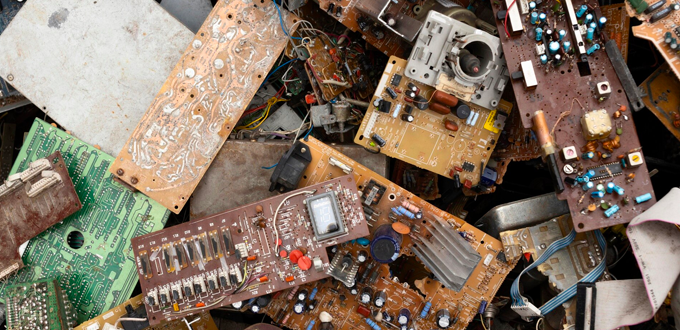
What happens to the numerous obsolete tech devices? Where do discarded electronics end up? Is it possible to reuse computers and electronic devices? What lies ahead for them? Nodo TAU provides valuable insights to these questions as they have created and supported a social venture that integrates environmental management of electronic waste, generates employment for young people, and promotes the reuse of computers and notebooks in educational communities.
Since its beginnings in 1995, Nodo TAU collects discarded equipment from companies or individuals and refurbishes them to be used in community centers, neighborhoods, and schools. They began receiving donations of large quantities of equipment, much of which could not be salvaged. This led them to address the issue of electronic waste.
Therefore, in 2019, they decided to promote a productive unit focused on environmentally responsible management of these wastes. Additionally, it offers a space for training and social interaction for young people in Rosario.
Nodo TAU recently obtained financial support from LACNIC’s FRIDA program, enabling it to expand its socio-occupational and digital inclusion initiatives.
The project has a facility located in Rosario, Argentina, equipped with specialized technology for handling electronic waste. This technology allows us to trace the waste all the way from its initial stages to its final disposal.
Nodo TAU is led by IT professionals, educators, and social activists committed to facilitating access to new technologies for community, educational, and neighborhood organizations. Simultaneously, it promotes environmental care, women’s rights, children’s rights, and the protection of human and social rights.
The Main Pillars. María Constanza Gómez, Treasurer at Cooperativa TAU Limitada and currently responsible for managing the facility, emphasized the project’s three central pillars: ensuring the sustainable management of technological waste, promoting youth employment, and repurposing equipment for an extended lifespan.
Regarding the first point, Gómez emphasized that their procedures recover raw materials (plastics, PVC, PC, metals, glass, etc.) to reintroduce them into production cycles.
Devices that are no longer functional are sent to the disassembly area, where they are dismantled into components to salvage any usable parts. Also, materials such as raw resources are recovered during this process. Items that cannot be recovered are then appropriately disposed of.
Gómez emphasizes the importance of raising awareness among individuals and organizations to avoid discarding this waste in standard trash bins due to its environmental hazards and its potential for effective reuse.
Useful Life. Elías Rodríguez, one of the young individuals who joined the initiative in its early stages, now serves as the President of Cooperativa TAU. He actively focuses on fostering youth employment and promoting the recycling of equipment for reuse.
Elías notes that in the refurbishment area, they focus on working with equipment that can be given a second lease on life. “Firstly, we label the received equipment to keep track of each unit. Next, the equipment undergoes analysis and is placed on a workstation, where we assemble batches of 10 CPUs. The repair team carefully assesses each piece of equipment, identifying any missing components such as RAM, disk, power supply, etc. Then, they proceed to refurbish. Out of 10 computers, we can put together 5 that might end up working perfectly. Before giving the final approval, we subject the equipment to an extensive computer-wide test to ensure they are in optimal condition.”
Once the equipment is ready, it is then transferred to sales, donations and digital communities. This is where the third pillar of the initiative comes into action: promoting access to information technologies for local social organizations and providing training in technological tools.
In this context, Nodo Tau has already equipped 64 digital communities in various neighborhoods of Rosario: these are rooms with four computers and a notebook, all sourced from recycling efforts. In addition, the project is supported with training sessions for young people.
The FRIDA funds received were used to develop a management system in order to improve all internal mechanisms for receiving, treating and referring equipment.
Also, to address technical safety aspects of the facility and provide internal training sessions for the working team.
In its brief history, Nodo TAU has processed over 100 tons of electronic waste, salvaging nearly 700 devices for a second useful life, and has established 64 community spaces with refurbished computers.