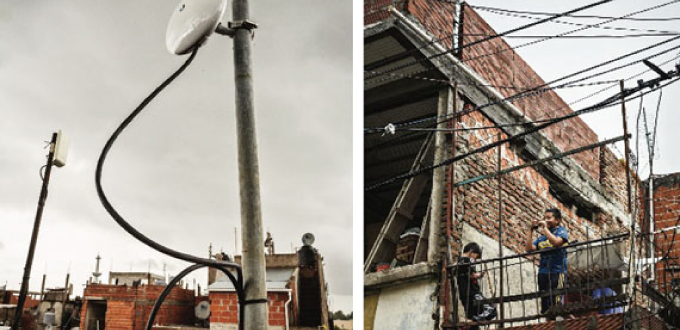
Community networks have made Internet access a reality for thousands of Latin Americans living in areas considered economically and socially vulnerable. There, in locations that are not served by the major companies and their fiber and wireless equipment, these social projects have allowed many people to connect to the Internet and avoid being relegated in the online world.
The success of this project led to it being recognized with one of the 2018 FRIDA Awards. Manuela González, a member of Atalaya and of the organization Proyecto Comunidad, observed that the social aspect of a community network is essential, as the very people who use the network are the ones who build it and assume the commitment to maintain the network and help it grow.
Although our background was not in technology, our experience told us that we needed to address the issue, as Internet access inequality, both in material and symbolic terms, broadens existing structural inequalities and because we understand that communication is a human right.
We developed three lines of work addressing: (a) the issues related to technological appropriation from the point of view of access, the non-commercial distribution of the Internet and the production of knowledge through the development of community connectivity networks in populations that currently have limited access or no access at all; (b) the production of content and the generation of local platforms for dissemination and community participation; and (c) the promotion of technological vocations through training courses and workshops on the use of information and communication technologies, telecommunications, programming, robotics and 3D printing.
The project began in Villa 20, an informal settlement in the city of Buenos Aires that is home to a socially and economically vulnerable population of more than 30,000. Just as Villa 20 is lacking in basic utilities, the people living there do not have the possibility of subscribing to a legal Internet provider. With the idea of achieving affordable Internet and ICT access for the population, a free public Wi-Fi network was designed with 27 access points located in the main streets of the settlement. In addition, the www.villa20.org.ar portal was developed and spaces for offering training in ICT were consolidated with a view to the production of local content.
The planning and installation of the infrastructure, which combines the use of optical fiber and radiofrequency, was accompanied by network training aimed at young people in the neighborhood. This allowed the consolidation of a technical team who can support the network and replicate the experience in other locations.
In 2016, we began working in the Puna region of the province of Jujuy, where local communities had extremely limited access to the Internet due to a lack of investments by major telecommunications companies.
This led to the creation of the Chaski social network, a community intranet which, thanks to a combination of telecommunications infrastructure and the use of free software for developing different platforms, allowed the construction of a local communication medium with a strong educational, technological and cultural imprint. The infrastructure was developed by young people living in Villa 20 who are part of the communities.
Later, in 2017, the Chaski network reached Cieneguillas, a town of 450 inhabitants located 35 kilometers away from the city of La Quiaca, which did not even have a telephone service. Providing connectivity in the town involved organizing multiple community actors faced with the technical challenge of installing two hops on two hills (using solar power). Thanks to the contribution of the local community, we were able to bring Internet services to Cieneguillas.
What have been the main contributions of the project?
The most important contribution of this experience is the creation of a successful connectivity model that can be replicated in other settlements and territories.
The project allowed the incorporation of young people aged 18 to 25 as part of the technical team of the Atalaya Sur Network. This meant not only ensuring the availability of a team that can maintain and support the networks, but also offering professional training that will afford them new employment opportunities. In this case, young people living in a context where they would hardly have had access to this type of knowledge.
Progress was made in Villa 20 in terms of training the neighbors in self-connection and basic network support, thus allowing them to detect any technical problems that may exist. This community process contributes to the care and maintenance of the network.
Currently, we are advancing in residential connections in Villa 20 and developing a sustainability plan that will allow connecting other neighborhoods.
Community networks involve a human component that goes far beyond technology, as they require community engagement and commitment. Is this the key to the success of community networks?
Developing these networks involves strong territorial work. Based on our experience, we are convinced that any community connectivity project requires the organization of the community, their needs and interests, and their processes for appropriating technology.
The Internet must be a public service and must be guaranteed for all. This means that we need to include the actors who are not currently included. Likewise, the community must also be able to assimilate the impact of technology based on territorial references, through intermediary institutions such as educational centers or social organizations, so that technology will be used as a territorial claim and not as a cultural bulldozer, enhancing existing community ties instead of replacing them with a virtual community that is insubstantial from the point of view of their social roots.
What is interesting is relying on telecommunication technologies for the construction of a public space, a space for the unrestricted participation of neighbors.
The social aspect is essential for this type of networks. The very people who use the network are the ones who build it, so the entire community is committed to maintaining it and contributing to its growth. The goal is to empower the communities through access and the use of technology.
Why have community networks been successful in areas of Latin America and the Caribbean where major telecommunications companies have not expanded their networks?
Community networks provide an answer to the problem of how to connect the populations that have no commercial interest to the market and have not been addressed through public policy.
The importance of digital networks in the construction of the public sphere, the high levels of concentration of the telecommunications market, and the biased logic of monopolistic and unidirectional communications make it necessary to generate experiences in community networks in locations that have not been of commercial interest to the market.
Vast territories and communities remain unconnected. This is the case not only of many rural communities but also of the poorest settlements in large urban centers. Despite being located in the jurisdictions with the highest levels of broadband penetration at a national level, such settlements do not have access to legal Internet providers as they are not considered profitable due to their extreme economic and social vulnerability nor do they fulfill the requirements to apply for non-reimbursable Universal Service contributions.
While community networks attempt to solve the issue of accessibility, it is necessary to highlight the need for public policies that will make connectivity possible for the disconnected populations. Through their telecommunications regulators, the States are responsible for guaranteeing connectivity in areas where there is none.
What was it like to participate in the workshop on community networks coordinated by FRIDA within the framework of the Internet Governance Forum?
The session where we were able to share the point of view of community networks with financial backers and other interested parties was particularly interesting. It allowed us to present an enhanced proposal for funding which, given the scarcity of resources, allows directing funds to strengthening community networks as a whole, without leaving any proposals aside. We stressed how a group of community networks in daily contact with local needs can contribute significantly to the best allocation of resources by the funders. Funding is a very important aspect for us, as we are currently looking to replace the wireless technology in Villa 20 with optical fiber. This decision seeks to develop an innovative technological model in the field of community networks that includes a process for training a local technical team and neighbors who are part of the community. In addition, in settlements having similar characteristics —densely populated, unreliable utilities and precarious constructions with zinc sheets and concrete and with no ventilation— the use of optical fiber will reduce the dependence on electricity, ensuring greater quality and stability for the network. In addition, we understand that the appropriation of the latest technologies by the most vulnerable sectors of society is a significant contribution towards reducing the digital divide, promoting labor market inclusion and equal opportunities.
We believe that a large part of the responsibility for the expansion of community networks falls on the States. Reality shows that groups of organized neighbors themselves are building community networks without much help from their governments. This leads us to believe that, as long as there are organized neighbors, community networks will continue to appear, and the LAC region is especially fertile for this type of popular initiatives. Even so, we must highlight the actors that enable the creation of these networks and stress the lack of commitment of those who should guarantee access to ICT.