After more than two decades of sustained expansion, the Internet continues to grow without losing its essence. Key technical factors —scalability, flexibility, adaptability, and resilience— help explain why this network has managed to consolidate and sustain its evolution over time.
A few years ago, more precisely in 2022, we shared the results of a study prepared by LACNIC and APNIC on the Internet’s evolution and technical performance over two decades.
Time has passed, but the core structure of those conclusions about the technical factors behind the Internet’s success remain valid. In fact, I would say that these factors are becoming increasingly important and serve as the foundation for the Internet’s continued growth and development.
(Free access, no subscription required)
It is therefore worthwhile revisiting the technical model that explains the success of the Internet and understanding why, unlike other networks that emerged in the 1970s and 1980s, some even with global reach, it has managed to consolidate itself as the critical infrastructure of modern life.
Ability to scale without breaking down
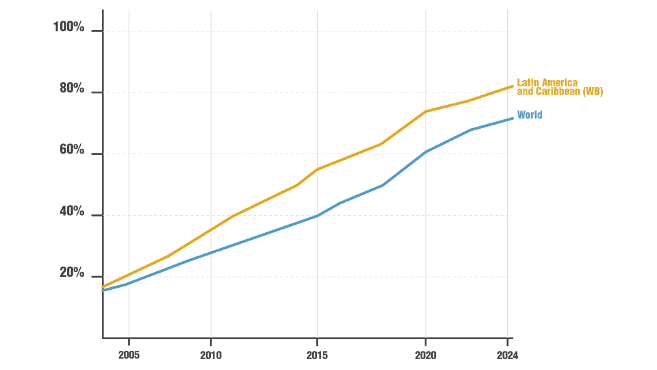
First, the number of connected users has continued to increase, even during global economic crises such as the dot-com bubble of 2001 and the financial crisis of 2008. This growth was not only sustained, but in Latin America and the Caribbean it occurred at a faster pace than the global average in several periods, which is also reflected in adoption indicators (Figure 1).
It is therefore worthwhile revisiting the technical model that explains the success of the Internet and understanding why, unlike other networks that emerged in the 1970s and 1980s, some even with global reach, it has managed to consolidate itself as the critical infrastructure of modern life.
Ability to scale without breaking down
First, the number of connected users has continued to increase, even during global economic crises such as the dot-com bubble of 2001 and the financial crisis of 2008. This growth was not only sustained, but in Latin America and the Caribbean it occurred at a faster pace than the global average in several periods, which is also reflected in adoption indicators (Figure 1).
Figure 1. Share of the population using the Internet (%), World and Latin America and the Caribbean. Source: Our World in Data, Share of the population using the Internet (ITU/World Bank indicator, IT.NET.USER.ZS).
This growth is further supported by the expansion of mobile connectivity. Mobile broadband has become a key driver of access, For example, the ITU reports that by 2025 there will be 99 mobile broadband subscriptions per 100 inhabitants worldwide.
The key lies in the original design: both the physical technologies (fiber optics, Wi-Fi, mobile networks, and, more recently, satellite connectivity) and the protocols allow the number of users and capacity to scale without altering the essence of the system. The IP protocol, conceived in the 1980s, can now operate on infrastructures that didn’t even exist back then. This is not accidental, but the result of deliberate architectural decisions made in the 1970s and 1980s.
Within this framework, the recent expansion of satellite connectivity also illustrates the Internet’s ability to incorporate new access layers without having to “reinvent” itself. The sharp increase in the annual number of objects launched into space (Figure 2) is an indirect indicator of this momentum.
Figure 2. Annual number of objects launched into space (world). Source: Our World in Data, Annual number of objects launched into space, based on national registers submitted to the UN (UNOOSA).
A network that is not a single network
The Internet’s scalability would not be possible without a flexible architecture.
In this sense, we believe two principles have been particularly important.
First, the layered model. Each protocol serves a specific function and can evolve or be replaced without necessarily impacting those “above” or “below” it. The lower layers are associated with physical transmission; the higher layers relate to the applications people use.
Second, the “network of networks” model. The Internet is not a single, centralized network, but a federation of autonomous networks. Each one makes its own technical and commercial decisions. A provider may use fiber; another may employ cellular networks (LTE or 5G); yet another may utilize satellite or wireless links. Even so, they can all interoperate seamlessly because the IP protocol abstracts applications from the specifics of each transport technology.
Interconnection among these networks is also flexible. It is based on private agreements (one-to-one peering) as well as on Internet Exchange Points (IXPs), which are spaces where multiple networks connect and agree on how to exchange traffic. This decentralized model has proven to be exceptionally efficient and adaptable.
Together, the combination of access technologies, both fixed and mobile, broadband and traditional, illustrates how the Internet can continue to expand by relying on multiple “layers” and means of connectivity (see Figure 3).
People don’t connect to the Internet because of the infrastructure itself, but because of what they can do with it: conduct business, communicate, access information, study, work, shop, and, of course, entertainment.
In the 1980s, its uses were limited: email, remote sessions, and file transfer. By 2002, the Web, instant messaging, and the first e-commerce portals had already emerged. Two decades later, the ecosystem is practically limitless: videoconferencing, video streaming, online banking, mass e-commerce, and social networks.
Platforms such as YouTube and Netflix are examples of applications that demand enormous volumes of data, services that were not even on the horizon when the network was originally designed.
This adaptability is explained, once again, by the layered model. Innovations can be developed at higher levels without altering the core of the network. Added to this is a key concept: permissionless innovation. On the Internet, it is not necessary to ask for permission to create a new application. Anyone can innovate on top of the existing infrastructure.
Resilience in case of attacks and crises
The continuous growth and economic value of online transactions have also attracted threats. Potential collapses of the routing and numbering systems have been predicted since the 1990s. In the early 2000s, major malware attacks such as ILOVEYOU and SQL Slammer appeared and distributed denial-of-service (DDoS) attacks capable of affecting millions of users became widespread.
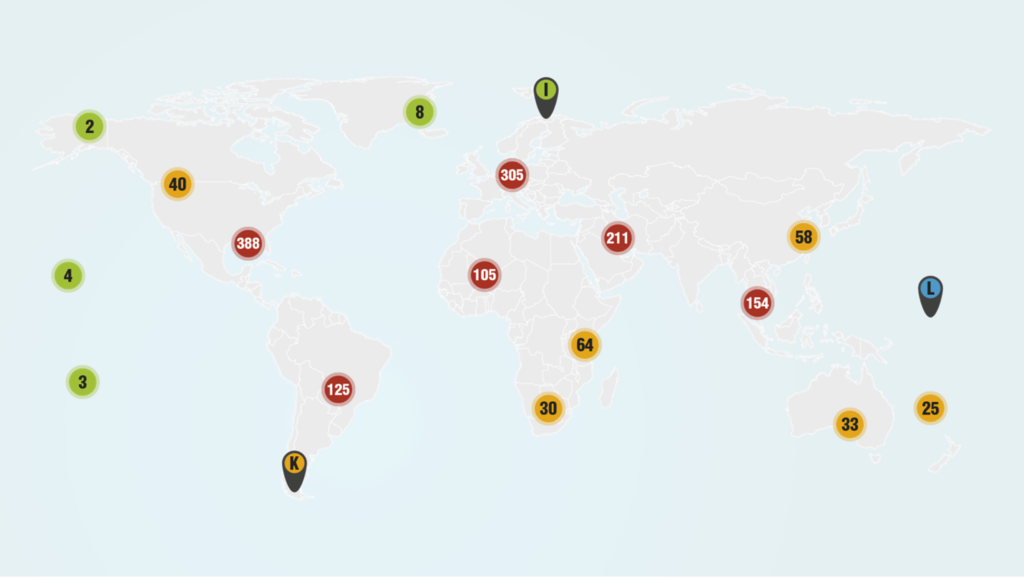
However, the Internet responded by strengthening its infrastructure and engineering. Increased bandwidth, the expansion of Internet Exchange Points (IXPs), and the distributed deployment of critical components —such as the DNS root system, which operates as a global network with hundreds of servers in multiple countries— reinforced the system’s robustness.
Due to their contribution to a faster, more reliable, and more efficient Internet, IXPs have been one of the keys to this robustness. By facilitating local traffic exchange, they reduce reliance on international routes for domestic traffic, an improvement that typically reduces costs, improves performance, and increases resilience.
There have also been decisive advances at protocol level: the adoption of IPv6 to expand the numbering space, the deployment of RPKI to strengthen routing system security, and technologies such as DNSSEC, DoT, and DoH to strengthen name resolution.
A recent article by one of the world’s leading cybersecurity companies illustrates the ongoing nature of these attacks: since the beginning of 2024, it reports having mitigated more than 14.5 million DDoS attacks, an average of 2,200 attacks per hour.
Figure 5.Evolution of peak bandwidth in volumetric DDoS attacks (cumulative record of public disclosures), 2011-2025. Source: Cloudflare
The Internet has always responded in multiple ways. In the case of DDoS attacks, the way to respond is essentially to increase infrastructure capacity. In addition to the increase in bandwidth mentioned earlier, I would also like to highlight the increase in the number of IXPs and DNS root-server copies.
The Internet is a platform constantly under construction. Like ancient Roman roads or the historic streets of any city, its surface undergoes changes, renovations, and modernization. However, its original spirit —an open, interoperable, and decentralized network— remains.
This balance between structural stability and constant innovation largely explains its technical success and social impact.