The LACNIC R&D Department conducted a study to identify how the countries in Latin America and the Caribbean are interconnected. Using data collected through the Speedchecker measurement platform, we analyzed the paths taken by data packets from each country to the rest of the region, including information on intermediate hops and observed latencies.
At LACNIC, we promote different types of Internet measurements across the countries in the region and at the interconnection level throughout Latin America and the Caribbean. These measurements help us understand the state of connectivity between networks in the countries within our area of influence and allow operators to use the information to improve network performance and interoperability.
(Free access, no subscription required)
2025 Traffic Paths Study
In this study we considered traceroute measurements originating in each country in the LAC region and destined for all other countries. We examined average latency and hop patterns and added an analysis of visualizations at the subregional level:
Central America: Costa Rica, Guatemala, Honduras, Mexico, Nicaragua, Panama, and El Salvador
South America: Argentina, Bolivia, Brazil, Chile, Colombia, Ecuador, Peru, Paraguay, Uruguay, and Venezuela
Caribbean: Dominican Republic, Haiti, and Trinidad and Tobago
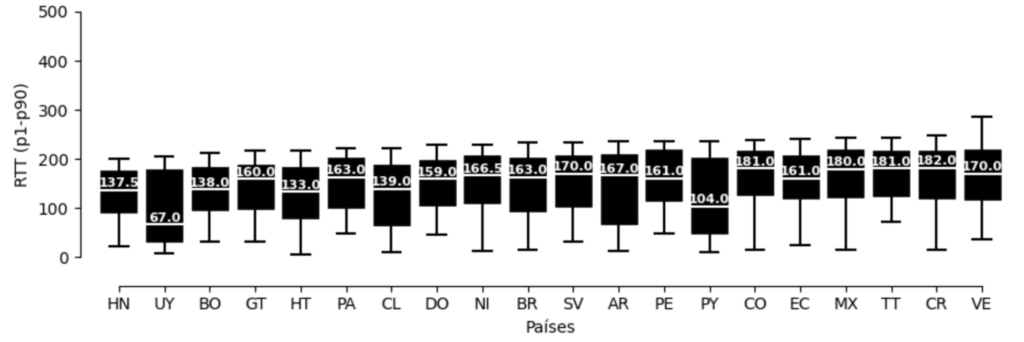
First, we analyzed the average latency from each country to the rest of the region, as shown in the graph below.
2025 Traffic Paths Study
In this study we considered traceroute measurements originating in each country in the LAC region and destined for all other countries. We examined average latency and hop patterns and added an analysis of visualizations at the subregional level:
Central America: Costa Rica, Guatemala, Honduras, Mexico, Nicaragua, Panama, and El Salvador
South America: Argentina, Bolivia, Brazil, Chile, Colombia, Ecuador, Peru, Paraguay, Uruguay, and Venezuela
Caribbean: Dominican Republic, Haiti, and Trinidad and Tobago
First, we analyzed the average latency from each country to the rest of the region, as shown in the graph below.
The measurements indicate that interconnection paths vary depending on the origin-destination country pair. In general, we observed that the latency of hops that leave the LACNIC region is higher than that of hops that remain within the region.
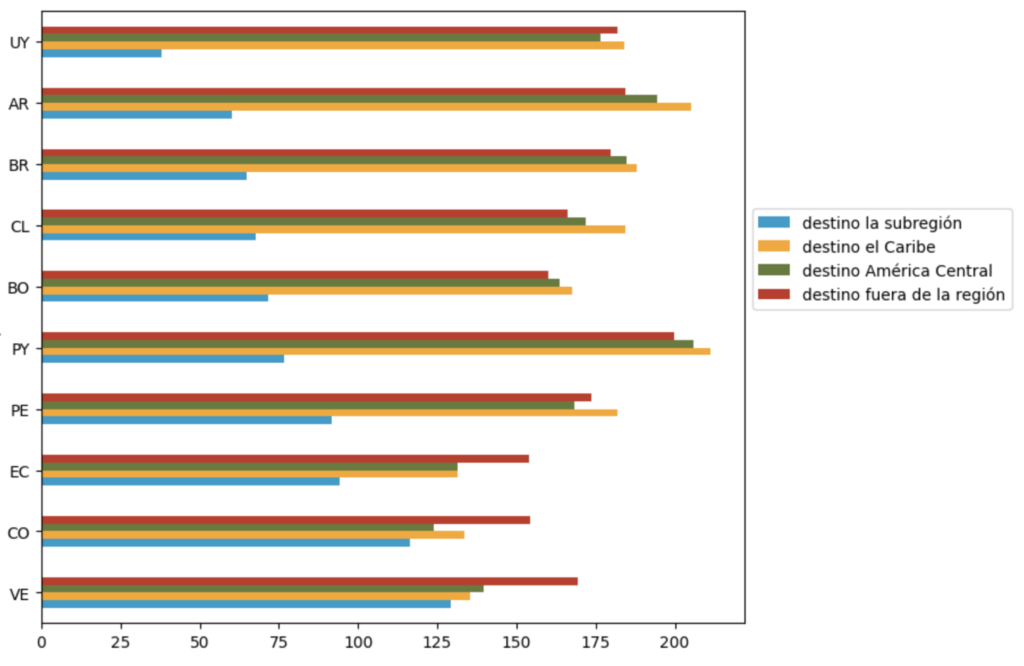
When the data was analyzed by subregion, latencies were generally consistent. However, in the Caribbean and Central American subregions, paths destined outside the region had lower latencies than paths destined to South America.
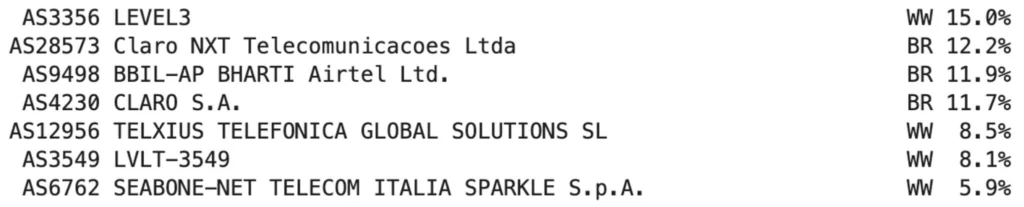
As in our first report on routes within a single country, we analyzed the ASNs that appear the most frequently by subregion, i.e., paths originating in one subregion and destined for each of the three. For example, the following image shows the ASNs appearing the most frequently on paths originating in and destined for South America:
The data shows that, within South America, certain Brazilian ASNs and ASNs with a global presence (WW) are the most frequently observed.
This study helped us gain a better understanding of how the countries of Latin America and the Caribbean are interconnected, not only by examining average latencies between country pairs, but also by identifying the actual paths followed by traffic and the autonomous systems involved.
Overall, the data shows that latency increases when traffic leaves the region, but it also reveals an interesting finding: in Central America and the Caribbean, it is sometimes faster for traffic to leave the region than to communicate with South America.
We invite you to read the full report available here and use these results as a starting point for your own analyses, compare them with local measurements, and explore opportunities for optimizing your networks. If you identify any inconsistencies with data from your country or have comments or questions, please contact us at imasd@lacnic.net.
Finally, we reiterate the importance of having a measurement platform with sufficient coverage to accurately represent the interconnection situation of each country in Latin America and the Caribbean. LACNIC promotes the deployment of RIPE Atlas probes and invites you to install one on your networks. For more information, visit this website or contact us at atlaslac@lacnic.net.
The views expressed by the authors of this blog are their own and do not necessarily reflect the views of LACNIC.