LACNIC Blog > Public Policy > The Transformation of Phone Calls: How the Internet Changed the Rules of the Game
The Transformation of Phone Calls: How the Internet Changed the Rules of the Game
August 26, 2026
By César Díaz, Head of Telecommunications Affairs at LACNIC
For most of us, making a phone call is still as simple as finding a contact, tapping the screen, and waiting for the other person to answer: “Hello?”
For more than a century, phone calls were made over the Public Switched Telephone Network (PSTN) using circuit switching. When you dialed a number, the network established a dedicated circuit between the two endpoints and reserved throughout the conversation, even during periods of silence.
Intelligence was concentrated in the telephone exchanges, which were responsible for transmitting voice and controlling the establishment, routing, and termination of each call.
(Free access, no subscription required)
However, today, every call—whether made from a fixed line or through an app—involves a much more complex technological process than we might imagine.
The migration from traditional telephone networks to Internet-based architectures is redefining how communications are delivered and, at the same time, presents new challenges for both Internet development and regulation in the region.
Understanding how a call travels over the Internet also helps us understand why developing open, secure, and resilient infrastructure is essential for driving digital transformation, innovation, and connectivity in the region.
However, today, every call—whether made from a fixed line or through an app—involves a much more complex technological process than we might imagine.
The migration from traditional telephone networks to Internet-based architectures is redefining how communications are delivered and, at the same time, presents new challenges for both Internet development and regulation in the region.
Understanding how a call travels over the Internet also helps us understand why developing open, secure, and resilient infrastructure is essential for driving digital transformation, innovation, and connectivity in the region.
The SS7 Era
To coordinate these functions, Signaling System No. 7 (SS7) emerged, one of the most important signaling systems in the history of telecommunications.
Developed in the 1970s and standardized through International Telecommunication Union’s (ITU) Q.700 recommendations, SS7 allowed separating signaling from the channel used to carry voice.
This system made it possible to establish and terminate calls, route international communications, facilitate roaming, query number portability databases, and offer services such as call forwarding, voicemail, and toll-free numbers.
While voice traveled over a circuit, switching centers exchanged SS7 messages to control the communication. Although its use has declined with the migration to IP networks, SS7 remains active in some countries.
The Internet Changed the Rules of the Game
IP networks completely transformed this architecture. Instead of maintaining separate infrastructures for voice and data, a single network began to carry all types of information.
Voice became just another data stream: it was digitized, divided into packets, and reconstructed at its destination in a fraction of a second.
To a large extent, this transformation was possible thanks to the work of various standardization organizations. The Internet Engineering Task Force (IETF) developed open protocols for signaling, transport, and control of multimedia communications over the Internet, including SIP, RTP, SDP, and RTSP. Other organizations, particularly the ITU-T, standardized numerous audio codecs used to convert voice into digital information and compress it for transmission.
Codecs played a decisive role in the development of IP telephony. In traditional digital telephony, a call typically requires a 64 kbit/s channel using the G.711 codec. With the advent of more efficient compression techniques, some codecs managed to reduce that bit rate to values close to 8 kbit/s and, in specialized applications, even to around 2-3 kbit/s.
In the latter cases, the amount of information needed to encode voice can be approximately twenty times less than on a traditional 64 kbit/s channel. Although IP protocol headers and other control data must be added to the audio traffic, this reduction allowed for a much more efficient use of network capacity.
The combination of open protocols, more efficient codecs, and a shared infrastructure made it possible to reduce costs, expand capacity, and integrate phone calls, video, messaging, and collaboration tools. These advances were essential for IP telephony to gradually replace traditional telephony.
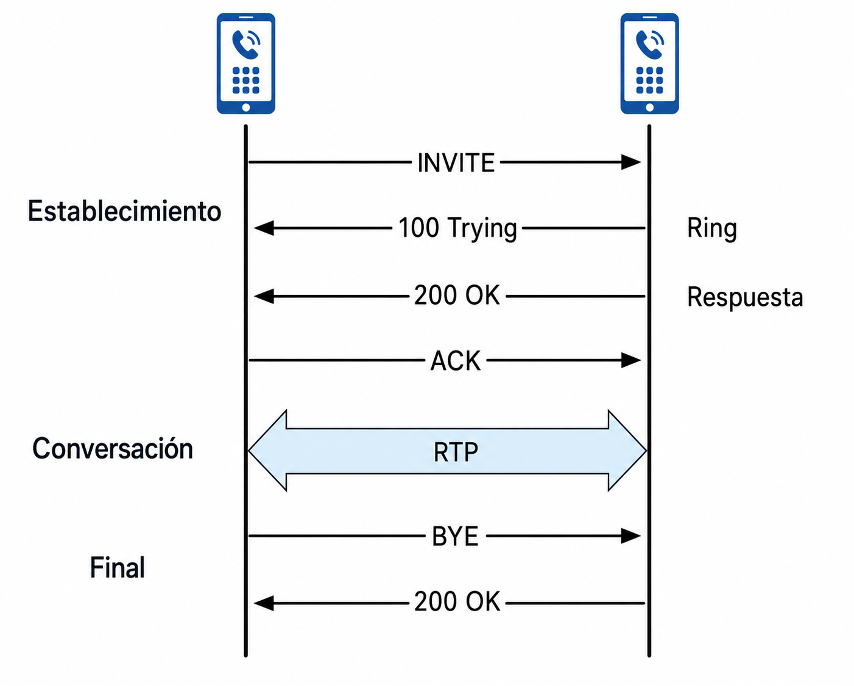
In IP networks, many of the traditional signaling functions are performed by the Session Initiation Protocol (SIP).
SIP does not carry voice itself. Its function is to locate the recipient and establish, modify, and terminate the session. During this process, the Session Description Protocol (SDP) allows negotiating elements such as codecs, ports, and multimedia capabilities.
Once communication is established, voice typically travels via the Real-Time Transport Protocol (RTP). At the same time, Quality of Service (QoS) mechanisms help reduce latency, jitter, and packet loss.
Simply put, SIP manages the call, SDP negotiates its characteristics, and RTP carries the voice.
This transition also presents a challenge in terms of resilience. Traditional fixed line telephony over copper lines could receive power from the telephone exchange itself and, under certain conditions, continue functioning during a power outage. Conversely, IP-based services depend on local equipment such as modems, routers, and terminals that require electricity to function.
Why Do We Still Use Phone Numbers?
Because the E.164 numbering system, defined by the ITU, remains the primary international system for identifying telephone subscribers.
In Panama, for example, the country code +507 identifies our numbers within the global numbering system. However, IP-based communication doesn’t necessarily require a phone number, as communications can also be established using a SIP address, a username, or an account on a digital platform.
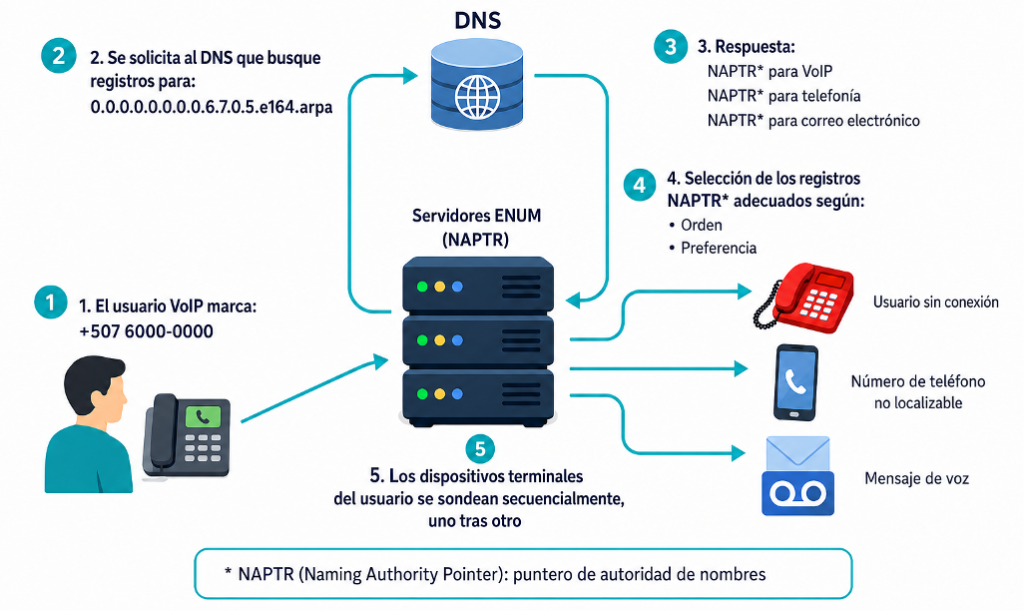
To connect these two worlds, ENUM (Telephone Number Mapping) was developed, a standard created by the IETF that uses the Domain Name System (DNS) to link an E.164 number to various Internet services.
For example, the Panamanian phone number +507 6000-0000 can be transformed into the ENUM domain 0.0.0.0.0.0.0.6.7.0.5.e164.arpa. Using NAPTR records, this domain can be linked to a SIP address, a messaging app, an email address, or a videoconferencing service.
The RIPE NCC operates the ENUM Tier 0 Registry for e164.arpa, from which the corresponding country code domains are delegated. This process is carried out in coordination with the ITU’s Telecommunication Standardization Bureau (TSB) and national authorities.
The RIPE NCC does not assign telephone numbers or directly manage user records. Its role is to maintain the top-level DNS infrastructure that connects E.164 country codes to national ENUM zones.
Although ENUM did not achieve widespread public adoption, it introduced an idea that remains highly relevant: using the Internet’s open and distributed infrastructure to locate identities and facilitate interoperable communications.
Due to its limited use, a review is currently underway regarding the continued existence of Public ENUM under the e164.arpa domain. The RIPE NCC, ITU-T, IAB, and the technical community are evaluating whether there is still an operational need that justifies maintaining this infrastructure.
A final decision has not yet been made. The discussion is focused on the public e164.arpa tree and does not necessarily imply eliminating the private ENUM implementations that some operators use for routing and call interconnection.
In turn, this convergence of telephony and the Internet raises new questions about how regulatory frameworks should evolve.
What Does This Transformation Mean for Regulators?
Traditional regulatory frameworks were designed for clearly distinct services: fixed-line telephony, mobile telephony, data transmission, television, and radio broadcasting. Today, those boundaries are becoming increasingly blurred.
A single IP infrastructure can carry calls, videoconferences, television, cloud services, artificial intelligence applications, and Internet of Things solutions.
This transformation is particularly important for the countries of the region. Connectivity not only supports the daily communications of individuals and businesses; it is also essential for competitiveness, trade, financial services, logistics, and digital transformation.
This reality forces us to reconsider several questions:
Regulation: How should we regulate voice services when they are no longer independent, but applications delivered over the Internet?
Innovation: How should we promote new services and business models without creating unnecessary barriers?
Security and resilience: How should we guarantee the security, continuity, and availability of communications?
Migration: How should we complete the transition to IP networks without affecting users?
Identity: What role will telephone numbers play as digital identities become increasingly prevalent?
In this context, deploying IPv6 and high-capacity networks, strengthening Internet Exchange Points (IXPs) and the DNS, promoting open standards, and improving routing security through RPKI are no longer purely technical matters.
What Does the Future Look Like?
More and more operators are retiring their old circuit-switched exchanges and migrating to All-IP architectures based on IMS platforms, which can integrate voice, video, and other multimedia services.
This evolution also brings new challenges: authenticating the origin of calls, combating identity theft, completing IPv6 deployment, and integrating communications with the cloud and artificial intelligence technologies.
But perhaps the most profound change is conceptual. For decades, telecommunications were primarily about connecting telephone numbers. Today, they are increasingly about connecting digital identities.
The next time you make a call from your cell phone, think about everything that can happen in a matter of milliseconds: SIP, RTP, IMS, DNS, gateways, QoS, and in some cases even SS7, all working together so that on the other end you can hear:
“Hello?”
The views expressed by the authors of this blog are their own and do not necessarily reflect the views of LACNIC.