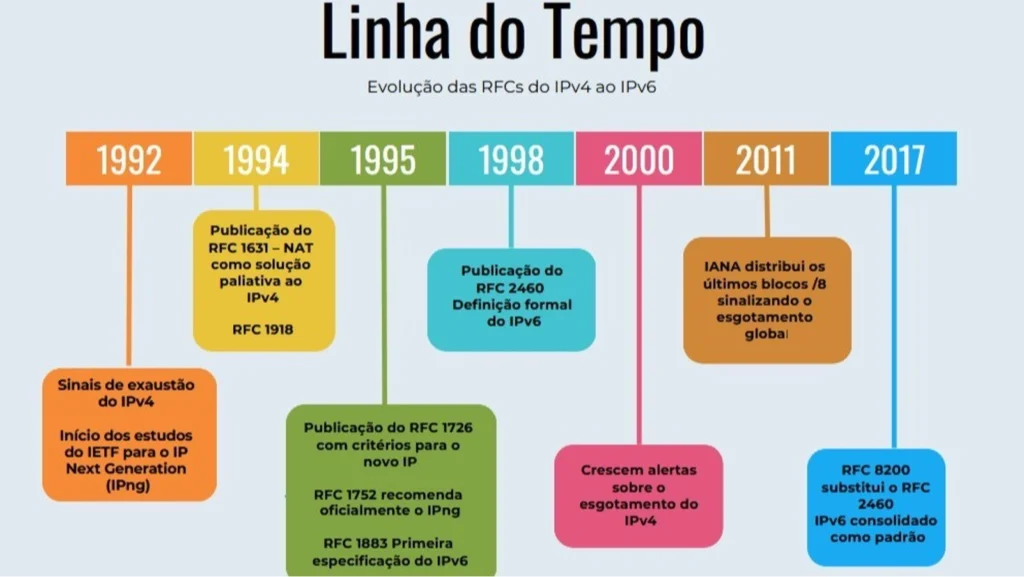
Recently, while preparing a timeline for a presentation, something caught my attention and that’s why I decided to write this post, a period that I consider the Internet’s missing link spanning 2000 to 2010.
An Announced Shortage of Addresses
IPv4 exhaustion had already been predicted in the early 1990s. The Internet was growing at a rapid pace, and the addressing model implemented uniquely and globally on 1st January 1983 provided “only” 4.3 billion addresses. Considering that the world’s population in the 1980s was about 4.4 billion, this calculation appeared to be reasonable.
We believed it would be enough for everyone, but while it might have worked for an academic or corporate Internet in the 1980s, in reality it was far from enough to meet the needs of a world undergoing a massive connectivity expansion.
(Free access, no subscription required)
The First Technical Responses
Even so, the technical community—particularly within the Internet Engineering Task Force (IETF)—didn’t remain idle. In 1994, RFC 1631 was published, introducing Network Address Translation (NAT) as a temporary solution (K. Egevang and P. Francis). Its purpose was to mitigate the shortage of public IP addresses.
At the same time, a group was analyzing proposals for a new version of the Internet Protocol (IP Next Generation or IPng), an effort that culminated in 1995 with RFC 1883, the first technical document describing what would become IPv6. This specification was authored by Steve Deering (Xerox PARC) andBob Hinden (Ipsilon Networks), two pioneers who deserve recognition for their foresight.
In 1998, after final adjustments, IPv6 was formally standardized with RFC 2460, and the new protocol was ready to be used. It introduced a series of solutions such as larger address space (128 bits), simplified headers, auto-configuration, mobility, and native security via IPsec, and most importantly, it eliminated the need for NAT.
The First Technical Responses
Even so, the technical community—particularly within the Internet Engineering Task Force (IETF)—didn’t remain idle. In 1994, RFC 1631 was published, introducing Network Address Translation (NAT) as a temporary solution (K. Egevang and P. Francis). Its purpose was to mitigate the shortage of public IP addresses.
At the same time, a group was analyzing proposals for a new version of the Internet Protocol (IP Next Generation or IPng), an effort that culminated in 1995 with RFC 1883, the first technical document describing what would become IPv6. This specification was authored by Steve Deering (Xerox PARC) andBob Hinden (Ipsilon Networks), two pioneers who deserve recognition for their foresight.
In 1998, after final adjustments, IPv6 was formally standardized with RFC 2460, and the new protocol was ready to be used. It introduced a series of solutions such as larger address space (128 bits), simplified headers, auto-configuration, mobility, and native security via IPsec, and most importantly, it eliminated the need for NAT.
Everything was well-documented. The infrastructure was technically ready. All that remained was to implement IPv6.
The Lost Decade (2000–2010)
Unfortunately, between 2000 and 2010, while the Internet experienced rapid expansion, the infrastructure that would shape the future of connectivity was, in my view, neglected in a certain way.
It was the decade of broadband, the explosion of Wi-Fi, and the rise of thousands of small, local providers across the world. Access grew, demand for IP addresses increased exponentially, yet all efforts related to IPv6 were ignored. At a time when we needed IP addresses the most to serve residential users, businesses, and companies, we decided to take a path contrary to everything that had been anticipated. This is something I am still trying to understand.
Our focus was on the Internet’s business model, not on its technical sustainability. The priority was selling connections, gaining market share, and providing immediate access. The technical cost was concealed behind the excessive use of NAT, CGNAT, and other palliative solutions that added complexity and reduced visibility and traceability across the network.
In my view, this negligence created a disconnect: the solution was ready, validated, and thoroughly specified, yet political, economic, and operational decision-making failed.
A Late Awakening
It wasn’t until 2011 that the world woke up, and the Internet Assigned Numbers Authority (IANA) officially announced the allocation of the last /8 IPv4 address blocks to the Regional Internet Registries (RIRs). The end of IPv4 had arrived.
Only then did various countries and organizations begin their IPv6 adoption efforts, but these efforts were reactive, fragmented, and overdue. The protocol was formally consolidated as a standard in 2017 with the publication of RFC 8200, which replaced RFC 2460.
It took more than 20 years from the initial proposal to its recognition as a standard. This was one of the longest periods of global technological inertia, especially considering that the need was known, the solution existed, and the risks had been mapped.
The Consequences of Ignoring IPv6
Even today, we continue to feel the weight of that lost decade and its consequences:
Networks behind CGNAT, which affects traceability;
High operational costs for maintaining compatibility with legacy systems;
Security challenges due to loss of traffic visibility;
Barriers to IoT, for which NAT represents a critical bottleneck;
An Internet that is more complex and harder to manage.
Some of today’s cyberattacks and difficulties encountered in criminal investigations are also direct consequences of the massive use of NAT due to the lack of public addresses.
What Can We Learn?
The history of IPv6 shows that designing strong technical solutions is not enough, as we must also ensure their timely adoption. The cost of ignoring a transition is immense, which we are now paying for in the form of fragmented fixes, loss of visibility, and missed opportunities.
More than “just more addresses,” IPv6 represents:
A return to simple Internet architecture;
The return of traceability and visibility of every connected device;
The foundation for emerging technologies such as IoT, 5G, and smart mobile networks.
Conclusion
Over 25 years after the first RFCs, IPv6 is finally advancing towards maturity. However, we must act with responsibility and commitment, as the Internet of the future cannot be built on the emergency solutions of the past. Lost time cannot be recovered, but we can prevent history from repeating itself.
The views expressed by the authors of this blog are their own and do not necessarily reflect the views of LACNIC.