“Don’t disconnect those who are already connected and connect those who are not”
December 22, 2016
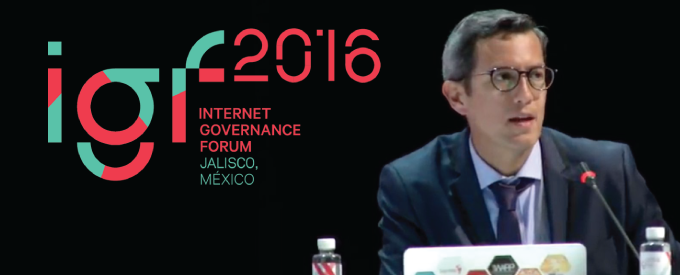
The main challenges for connecting those who are not yet connected to the Internet and keeping existing Internet users online require the collaboration and participation of the various actors with an interest in Information Technology. The multistakeholder approach will allow addressing the challenges currently affecting the Internet with greater success, said Oscar Robles, LACNIC CEO, in his speech at the High-Level Dialogue during the Internet Governance Forum (IGF) held in Guadalajara (Mexico) during the first week of December.
Robles participated in the High-Level Meeting, a session that kicked off the IGF debates, along with the world’s top Internet leaders.
Connecting the next billion users and making sure that those who are already using the Internet continue to do so “requires much more complex and comprehensive projects involving multiple skills, multiple actors and multiple stakeholders,” noted LACNIC’s CEO. (Watch the presentation: https://youtu.be/ja9nk7g0Tzg?t=1h42m8s).
Robles observed that, in order to reduce the digital divide, it is important “not to disconnect those who are already connected and connect those who are not,” adding that consideration should also be given to those who for some reason become disconnected. In this sense, he warned about cases where companies no longer find it profitable “to connect some of the people who are already connected” to the Internet. In Robles’s opinion, this is where States can play a vital role. “As Vint Cerf mentioned, the challenge for States is to ensure proper incentives for maintaining those who are already connected online and bringing connectivity projects to those who are not yet connected,” he observed.
(Free access, no subscription required)
Robles argued that proposals should be innovative, different from those that have been implemented so far —mostly engineering projects—, and that solutions will require much more complex and comprehensive ideas and the participation of multiple stakeholders.
“When we connected to the Internet, with each device we received 65,536 connections and possibilities for innovation. There is a risk that new users will not be afforded the same possibilities, either because of zero rating issues or because the necessary protocols such as IPv6 are not being deployed,” Robles emphasized.
He also proposed regaining the trust of the many thousands of Internet users who feel they are under surveillance.