LACNIC Blog > FRIDA Program > Community Networks Led by Women from Quilombolas and Marisqueiras Communities
Community Networks Led by Women from Quilombolas and Marisqueiras Communities
March 8, 2019
Two community network projects led by indigenous women will bring the Internet to their communities in northeastern Brazil through an initiative funded by LACNIC’s FRIDA Program.
Both proposals were selected as the result of a call by Brazilian organization Artículo 19 to support communities in vulnerable areas so they can have access to the digital world. This initiative to promote organizations led by women was selected as the winner of one of last year’s FRIDA Grants aimed at promoting community networks.
Within the framework of the activities organized for 8 March, the installation of the first of these community networks in the Peri Peri community (Piauí) will be announced, a project led by the Ayabás Institute for Black Women. The second network will be installed in April in Itaparica, Bahia, with the support of Periféricas.
Laura Conde Tresca, acting executive director of Artículo 19, observed that they had encouraged projects presented by associations led by women to “recognize the gender oppression that is still very present in Brazilian society.”
(Free access, no subscription required)
What can you tell us about the two communities selected to deploy these networks?
The two projects we selected were submitted by groups working in northeastern Brazil, Periféricas (Bahia) and the Ayabás Institute of Black Women (Piauí), comprised and led by indigenous and black women, politically organized to guarantee their rights, strengthen guidelines for women, and against domestic and sexual violence. The Ayabás Institute will accompany and locally articulate the installation of a network in the Peri-Peri community in the state of Piauí, while Periféricas will offer technical, political and social support to groups living in greater Salvador and Marisqueiras de Itaparica (interior of the state), where the network will be implemented. In addition to being highly respected among women’s movements, these groups were selected because they work with communities in their respective states, so they will also multiply the knowledge they acquire and offer technical and political support for the workshops and community networks installed by the project, thus strengthening local ties and increasing their sustainability.
Why did you put special emphasis on working with Women’s Associations for these projects? How do these female leaders impact the long-term sustainability of community networks and community access to the Internet?
What can you tell us about the two communities selected to deploy these networks?
The two projects we selected were submitted by groups working in northeastern Brazil, Periféricas (Bahia) and the Ayabás Institute of Black Women (Piauí), comprised and led by indigenous and black women, politically organized to guarantee their rights, strengthen guidelines for women, and against domestic and sexual violence. The Ayabás Institute will accompany and locally articulate the installation of a network in the Peri-Peri community in the state of Piauí, while Periféricas will offer technical, political and social support to groups living in greater Salvador and Marisqueiras de Itaparica (interior of the state), where the network will be implemented. In addition to being highly respected among women’s movements, these groups were selected because they work with communities in their respective states, so they will also multiply the knowledge they acquire and offer technical and political support for the workshops and community networks installed by the project, thus strengthening local ties and increasing their sustainability.
Why did you put special emphasis on working with Women’s Associations for these projects? How do these female leaders impact the long-term sustainability of community networks and community access to the Internet?
Artículo 19 encouraged associations led by women to submit their proposals, especially to recognize the gender oppression which is still very present in Brazilian society. Therefore, in order to democratize access to connectivity and contribute to the prominence of women in public spaces, we included the gender criterion in our selection process, which we also do internally within the organization when selecting our collaborators.
In the case of the community network project funded by FRIDA (the Regional Fund for Digital Innovation in Latin America and the Caribbean), we are convinced that the role of women in social articulation is essential for the sustainability of the networks. The sustainability of community networks depends not only on financial aspects but also on aspects relating to social mobilization and technological resources. We want to encourage the participation of a greater number of women technicians in community networks. This is important for knowledge to circulate and not remain centralized in the hands of the usual male figures. Not only to build networks that take women’s needs into account, but also to imbue their design with the female logic.
How do you expect these networks to impact the rights of women and girls in the communities they benefit?
We hope that the connectivity established in these communities will be a means for these women to claim their rights. The presence of women in digital environments helps promote their autonomy and even addresses other broader issues within the community. This practice also creates an environment and favors a culture that will help future generations of women feel comfortable when taking on public leadership roles and not be limited or constrained in doing what they want and are capable of doing.
We understand that the participation of female leaders contributes to achieve the social commitment to diversity, equality and inclusion within each community and therefore promotes a more plural environment.
There is a major pending debate on gender equality within the community networks movement, specifically, that women who are part of the communities should actively participate in the process of setting up and maintaining these networks. What lessons are you learning from your project that will contribute to this debate?
I believe that the way in which we designed the project challenges the dominant logic of the role women play in the digital sphere. Historically, women were assigned a social role in the private sphere. The tasks of caring for children and the elderly and education were socially attributed to women. On the contrary, innovation, challenges, all things “new” —in other words, the public space— were attributed to men. By reversing these roles and becoming involved in the field of technological innovation, digital advances and connections between the major players in the sector, we are reaching the public sphere. Our goal is to break with these socially imposed roles by assigning spaces to women within the public sphere and engaging in the issues with the greatest impact and reach.
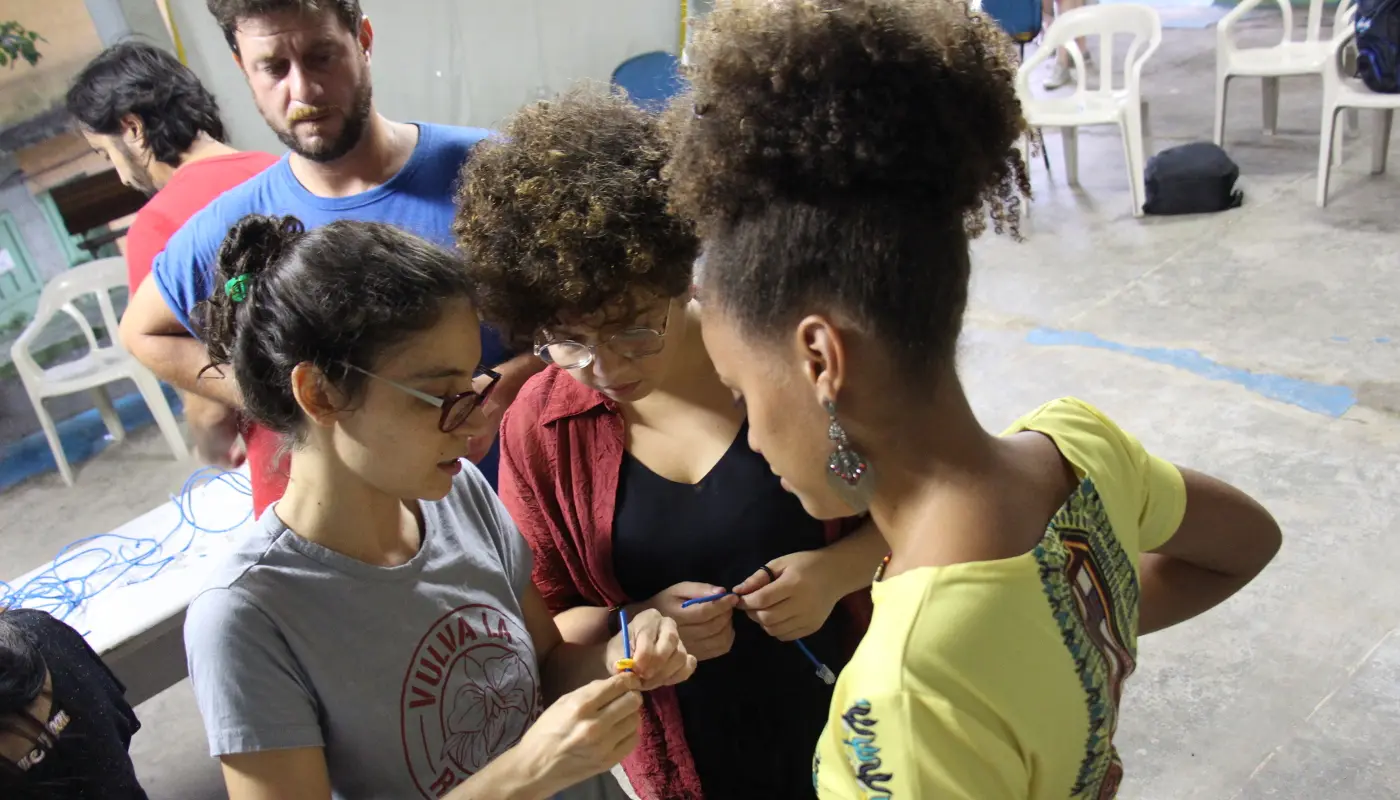
Encontro promovido na Casa dos Meninos em janeiro de 2019. Na foto, a fellow da Mozilla na ARTIGO 19, Bruna Zanolli, auxilia crimpagem de cabo com participantes.