LACNIC Blog > Events > 17 Years Observing BGP: What Doug Madory Learned About Shutdowns, Hijacks, and Routing Security
17 Years Observing BGP: What Doug Madory Learned About Shutdowns, Hijacks, and Routing Security
16/11/2026
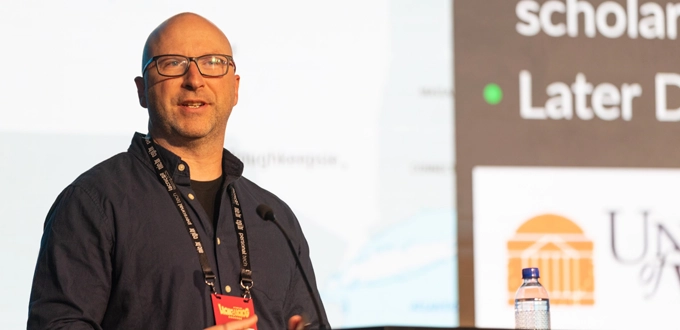
At LACNIC 46 LACNOG 2026, Infoblox’s Director of Internet Analysis explored how to interpret global routing patterns and provided specific actions for network operators, including the creation of ASPA records, a task that can already be performed through the MiLACNIC portal.
Seventeen years of observing BGP, the protocol through which Internet networks announce the paths to reach each destination, have left him with a notebook full of shutdowns, politically motivated traffic redirections, and attacks on Internet infrastructure. According to Doug Madory, this experience has also led him to a conclusion rarely heard in the field of security: significant progress has been made, but the fight never ends. This is the summary he shared at LACNIC 46 LACNOG 2026, held in Mendoza.
Madory divided his presentation into two parts: geopolitics and security. The first examined how governments disrupt, filter, or reroute Internet traffic; the second explored how attackers hijack routes and how the community defends itself. Both presented data corresponding to 2026, from the Internet shutdowns in Iran to an attack on a hosting software provider that occurred on August 28.
The fundamental challenge, Madory noted, is that understanding BGP dynamics is a multi-dimensional problem. His analysis of any event focuses on three questions: its reach (how far it propagated), its duration (how long it lasted), and its context (which autonomous systems were involved).
(Free access, no subscription required)
Standard tools alone are not enough. BGPlay—which is still in use—visualizes individual routing announcements, which requires users to watch a lengthy animation before they can draw any meaningful conclusions. Simply counting announcements is also not particularly useful, as this number could mean nothing or it could mean a great deal. The number itself does not distinguish between the two.
Madory’s proposal is to shift attention from the announcements themselves to hidden status in routing tables, of which the advertisements are merely what can be observed.
From ROV to ASPA
Madory began by reviewing the basics. A Route Origin Authorization (ROA) specifies which autonomous system (i.e., an operator’s network, identified by a unique number) is authorized to announce a particular prefix. Route Origin Validation (ROV) checks routes against these authorizations and rejects those that are invalid. According to the NIST RPKI monitor, 71% of IPv4 routes and 79% of IPv6 routes have an associated ROA. Aggregated traffic data for October 2026 shows that 78% of traffic, measured in bits per second, is directed toward routes covered by an ROA.
A recent surge in coverage has been driven by China. Since April 2026, ROA coverage there has risen from 4% to 81%, increasing coverage for the APNIC region from 55% to 77% and impacting global statistics.
The next step is Autonomous System Provider Authorization (ASPA), which validates the entire path rather than just the origin. While ROV asks whether an autonomous system is authorized to originate a prefix, ASPA checks whether the route follows legitimate commercial relationships. Each network signs an ASPA object listing its transit providers. Routers then check that the path ascends through providers and descends only once, without any “valleys.” This allows detecting two threats that ROV cannot identify: route leaks, such as the 2019 incident involving Verizon and DQE, and hijacks involving a spoofed origin.
ASPA adoption is advancing registry by registry. RIPE NCC activated ASPA in its RPKI dashboard in November 202′; ARIN fully enabled ASPA in January 2026; MyAPNIC added it in July; and LACNIC introduced configuration through MiLACNIC in September. Cloudflare Radar data shows that the strongest growth has occurred in the RIPE NCC region, with approximately 1,900 entries.
17 Years of Learning
Madory was pessimistic regarding the geopolitical landscape: Internet shutdowns and blocks are not likely to end anytime soon, and as they become more sophisticated, they are also becoming more difficult to measure. Politics often shapes the paths Internet traffic takes. He warned that digital authoritarianism will continue to evolve, that other countries may adopt “allowlist”” systems, and that the digital rights community needs support and resources.
On security, he was more optimistic. Improvements have been massive: large-scale, devastating route leaks are largely a thing of the past, and most well-known incidents could not happen today. ROV and ASPA—and, eventually, BGPSEC—are giving adversaries what they deserve. However, this is a multi-year project, and the fight continues.
Three tasks for network operators
Create ROAs for an exact prefix length (not using ‘maxLength’) and reject invalid routes.
Create ASPA records, which you can already do thrugh MiLACNIC.
Regularly review AS-SETs (lists of networks an operator identifies as its clients), routing policies, and prepending (repeating a network’s own autonomous system number to make a route less preferred).
“Always moving forward”
Madory closed with the motto “always moving forward.” He described the Internet as the defining technology of modern civilization: a beautiful, remarkable, and resilient creation. He then asked what we can do to survive this “AI adolescence.” In his view, the volume of artificial intelligence traffic will not break the Internet, but the pace of new exploits could. His answer was collective: we can fix the problems by working together, and communities like LACNIC matter. His final slide featured an embroidered message that perfectly captured the spirit of his talk: : “”well-behaved routes rarely make history.”