LACNIC Blog > Events > Steve Crocker: “There Are Only Two Kinds of IP Addresses: IPv6 and Non-IPv6.”
Steve Crocker: “There Are Only Two Kinds of IP Addresses: IPv6 and Non-IPv6.”
September 29, 2017
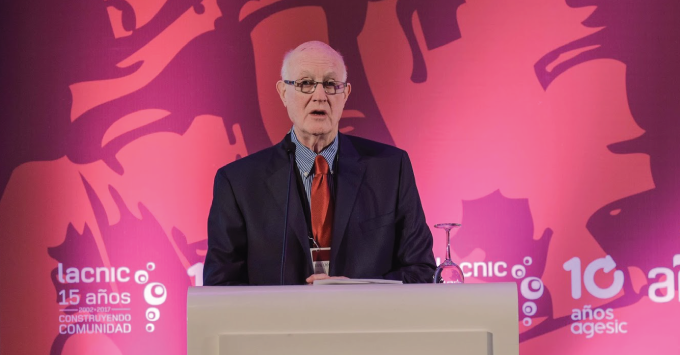
Steve Crocker, chairman of the board of the Internet Corporation for Assigned Names and Numbers (ICANN), admitted that the coexistence of IPv4 and IPv6 has generated certain tensions, though he stressed that IPv6 will be the dominant system in a not-too-distant future.
In his presentation at LACNIC 28 – LACNOG 2017, Crocker emphasized the importance of IPv6 deployment.
Speaking to the Latin American and Caribbean Internet community gathered in Montevideo to celebrate LACNIC’s 15th anniversary, Crocker highlighted the role and leadership of the Internet Regional Registry within the region and its cooperation with ICANN over the years.
He explained that both LACNIC and ICANN are part of a larger Internet ecosystem and that its development has benefited both organizations as well as the ecosystem in general. “Cooperation is the key to our organizations’ success,” he observed.
(Free access, no subscription required)
Crocker focused his presentation on the development of IPv6, the Internet protocol created to replace the current address system. He noted that while there are many reasons to adopt IPv6, the Internet is falling behind because many people do not agree with or resist this change. He explained that having both systems in operation (IPv4 and IPv6) means that there are delays and friction which are slowing down the process because not everyone wants to change to the new system.
Crocker also said he cannot anticipate “when the magic day will come when IPv4 will disappear from every network” and that he believes there is still a long way to go. “This is not a typical transition we are talking about; instead, in a way, it is the coexistence of IPv4 and IPv6,” said the chairman of the ICANN Board.
“The transition process is complex and time-consuming, as it is really difficult to make something new work together with something old. Therefore, the key is to work in stages.”
Crocker focused his presentation on the development of IPv6, the Internet protocol created to replace the current address system. He noted that while there are many reasons to adopt IPv6, the Internet is falling behind because many people do not agree with or resist this change. He explained that having both systems in operation (IPv4 and IPv6) means that there are delays and friction which are slowing down the process because not everyone wants to change to the new system.
Crocker also said he cannot anticipate “when the magic day will come when IPv4 will disappear from every network” and that he believes there is still a long way to go. “This is not a typical transition we are talking about; instead, in a way, it is the coexistence of IPv4 and IPv6,” said the chairman of the ICANN Board.
“The transition process is complex and time-consuming, as it is really difficult to make something new work together with something old. Therefore, the key is to work in stages.”
According to Crocker, we are in a period of IPv6 and IPv4 coexistence because it is not possible eliminate IPv4 instantly, yet there is no other option but to advance towards IPv6.
To see where we stand and where the tensions between the two Internet protocols are headed, he suggested dividing the process into five major phases. “Phase 1 was IPv4-only and is now over. Phase 2 is mostly IPv4 and the introduction of IPv6; this is the phase we are currently in. Phase 3 will see greater balance between the two protocols. Phase 4 will be mostly IPv6 and mark the end of IPv4. Phase 5 will be IPv6-only. This is a way of recognizing where we are right now and how to move forward,” Crocker said.
The path towards IPv6 is now quite smooth because many bumps have already been eliminated. According to Crocker, in the coming years we will see a major drive to complete the transition.
In Crocker’s opinion, we need to embrace the idea that there are only two kinds of Internet addresses. “IPv6 addresses and non-IPv6 addresses,” he concluded.
Before closing his presentation, Crocker congratulated LACNIC for “the great work carried out over the course of these 15 years.”