Peering Capacity at Public Internet Exchanges: What the Data Reveals
July 22, 2026
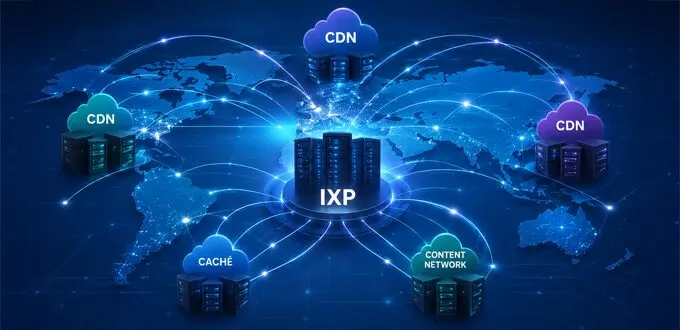
This article was originally published on RIPE Labs
This study delivers data-rich insights into the decisions made by the most IXP-connected CDN, cloud and content networks, analysing their strategies both individually and collectively as a group that exerts significant influence on the global interconnection landscape.
The distribution of CDN, cloud and content provider capacity across Internet Exchanges (IXPs) provides a fascinating lens into the physical infrastructure of the Internet and public peering.
(Free access, no subscription required)
While hyperscalers and CDNs increasingly deploy private backbone infrastructure, public peering remains a critical mechanism for regional traffic distribution, cache efficiency, eyeball reach, and resilience.
This study aggregates the port capacity of ten of the most IXP-interconnected CDN, cloud and content networks and ranks IXPs by total capacity. This ranking provides insights into the choices made by the networks, on an individual basis but also collectively as a group of CDN, cloud and content providers with significant influence in the global interconnection ecosystem. The networks covered are Akamai, Meta, Amazon, Hurricane Electric, Cloudflare, Fastly, Microsoft, Google, Netflix and Bytedance.
The limitations of this analysis are obvious: presence at exchanges could be incorrect or port capacity could be out of date, for instance. However, most of the networks under analysis depend heavily on PeeringDB automation. This gives the report a relatively high level of confidence.
While hyperscalers and CDNs increasingly deploy private backbone infrastructure, public peering remains a critical mechanism for regional traffic distribution, cache efficiency, eyeball reach, and resilience.
This study aggregates the port capacity of ten of the most IXP-interconnected CDN, cloud and content networks and ranks IXPs by total capacity. This ranking provides insights into the choices made by the networks, on an individual basis but also collectively as a group of CDN, cloud and content providers with significant influence in the global interconnection ecosystem. The networks covered are Akamai, Meta, Amazon, Hurricane Electric, Cloudflare, Fastly, Microsoft, Google, Netflix and Bytedance.
The limitations of this analysis are obvious: presence at exchanges could be incorrect or port capacity could be out of date, for instance. However, most of the networks under analysis depend heavily on PeeringDB automation. This gives the report a relatively high level of confidence.
At a glance
The data highlights the enormous scale at which major CDNs, cloud, and content providers participate in public Internet exchange ecosystems globally. Sourced from PeeringDB, the table below ranks the networks with the largest deployed port capacity at IXPs, illustrating how deeply integrated these operators are within the global Internet infrastructure. It also shows the number of exchanges they participate in (IX count) and the number of ports (Port count).
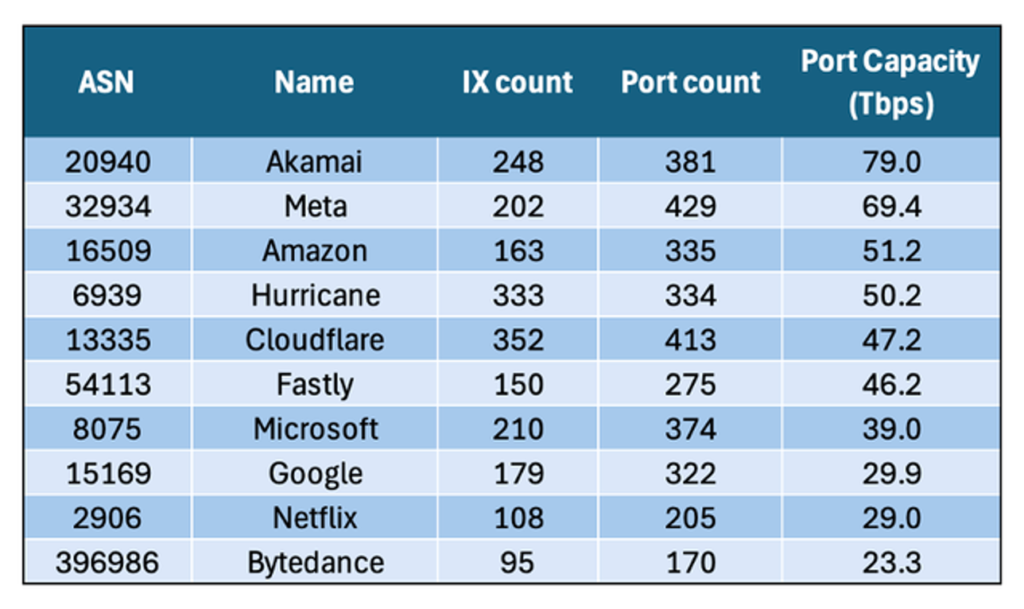
Akamai leads with 79 Tbps of deployed public peering capacity across 248 exchanges, reinforcing its long-standing strategy of distributing content as close as possible to end users. Meta follows closely with 69.4 Tbps, despite being present at fewer exchanges, indicating a strategy focused on very high-capacity deployments at key metros. Amazon ranks third with 51.2 Tbps, reflecting the growing importance of AWS and cloud-driven traffic flows at IXPs.
Cloudflare stands out as the most broadly connected network in the dataset, participating in 352 exchanges worldwide, while Hurricane Electric (the only non-CDN network in the benchmark) maintains the second largest exchange footprint overall with connectivity to 333 IXPs. Fastly, Microsoft, Google, and Netflix also show substantial global peering presence, highlighting the continued importance of public interconnection for large-scale content delivery, cloud services, and traffic localisation. Lastly ByteDance shows its limited footprint but high capacity deployed.
Overall, the data demonstrates that public peering remains a critical component of their Internet architecture, even for hyperscale operators with extensive private backbone infrastructure.
Analysis: Global Observations
The data reveals several notable geographic and strategic patterns.
The top three exchanges globally are not surprising – although their order may be. IX.br Sao Paulo, DE-CIX Frankfurt and Equinix Singapore are the exchanges with the largest deployed peering capacity. Note that Sao Paulo is also the exchange with the highest number of participants – 1861 according to PeeringDB – and peak/average traffic of 31Tbps/18Tbps according to their own statistics. DE-CIX Frankfurt is the largest European exchange by participant count (1017 networks), and its peak/average traffic is 18Tbps/12Tbps. Finally, Equinix Singapore with a more modest 465 participants have a peak/average traffic of 20Tbps/14Tbps.
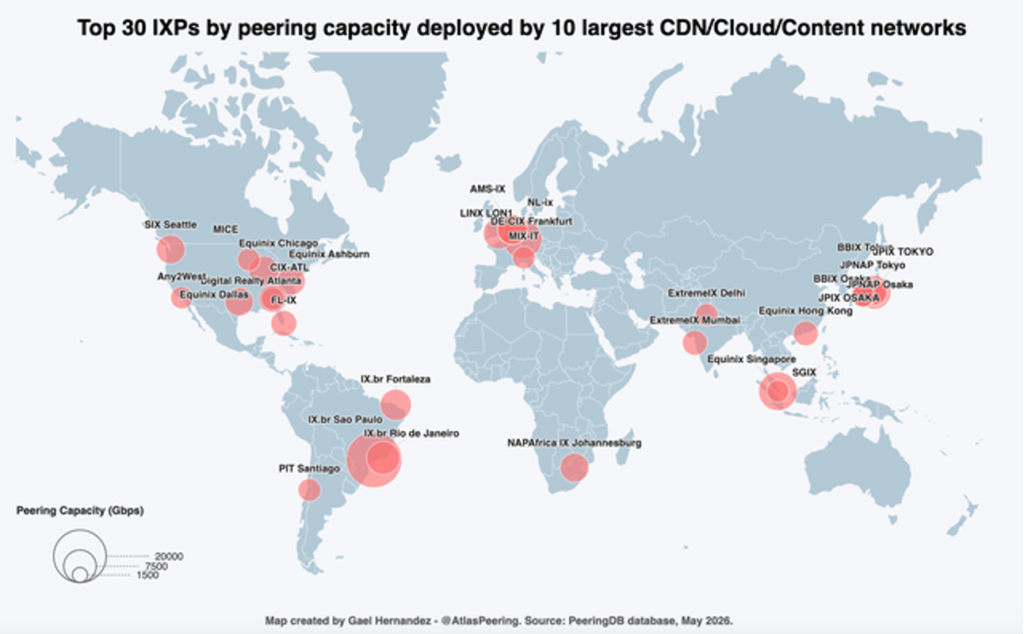
What stands out most is the scale gap between the first and second ranked exchanges: from 22.8 Tbps down to 11 Tbps, a drop of more than 50%. This suggests an exceptional level of traffic gravity and aggregation at the leading exchange, reinforcing the “winner-takes-most” dynamics often observed in Internet interconnection ecosystems.
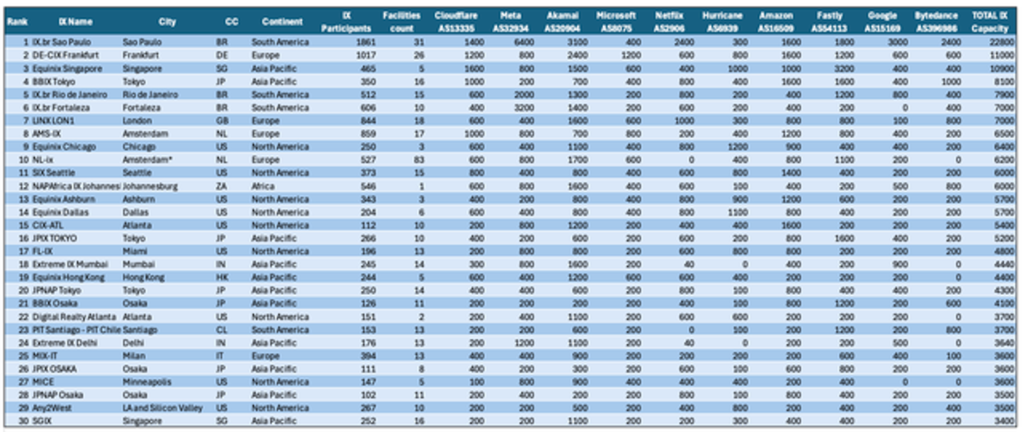
One of the more unexpected findings is the dominance of Brazil. Three Brazilian exchanges appear within the global top six, highlighting the maturity of Brazil’s domestic interconnection ecosystem and the success of IX.br in driving local traffic exchange at massive scale. This reflects several structural advantages: a large domestic Internet population, strong local content consumption and an active public peering culture.
Another notable trend is the limited presence of commercial colocation-led exchanges in the top 30 list, with Equinix taking five positions in the global top 20 for exchanges in Singapore, Chicago, Ashburn, Dallas and Hong Kong. The only other two IX ran by a colocation provider are Any2 West by Coresite and Digital Realty Atlanta. This highlights the increasing convergence between data centre ecosystems and Internet exchange infrastructure. Large CDNs increasingly optimise deployment by colocating peering, compute, caching, and cloud interconnection within the same metro facilities.
Despite regional differences, several exchanges have emerged as universally important aggregation hubs. Every CDN and content provider analysed is present in the following five exchanges:
These exchanges have effectively become mandatory interconnection points for global content distribution.
From a geographic perspective, the top 30 exchanges are distributed as follows:
- Europe: 5 exchanges in Frankfurt, London, Amsterdam (x2) and Milan.
- South America: 4 exchanges in Sao Paulo, Rio de Janeiro, Fortaleza and Santiago de Chile.
- Asia-Pacific: 11 exchanges in Singapore (x2), Tokyo (x3), Mumbai, Hong Kong, Osaka (x3) and Delhi.
- North America: 9 exchanges in Chicago, Ashburn, Seattle, Dallas, Atlanta (x2), Miami, Minneapolis and Los Angeles/Silicon Valley.
- Africa: 1 exchange in Johannesburg.
- Asia-Pacific’s strong representation reflects both population scale and the fragmentation of the interconnection fabrics in key metro areas, notably Japan with six exchanges and Singapore with two.
Lastly, several operators demonstrate extremely broad deployment footprints. Cloudflare, Meta, Akamai, Microsoft, and Fastly are present in all top 30 exchanges, although their deployed capacities vary significantly by market and strategic priorities.
Europe
Europe’s rankings challenge some traditional assumptions about interconnection hierarchy.
Historically, European Internet infrastructure discussions often focused on the “FLAP” markets: Frankfurt, London, Amsterdam and Paris. However, Paris does not appear among the leading four European exchanges in this dataset. Instead, NL-IX occupies the fourth position.
This is particularly interesting because NL-IX operates a highly distributed model spanning over 8 countries, with more than 525 participants across 83 facilities in 12 cities throughout Europe. Its ranking suggests that distributed exchange architectures may increasingly complement – or partially substitute – the traditional single-metro exchange model.
The final European exchange appearing in the rankings is MIX-IT Milan, confirming Milan’s consolidation as a Southern European interconnection hub. One of the peculiarities of this exchange is that it also operates a datacenter facility, MIX DC Caldera.
South America
South America’s rankings are heavily dominated by Brazil. The first – and only – non-Brazilian South American exchange in the rankings is PIT Chile in Santiago.
Brazil’s strong representation demonstrates how a coordinated national exchange strategy can materially influence Internet localisation and content distribution economics. Meta’s deployment strategy is particularly notable:
- IX.br Sao Paulo aggregates 6.4 Tbps of Meta IXP capacity,
- IX.br Fortaleza follows with 3.2 Tbps,
- IX.br Rio de Janeiro reaches 2 Tbps.
These large numbers show how Meta is using public peering as the main delivery mechanism in Brazil, possibly unveiling the logistic and import complexities of the country.
Fortaleza’s role is especially important given its position as a major submarine cable landing hub connecting South America, North America, Europe, and increasingly Africa.
Asia-Pacific
Asia-Pacific contains the highest number of exchanges within the top 30 globally.
The leading exchanges are Equinix Singapore and BBIX Tokyo, followed by Equinix Hong Kong, JPNAP Tokyo and BBIX Osaka. This indicates the continued dominance of Singapore, Tokyo, and Hong Kong as regional interconnection capitals.
Interestingly, Japan supports multiple peering fabrics within the same metro area, reflecting both the scale and competitive diversity of the Japanese Internet ecosystem with three distinctive IXP families: JPNAP, BBIX and JPIX.
India also emerges as an increasingly important market of 1.4+ billion users. Extreme-IX Mumbai and Extreme-IX Delhi appear as the most popular interconnection platforms for CDN deployment in India. This aligns with India’s rapid growth in Internet usage, video consumption, mobile broadband adoption, and hyperscale infrastructure investment.
Australian exchanges are absent probably due to its population of 30 million (equivalent to Mumbai, for instance). Other reasons could be the choice of alternative architectures, such as deep-caches due to Australian’s concentrated ISP market around Telstra, Vocus, Optus and TPG.
North America
North America presents an interesting contrast.
The highest-ranked North American exchange is Equinix Chicago, yet it only ranks 9th globally. This likely reflects the historical tendency in North America toward private interconnection and bilateral peering rather than concentration around large public exchanges.
Nevertheless, North America remains strongly represented overall, with six exchanges appearing within the global top 20.
An especially notable finding is the presence of four community-driven exchanges among the leading North American platforms: SIX Seattle, MICE, CIX Atlanta and FL-IX Miami. Their rankings demonstrate that carrier-neutral and community-oriented interconnection models continue to play an important role even within highly commercialised Internet markets.
Canada is also absent from the global top 30 due to its limited Internet user population. The first Canadian exchange, TorIX, appears as 31st and most likely because of US networks peering there. This reflects a stronger dependence on US interconnection ecosystems as well as a lower domestic market scale or a greater use of private interconnection models.
Africa
Africa remains comparatively underrepresented. NAPAfrica Johannesburg is the only African exchange in the top 30, ranking 12th globally. While this demonstrates Johannesburg’s role as the continent’s primary digital hub, it also illustrates the broader gap in interconnection density between Africa and other regions. The second African hub is IXPN Lagos in Nigeria, back in 60th place.
Final Thoughts
This study reinforces several broader conclusions about the evolution of the Internet to its current form.
First, public peering remains strategically important even in the hyperscale era. CDNs, Cloud and Content providers continue to invest heavily in public exchange connectivity as part of their “edge” because IXPs provide efficient access to eyeball networks, lower latency paths, and regional traffic localisation.
Second, geography and demographics still matters. The largest exchanges are concentrated in metros that combine:
- Dense fiber ecosystems
- Hyperscale data centres
- Submarine cable connectivity
- and large populations of Internet users
Finally, the rankings demonstrate that interconnection to the public Internet is no longer dominated exclusively by North American and European exchanges. Brazil, Singapore, Tokyo, Mumbai, and Johannesburg also serve as regional hubs of the global interconnection fabric.
Acknowledgements
Thanks to Gaurab Upadhaya for suggestions in relation to the lack of Australian and Canadian exchanges and to Randy Epstein for pointing out that Any2 exchanges are owned by Coresite.
The views expressed by the authors of this blog are their own and do not necessarily reflect the views of LACNIC.