Currently, the challenges involved in consolidating a free, open, and secure Internet have become more complex and interdependent. The stability and security of the Internet no longer depend solely on the technical infrastructure, but also on governance, transparency, and international collaboration in the face of threats such as cyberattacks, disinformation, and algorithmic manipulation. The infrastructure that sustains the global network is increasingly vulnerable to geopolitical conflicts, market monopolies, and technological dependencies. Ensuring resilient infrastructure requires strengthening trust mechanisms, diversifying providers of essential services, and promoting common standards that balance security with the protection of human rights and digital freedoms.
On the other hand, the challenges related to connectivity, openness, and artificial intelligence show that the promise of an equitable global network remains an unfinished task. Deep access gaps persist across regions, gender, ethnic and racial groups, and social classes, while the growing centralization of platforms limits the freedom to create and circulate content. The evolution of digital inequalities in Latin America, for instance, has proven to be a complex and multifactorial phenomenon. Various studies have shown that the region’s pre-existing structural fissures—rooted in a history of profound and persistent inequality—have shaped how these technologies are adopted (Gómez Navarro et al., 2018; Lombana-Bermudez, 2018). Thus, as digital transformation unfolds in a context marked by asymmetries and significant social disparities, it has tended to exacerbate exclusion and dependency.
The difficulty in addressing digital inequalities in Latin America lies precisely in their structural nature: gaps in access to and use of technology overlap with and reinforce other forms of social, economic, and cultural exclusion. The main obstacles include affordability, as the cost of data plans and devices remain one of the primary barriers for the population, particularly for lower-income households (Méndez-Romero, 2025). In addition, critical infrastructural deficiencies persist, with low penetration of high-quality fixed broadband and a significant rural–urban divide, where deployment in remote areas is not profitable for the private sector. The lack of digital skills among a substantial portion of the population—in 2021, only between 5% and 15% of adults in most countries in the region possessed medium- or high-level problem-solving skills—, intersects with weaknesses in educational systems and limits people’s ability to take advantage of the opportunities offered by digital transformation.
(Free access, no subscription required)
Various regional stakeholders—including civil society organizations, service providers, universities, and governments—have confronted the complex challenges of building an open, free, and secure Internet in Latin America within a global context accelerated by technological change. Through LACNIC (the Internet Address Registry for Latin America and the Caribbean), these actors have shaped a robust ecosystem that has transformed the Internet in the region. Since its establishment in 2002, LACNIC, as an international, non-governmental, and nonprofit organization, has played a leading technical role, enabling diverse stakeholders and the technical community to access opportunities and develop projects in accordance with the specific needs of the region’s varied contexts.
These opportunities take shape through financing mechanisms, the creation of specialized forums, and a governance model that grants the community direct authority over the rules governing resource administration. These spaces have made it possible to implement improvements in the resilience of critical infrastructure, demonstrating that the strength of the network depends as much on technical excellence as on institutionalized human collaboration.
Additionally, the Regional Fund for Digital Innovation in Latin America and the Caribbean (FRIDA Program), has served as a driver of regional innovation by financing projects ranging from the defense of human rights and support for digital literacy to technical improvements in cryptography and network architecture. It promotes the development of open resources and solutions intended for the common good.
Various regional stakeholders—including civil society organizations, service providers, universities, and governments—have confronted the complex challenges of building an open, free, and secure Internet in Latin America within a global context accelerated by technological change. Through LACNIC (the Internet Address Registry for Latin America and the Caribbean), these actors have shaped a robust ecosystem that has transformed the Internet in the region. Since its establishment in 2002, LACNIC, as an international, non-governmental, and nonprofit organization, has played a leading technical role, enabling diverse stakeholders and the technical community to access opportunities and develop projects in accordance with the specific needs of the region’s varied contexts.
These opportunities take shape through financing mechanisms, the creation of specialized forums, and a governance model that grants the community direct authority over the rules governing resource administration. These spaces have made it possible to implement improvements in the resilience of critical infrastructure, demonstrating that the strength of the network depends as much on technical excellence as on institutionalized human collaboration.
Additionally, the Regional Fund for Digital Innovation in Latin America and the Caribbean (FRIDA Program), has served as a driver of regional innovation by financing projects ranging from the defense of human rights and support for digital literacy to technical improvements in cryptography and network architecture. It promotes the development of open resources and solutions intended for the common good.
Beyond Technological Solutionism: Education and Critical Digital Literacy
Digitalization and the advancement of socio-technical systems linked to the Internet pose ethical challenges because these technologies embody an intrinsic morality due to their tremendous transformative power, deeply affecting identity, human rights, and politics. These systems have significant implications for privacy, equality, and inclusion, as well as for social and economic justice. In practice, the deployment of digital technologies and Internet-related systems has amplified pre-existing social inequalities—related to race/ethnicity, gender, and class—leading to discrimination and exclusion.
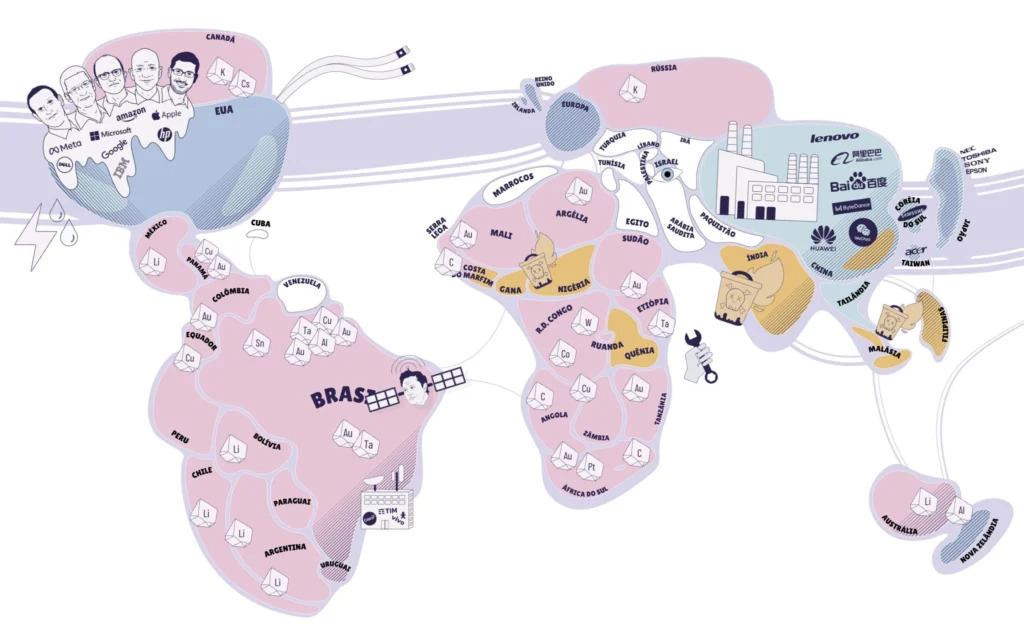
Additionally, the infrastructure behind these technologies—often mistakenly perceived as “dematerialized” or “artificial”—is grounded in an extractivist capitalist model that disregards the ecological impacts of its life cycle. This includes the extraction of conflict minerals and rare earth elements, massive energy consumption, and the billions of liters of water required to cool data centers (Valdivia, 2025).
A crucial ethical issue is the predominance of technological solutionism, which often assumes that technology is inherently superior for addressing complex social problems, thereby dismissing other forms of knowledge. This techno-deterministic perspective regards quantification and formalization as morally superior to any other form of understanding or social approach.
Critical digital education and literacy are essential for generating alternatives to techno-deterministic digitalization processes and to systems designed for corporate profit, surveillance, and the maximization of engagement metrics. Critical consciousness—a concept rooted in Paulo Freire’s ideas on political mobilization and popular education—is of vital importance in the design of technologies and infrastructures because it enables technical professionals to adopt a multidimensional perspective, and to develop an informed awareness of the complexity of socio-technical systems. This awareness is crucial for recognizing how a purely technical worldview tends to regard other humanistic disciplines as imprecise, and how it can lead to the false belief that technology itself is a neutral solution to social problems.
By developing critical consciousness, the various actors participating in the Internet ecosystem—including those in positions of privilege (e.g., operators, researchers, developers, and public policy designers)—are compelled to recognize and acquire the knowledge necessary to transform unjust social processes and work toward positive structural change (Malik & Malik, 2021). This critical practice leads to participatory paradigms that value the lived experiences of all people, seeking to build knowledge collectively in order to transform the world. In this sense, the central aim of critical digital education and literacy should not be merely the training of future workers for the technology industry, but rather cultivating critical awareness across the population about how technologies are embedded in power relations, enabling citizens to see themselves as creators and designers of technologies rather than merely users (Ochigame, 2025).
The FRIDA Program has played a fundamental role in funding inclusion initiatives that foster digital education and literacy in Latin America, prioritizing populations most affected by structural inequalities (e.g., women, Indigenous peoples, youth, and rural communities) and adapting to the needs and cultural diversity of local contexts. Among the notable digital inclusion initiatives is the work of New Sun Road in Guatemala, which supported training in digital skills for Maya women leaders in Community Digital Centers implemented in rural areas, producing tutorials in Qʼeqchiʼ and Chuj to overcome language barriers and facilitate socioeconomic inclusion. The “Tec Para Todos” project by PSYDEH in Mexico offered digital literacy and entrepreneurship workshops for Indigenous women affiliated with cooperatives in the Sierra Otomí–Tepehua–Nahua region. Meanwhile, the Foundation InternetBolivia.org designed an “Intercultural Digital Inclusion Curriculum Framework” to support public policies on digital literacy through a process that involved intersectoral dialogue and validation with rural and urban communities in Bolivia. Additionally, FRIDA has supported cultural preservation and the digital rights of local communities through projects such as InDigital by Surco A.C. in Oaxaca, which promotes access to information on digital security in Indigenous languages, and the Okamasüei initiative of the Sulá Batsú cooperative in Costa Rica, which helps Cabécar women develop digital skills to protect their ancestral knowledge.
Conclusion: Ethical and Democratic Digital Innovation
The deployment of a truly open, free, and secure Internet requires rethinking its technical and social foundations, promoting an ethic-oriented approach toward the public interest, and strengthening community-based and decentralized initiatives that restore the democratic and plural character of the network. It is essential to counteract the trend toward the privatization of infrastructures by developing open standards, democratic governance frameworks, and community connectivity projects. Robust, inclusive, and multilateral governance is a necessary condition for maintaining an open, secure, and inclusive Internet. This involves establishing institutional frameworks that balance power among governments, companies, academia, civil society, and technical communities, while ensuring the protection of digital rights and the public good.
As demonstrated by LACNIC’s experience in Latin America and the Caribbean, it is possible to implement participatory governance of socio-technical systems guided by the public interest. Through a model that promotes the participation of multiple stakeholders (e.g., Internet service providers, universities, governments, private-sector actors, and civil society), together with the development of policy through a bottom-up process, consensus-based rules for resource administration can be achieved. LACNIC has acted as an innovative platform for cooperation, enabling academic, commercial, and civil society actors to work together as a diverse technical community to build capacities and develop projects that respond to the specific needs of local contexts while adapting to the rapid transformations of the global digital ecosystem.
Today, digital innovation cannot be understood solely as a technical or economic process but rather as a profoundly social and political phenomenon that requires an ethical vision of technological development and multidimensional inclusion. The persistence of access gaps, the unequal distribution of capacities, and the concentrated control of digital infrastructure have shown that innovation without inclusion can reproduce and intensify existing inequalities. The present and future development of sustainable digital infrastructures must place public and democratic interest at the center of their design and operation, recognizing that technology is not inherently neutral (Ochigame, 2025). It is imperative to reimagine and build alternatives—public-interest infrastructures—intentionally designed to serve the collective good and grounded in values such as democracy, inclusion, diversity, transparency, accountability, and technological sovereignty. Only through a combination of inclusive policies, international cooperation, critical awareness, and ethical technological design will it be possible to create and sustain a truly open, stable, and secure Internet.
Gómez Navarro, D. A., Alvarado López, R. A., Martínez Domínguez, M., & Díaz de León Castañeda, C. (2018). La brecha digital: una revisión conceptual y aportaciones metodológicas para su estudio en México. Entreciencias: Diálogos en la Sociedad del Conocimiento, 6(16), 49-64. https://doi.org/10.22201/enesl.20078064e.2018.16.62611
Lombana-Bermudez, A. (2018). La evolución de las brechas digitales y el auge de la Inteligencia Artificial (IA). Revista Mexicana De Bachillerato a Distancia, 10(20), 17–25. https://doi.org/10.22201/cuaed.20074751e.2018.20.65884
Ochigame, R. (2025). Informática do oprimido. Editora Funilaria. Sao Paulo.Valdivia, A. (2025). The supply chain capitalism of AI: a call to (re)think algorithmic harms and resistance through environmental lens. Information, Communication & Society, 28(12), 2118–2134. https://doi.org/10.1080/1369118X.2024.2420021
The views expressed by the authors of this blog are their own and do not necessarily reflect the views of LACNIC.