If you’re looking for a snapshot of the Latin American telecommunications landscape going into 2026, look no further than what’s going on in Brazil. As the largest regional economy, Brazil’s telecom market influences the direction of regional markets—and there’s a lot to take note of.
Using our own data and analysis, and with input from our telecom industry contracts in Latin America, we’ve summarized what you need to know about the telecom industry in Brazil as we look to 2026.
(Free access, no subscription required)
Read on to learn about:
The rapid growth of data centers across Brazil, with a focus on emerging hubs, and driving forces such as reliable energy, government incentives, and subsea cable proximity.
Price erosion in Brazil’s wholesale market for backbone connectivity and IP transit.
The increasing importance of digital sovereignty in network infrastructure, and considerations for diverse routing of submarine cables and alternative satellite connectivity solutions.
More data centers, in more locations
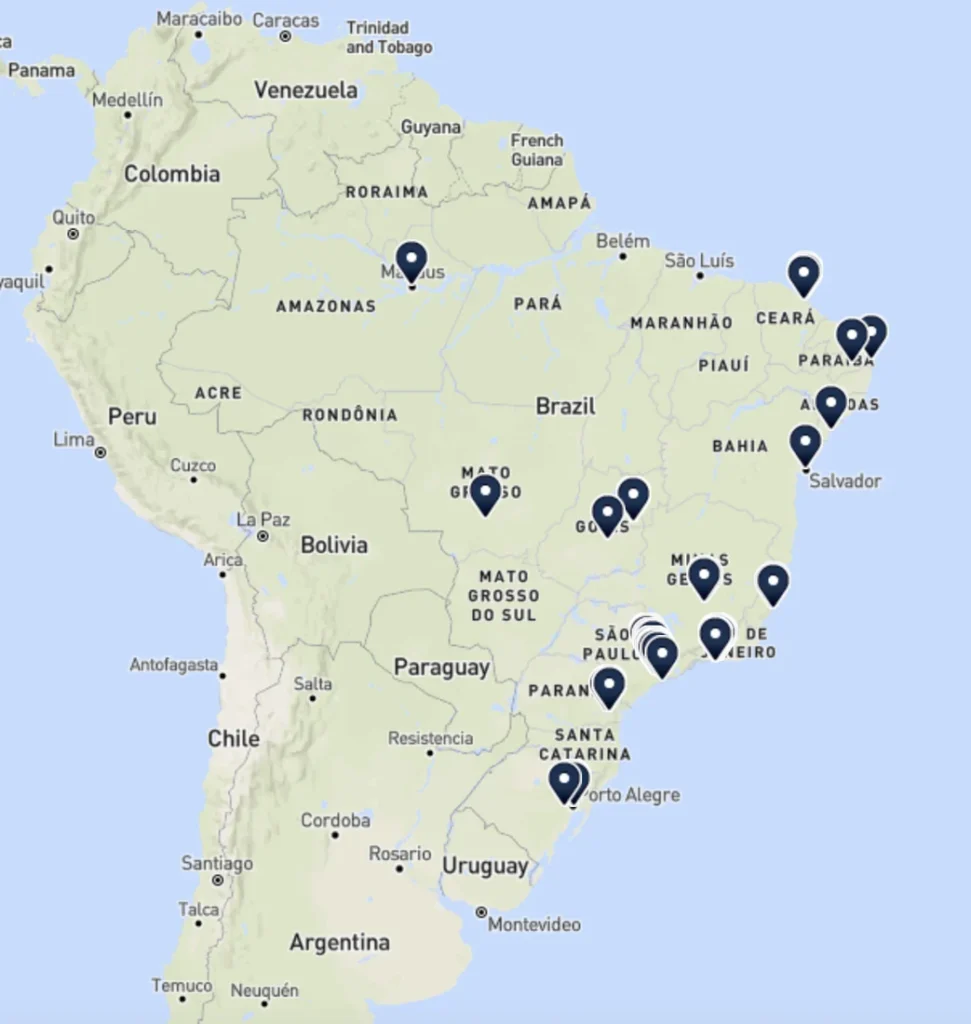
According to our Data Center Research Service platform, Brazil is currently home to 112 data centers. But that number is quickly growing, with a range of companies looking to open new facilities in the near future.
Map of current data centers in Brazil. Source: TeleGeography’s Data Center Research Service
Read on to learn about:
The rapid growth of data centers across Brazil, with a focus on emerging hubs, and driving forces such as reliable energy, government incentives, and subsea cable proximity.
Price erosion in Brazil’s wholesale market for backbone connectivity and IP transit.
The increasing importance of digital sovereignty in network infrastructure, and considerations for diverse routing of submarine cables and alternative satellite connectivity solutions.
More data centers, in more locations
According to our Data Center Research Service platform, Brazil is currently home to 112 data centers. But that number is quickly growing, with a range of companies looking to open new facilities in the near future.
Map of current data centers in Brazil. Source: TeleGeography’s Data Center Research Service
Many of the planned data centers in Brazil will be constructed in a familiar location: São Paulo. The greater metropolitan area of São Paulo has historically served as a hub for data centers—and related connectivity—within Brazil and Latin America. We expect this to remain true for the foreseeable future. But as the workload on São Paulo’s network keeps rising, other cities are jockeying for investment to decentralize some of the expected growth in the country.
Outside of São Paulo, Fortaleza has emerged as an increasingly attractive location for new data centers to be constructed. Contacts we spoke with note that several factors help explain this, including a reliable energy grid, governmental incentives, and proximity to multiple subsea cables.
Another city that has repeatedly been mentioned is Porto Alegre. This comes after Meta and V.tal announced plans to extend the Malbec system to land there. According to TeleGeography’s submarine cable map, this would be the first subsea system to arrive in Porto Alegre, potentially sparking new investment in data centers throughout the surrounding area.
Other Brazilian cities we have heard discussed include Recife, Natal, Manaus, and Brasilia. When evaluating potential sites for network expansion, factors like energy availability, environment impact, and proximity to submarine cable landing stations.
Transport and IP price erosion
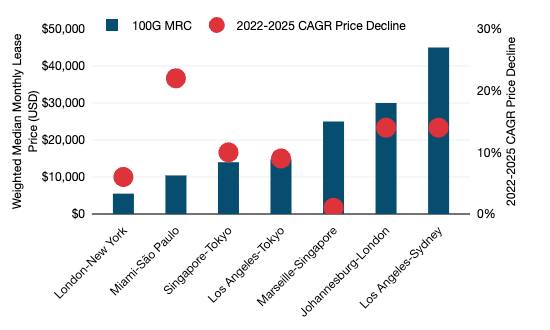
Another topic we have been paying attention to is a familiar one: price erosion. Specifically in the wholesale market, the cost of backbone connectivity has plummeted in Brazil. That’s especially true in major markets like São Paulo where strong competition and abundant supply have pushed prices down in recent years.
Weighted Median 100 Gbps Wavelength Prices & CAGR Price Decline on Global Routes
In the above figure, you can see pricing from our Wavelengths Pricing Database to help visualize this point. Each bar represents the weighted median monthly lease price for 100 Gbps wavelengths on select routes around the world, with the red bubbles showing price erosion from 2022-2025. Toward the left is Miami–São Paulo, where the weighted median price for 100 Gbps was $10,400 in Q2 2025, a 22% drop since 2022. We’ve recently heard even more aggressive quotes, with some contacts reporting as low as $5,000 for 100 Gbps on this main route between Brazil and the United States.
Similar to transport, IP transit prices have also become extremely competitive in Brazil. We typically hear carriers report flat pricing approaches in Brazil’s top three connectivity hubs of São Paulo, Rio de Janeiro, and Fortaleza. And across all those markets, we have been told that prices have fallen as low as $0.10/Mbps for a 10 GigE port.
According to our IP Transit Pricing Database, the weighted median price for a 10 GigE port in São Paulo was $0.30/Mbps in Q2 2025. Compare that to five years ago, when our weighted median price for a port in São Paulo of the same capacity had a weighted median price of $1.04/Mbps. That’s a rate of 22% erosion, compounded annually over that time period.
The influence of geopolitics on connectivity
Whether in Brazil or elsewhere, the topic of digital sovereignty keeps coming up. As it relates to network infrastructure, two main themes stand out:
Submarine cables
Satellites
More specifically, industry stakeholders are discussing options for diverse routing of subsea systems and alternatives to U.S.-based satellite connectivity solutions.
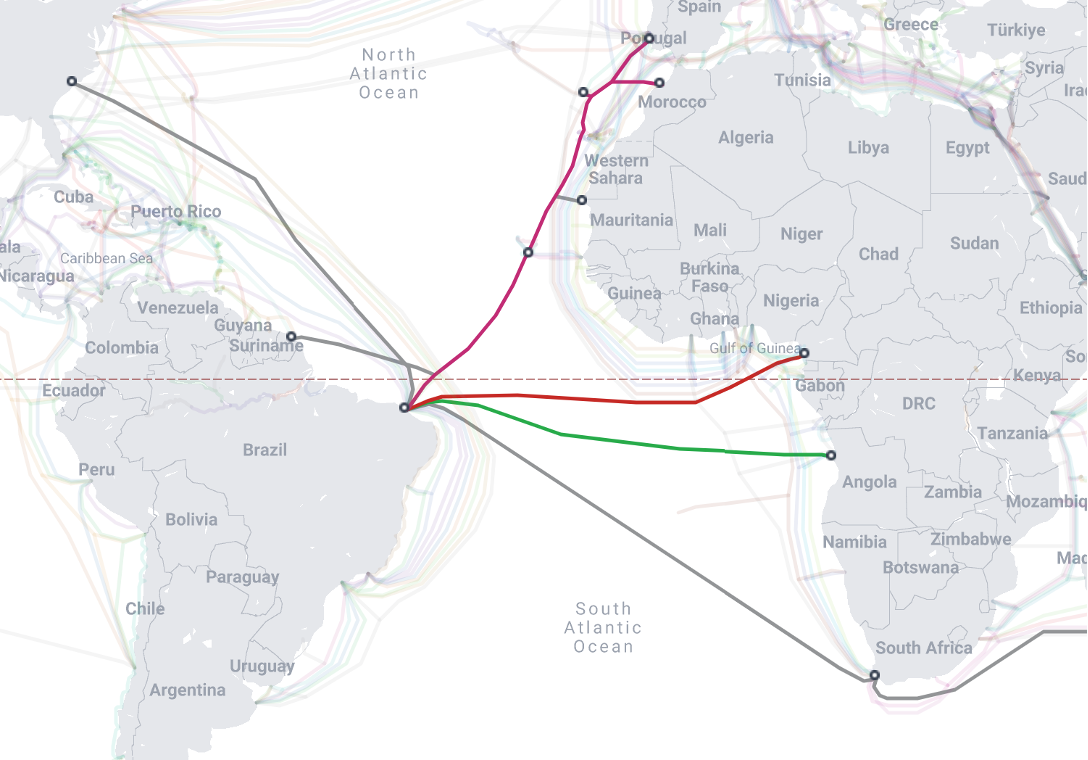
Map of existing and planned submarine cable systems connecting Brazil to Africa and Europe. Source: submarinecablemap.com
Brazil’s international connectivity has historically been to the U.S. But several subsea systems offer diverse options, including EllaLink, SACS, SAIL, and the planned Waterworth project which—while still involving a U.S. landing station—would create a novel route from Brazil to South Africa. Current geopolitical tensions have led many in the telecom industry to reconsider who owns the underlying infrastructure, which countries it connects to, and how to mitigate any potential risk.
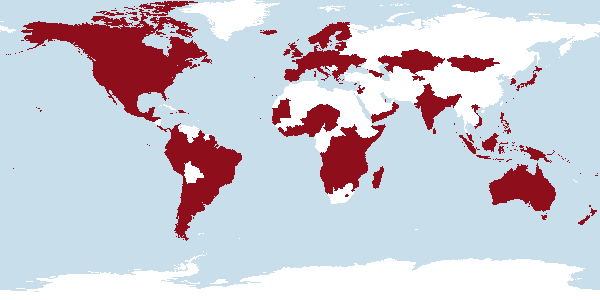
Similar to subsea cables, those interested in satellite connectivity have increasingly asked what options exist that support a given country’s goals of data sovereignty. Much of this attention is directed toward Low Earth Orbit (LEO) satellites, where the only active commercial constellations are U.S.-based Starlink and Eutelsat’s OneWeb, a European company.
A common conversation we heard regarding satellites begins with the question, “how can we connect the unconnected?” The answer to this question, in terms of data security and infrastructure management, can become complicated in many parts of the world, including in Brazil.
Map of countries where Starlink services are currently commercially available. Source: TeleGeography’s GlobalComms Database.
The views expressed by the authors of this blog are their own and do not necessarily reflect the views of LACNIC.