Cybersecurity in the Age of The Cloud and Artificial Intelligence
October 28, 2025
The rise of artificial intelligence marks another major turning point in the history of technology. Just as the sound of a dial-up modem once announced the arrival of the Internet in homes during the 1990s, AI has now quietly woven itself into our everyday lives—so seamlessly that many people can’t even recall when it first became part of their routines.
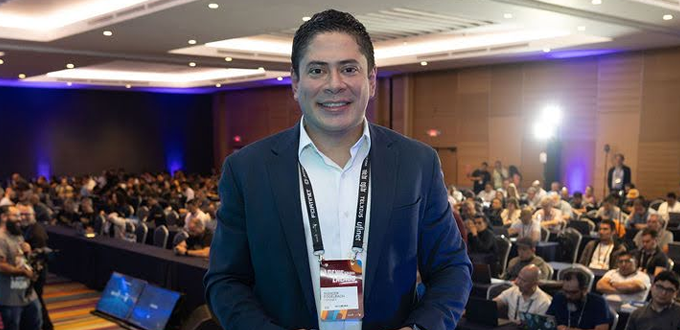
Fogelbach referenced Gartner’s well-known “hype cycle,” which describes the maturity path of technologies—from the initial wave of excitement to their practical adoption. “Back in 2013, machine learning appeared on that curve as a promising yet uncertain technology. Ten years later, it’s no longer there; it has become a natural part of our lives, and its place has been taken by generative artificial intelligence,” he explained.
In a lively and interactive presentation, Fortinet’s Systems Engineering Manager used playful examples—such as identifying animals by their attributes—to illustrate how algorithms learn and how AI adds context, not just data.
(Free access, no subscription required)
“It’s not enough to know it has long ears and a short tail—you need to understand whether we’re talking about a real rabbit, a stuffed toy, or a cartoon character,” he joked, highlighting the difference between recognition and understanding—two abilities that AI is only beginning to master.
Attackers Are Learning Too
In the field of cybersecurity, the rise of artificial intelligence has two sides. On one hand, it allows manufacturers and experts to identify threats with greater speed and accuracy; on the other, it is also empowering attackers.
“Cybercriminals are using artificial intelligence to create more disruptive attacks, automate vulnerability scanning, and design phishing campaigns that are far more convincing,” warned Fogelbach. The era of the old “Nigerian prince” email is over —today’s scams are personalized messages generated by artificial intelligence that mimic the tone and writing style of a boss or coworker.
“It’s not enough to know it has long ears and a short tail—you need to understand whether we’re talking about a real rabbit, a stuffed toy, or a cartoon character,” he joked, highlighting the difference between recognition and understanding—two abilities that AI is only beginning to master.
Attackers Are Learning Too
In the field of cybersecurity, the rise of artificial intelligence has two sides. On one hand, it allows manufacturers and experts to identify threats with greater speed and accuracy; on the other, it is also empowering attackers.
“Cybercriminals are using artificial intelligence to create more disruptive attacks, automate vulnerability scanning, and design phishing campaigns that are far more convincing,” warned Fogelbach. The era of the old “Nigerian prince” email is over —today’s scams are personalized messages generated by artificial intelligence that mimic the tone and writing style of a boss or coworker.
Deepfakes—AI-manipulated images, audio, or videos—mark a new frontier of deception. Fogelbach shared the case of an executive who nearly transferred funds after receiving a fake call featuring what seemed to be his superior’s voice. “We now have to ask questions that challenge artificial intelligence,” he advised. “If the conversation can’t recall something personal, it’s probably not real.”
According to estimates supported by AI-based tools, the effectiveness of phishing attacks has increased by 50% in recent years due to the use of these technologies.
The Enemy and the Weak Points
Drawing inspiration from The Art of War by Sun Tzu, Fogelbach encouraged the audience to view cybersecurity as a strategic battle. “The first step is knowing what we want to protect—our digital assets. The next is understanding the adversary and recognizing our own vulnerabilities,” he said.
Latin America faces two major challenges: a shortage of specialized talent—an estimated 700,000 cybersecurity positions remain unfilled across the region—and severe technological fragmentation, with too many tools that don’t communicate with each other. “It’s an operational nightmare: multiple consoles, different languages, and a lack of unified visibility,” he explained.
Fortinet, like other security providers, has been using artificial intelligence for over a decade. Initially, it was applied to detect patterns in malicious code; later, to automate incident response; and now, to enable natural interaction with security platforms through generative AI.
“The future isn’t about replacing human experts—it’s about enhancing their defensive capabilities,” he emphasized. He explained that AI systems should work hand in hand with analysts, integrated into Threat Intelligence Centers that connect data and anticipate potential attacks.
Integration, Coordination, and Culture
To conclude, Fogelbach emphasized that an effective cybersecurity strategy relies on much more than technology alone. “We need culture, coordination, and integrated tools. It’s not about having 18 different platforms—it’s about making sure they communicate with one another and enable a quick response to any threat,” he said.
As attackers continue to automate their operations and digital environments become more dispersed—spanning the cloud, data centers, and remote devices—cybersecurity requires a comprehensive approach.
“Artificial intelligence is here to stay,” Fogelbach concluded. “The real difference will depend on who uses it better: the attackers or the defenders.”