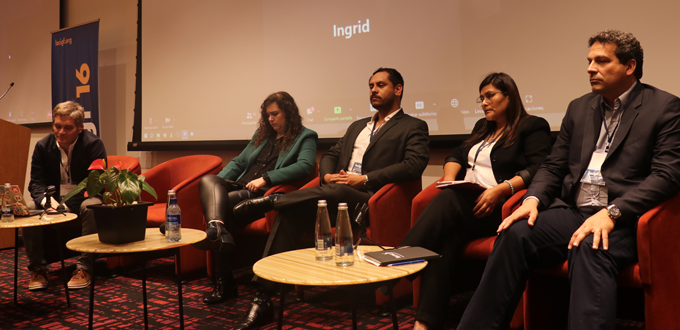
This past 5 December, I had the opportunity to moderate the closing panel of the 16th edition of LACIGF, “Internet Blocking: Reasons, Consequences, and How to Avoid Fragmentation.”
The panel included the participation of prominent specialists on the subject, with whom we explored the reasons and consequences of website blocking on the Internet.
During the panel, IGF MAG member Bruna Martins dos Santos referred to Internet fragmentation as a “complex issue” defined as the “intentional or unintentional effects of political decisions, products, modifications to protocol models or others that can have a negative impact on end users.” She called for discussion among all the actors involved in this chain of decisions so that the Internet can continue to be open, interconnected, and interoperable.
(Free access, no subscription required)
Juan Carlos Lara of Derechos Digitales then stressed the need to think about website blocking as an instance that “affects freedom of expression,” which involves much more than simply expressing one’s opinion, including the ability to “seek, find, and disseminate information.” He also linked website blocks with the inability to associate with others, conduct economic activities, access education, or participate in various spheres of social activity. He stressed that, even if a website block is legitimate, “the measure may be disproportionate” and can potentially “encroach on other issues that are part of legitimate public life.”
In this sense, Paloma Szerman of WhatsApp shared the case of the application, which was blocked throughout Brazil because of a court order resulting from an alleged refusal to intercept communications that had allegedly taken place on the platform. “The app is end-to-end encrypted; no one who is not there can participate in the conversation. This is how fundamental rights are guaranteed,” she said. Thus, she questioned the proportionality and effectiveness of this type of order, given that they could potentially create social upheaval or hinder the daily and economic functioning of a society or communications.
German López Ardila, a member of Youth LACIGF who is participating in LACNIC’s Líderes Program, shared the conclusions of his research on how some bills were under discussion in the Colombian Congress with some potential to block content, censor or stop the flow of legitimate content between 2018-2022. His study found that the reasons for the blocking attempts involved damage to reputation, misuse of copyright, measures to protect children and adolescents, sexual crimes, fake news, or consumer protection. He noted that “although the intentions were in good faith, the blocks turned out to be rather inefficient measures.”
Juan Carlos Lara of Derechos Digitales then stressed the need to think about website blocking as an instance that “affects freedom of expression,” which involves much more than simply expressing one’s opinion, including the ability to “seek, find, and disseminate information.” He also linked website blocks with the inability to associate with others, conduct economic activities, access education, or participate in various spheres of social activity. He stressed that, even if a website block is legitimate, “the measure may be disproportionate” and can potentially “encroach on other issues that are part of legitimate public life.”
In this sense, Paloma Szerman of WhatsApp shared the case of the application, which was blocked throughout Brazil because of a court order resulting from an alleged refusal to intercept communications that had allegedly taken place on the platform. “The app is end-to-end encrypted; no one who is not there can participate in the conversation. This is how fundamental rights are guaranteed,” she said. Thus, she questioned the proportionality and effectiveness of this type of order, given that they could potentially create social upheaval or hinder the daily and economic functioning of a society or communications.
German López Ardila, a member of Youth LACIGF who is participating in LACNIC’s Líderes Program, shared the conclusions of his research on how some bills were under discussion in the Colombian Congress with some potential to block content, censor or stop the flow of legitimate content between 2018-2022. His study found that the reasons for the blocking attempts involved damage to reputation, misuse of copyright, measures to protect children and adolescents, sexual crimes, fake news, or consumer protection. He noted that “although the intentions were in good faith, the blocks turned out to be rather inefficient measures.”
Likewise, Alvaro Rueda of the Colombian Department of Digital Transformation shared that “there is no bill or initiative in Colombia which seeks to regulate the activity other than the laws that protect children and adolescents or copyright.” He did highlight that the Cybersecurity Agency will be created due to the need to strengthen cyber defense, which requires more data to support informed decision-making.
In turn, Esteban Lescano of LAC-ISP highlighted that “the first thing we need to consider is that access is the very nature of an Internet Service Provider (ISP), so suspending or blocking access prevents or restricts its DNA.” He explained that most ISPs do not have a legal department, so the technical implementation of blocking orders requires very precise and non-generic orders. He also stressed that once a block is implemented, “it is not reviewed and does not prevent the content from being available.” However, users perceive an error in the service that may damage the provider’s reputation.He said that the ISP has no responsibility for the effectiveness of the block, nor can it actively monitor what a user does, and added that website blocks “have a hidden cost” that includes time, as well as the human and technological resources invested for the block to remain active.
In a similar sense, Lia Solis of the Latin American and Caribbean Network Operators Group (LACNOG) explained that they must analyze “the entire Network to see where to implement the block,” which is never a simple task, and its side effects include “the possibility of blocking other applications,” damaging both the client and the operators. To conclude, she emphasized that the judicial sphere “requires much more precise technical knowledge.”
This type of open discussions and exchanges between the different stakeholders are necessary in the region, where website blocking is increasingly being used as a tool to combat various online activities.
The views expressed by the authors of this blog are their own and do not necessarily reflect the views of LACNIC.