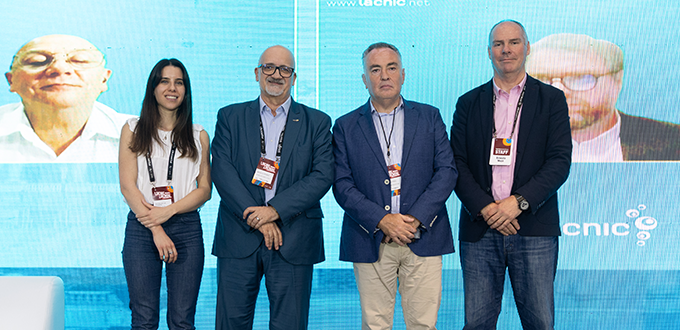
A panel on Website and IP Blocking as a Strategy against Content Piracy was organized as part of the LACNIC 44 event. The session was moderated by Rocío de la Fuente (LACTLD) and brought together technical, legal, and public policy experts to analyze the scope, limitations, and impacts of a practice that is gaining ground in several countries in the region.
The panel addressed the expansion of domain and IP address blocking as a way to combat the unauthorized distribution of audiovisual and sports content on the Internet. While the panelists agreed that piracy causes significant economic harm, they differed on the technical effectiveness, legal proportionality, and potential effects of these measures on Internet stability and openness.
Between Protection and the Risk of Overregulation
Jorge Bacaloni, Regional Anti-Piracy Manager at DirecTV Latin America and president of Alianza, the Alliance Against Audiovisual Piracy, acknowledged that, while controversial among the technical Internet ecosystem, website and IP blocking is considered an effective tool to combat audiovisual piracy. He argued that piracy not only involves violations of intellectual property rights but can also serve as a gateway for other crimes such as illegal gambling, child pornography, or malware distribution. In this sense, Bacaloni stated that blocks are a legitimate instrument within a broader set of measures. He rejected the idea that they “break the Internet” and compared their use to measures against other serious crimes such as drug trafficking or child exploitation, where blocking is routinely implemented without questioning their validity or effectiveness.
(Free access, no subscription required)
Technical and Operational Challenges
Next, LAC-ISP President Basilio Rodríguez Pérez explained that Internet service providers in Brazil receive multiple court orders requiring them to block IP addresses, domains, or URLs, which creates a significant operational burden for companies in the sector. He noted that many of these blocks are ineffective, as some affect legitimate services, while others target domains that are beyond the reach of the provider.
Rodríguez also highlighted that the use of VPNs reduces the effectiveness of these measures and recalled cases, such as the temporary blocking of Twitter (now X) in Brazil, which many users easily bypassed. Although mechanisms with defined timeframes have been implemented, technical challenges and a lack of understanding of the complexity of the process among judicial authorities persist.
The Case of Uruguay
From a regulatory perspective, Gonzalo Balseiro, president of the Uruguayan Communications Services Regulatory Unit (URSEC), described the three types of blocks that currently apply in the country, each with a different origin and nature.
Technical and Operational Challenges
Next, LAC-ISP President Basilio Rodríguez Pérez explained that Internet service providers in Brazil receive multiple court orders requiring them to block IP addresses, domains, or URLs, which creates a significant operational burden for companies in the sector. He noted that many of these blocks are ineffective, as some affect legitimate services, while others target domains that are beyond the reach of the provider.
Rodríguez also highlighted that the use of VPNs reduces the effectiveness of these measures and recalled cases, such as the temporary blocking of Twitter (now X) in Brazil, which many users easily bypassed. Although mechanisms with defined timeframes have been implemented, technical challenges and a lack of understanding of the complexity of the process among judicial authorities persist.
The Case of Uruguay
From a regulatory perspective, Gonzalo Balseiro, president of the Uruguayan Communications Services Regulatory Unit (URSEC), described the three types of blocks that currently apply in the country, each with a different origin and nature.
The first has been in effect since 2017 and applies to illegal gambling sites.
The second was implemented in 2020 and aims to prevent the illegal transmission of subscription television services. It authorizes preventive or punitive blocking of IP addresses, domains, or URLs for up to 30 days.
The third was established in 2022 and allows live sports broadcasts to be disabled in real time, with administrative injunctions issued by URSEC.
Balseiro stressed that each type of block follows specific procedures and that the regulator’s actions seek to balance the protection of rights with the proper enforcement of regulations.
Technical and Regional Perspective
In turn, LACNIC Executive Director Ernesto Majó emphasized that the organization approaches the issue of blocking from a strictly technical point of view. “Our perspective is focused on ensuring the operation of the Internet, which is our primary concern,” he stated. Majó explained that LACNIC acknowledges the issues related to piracy but warned about the potential consequences of the widespread implementation of blocking without adequate technical precision.
He noted that similar initiatives are being implemented in different countries across the region with varying results. “Our concern is fundamentally technical, as these measures can have temporary or even permanent impacts on network operations,” he said. He also reiterated that LACNIC’s mission is to maintain a reliable registry of numbering resources and to ensure their availability for the Internet community.
Legal Framework and Effectiveness
From the operators’ perspective, Sergio Píris, Manager of Criminal Affairs, Technology Crimes, Anti-Piracy, and Judicial Requirements at Telecom Argentina, argued that piracy is a business model that generates significant revenue and, in many cases, is related to organized crime. He stated that in Argentina, administrative blocking without a court order is unacceptable and that, while necessary, judicial procedures pose operational challenges and reveal limited technical understanding on the part of the authorities.
Píris stressed the need to review and strengthen the legal framework to ensure a balance between the protection of rights and the legal certainty required by the companies that must implement the measures.
Toward a Balanced, Multistakeholder Approach
The debate made it clear that website blocking is a controversial measure. The panelists agreed on the need for proportional mechanisms that include judicial oversight, time limits, and transparency in their implementation.
They also emphasized the importance of ongoing dialogue among authorities, operators, rights holders, the technical community, and civil society to develop balanced regulatory frameworks.
The session concluded with a summary by moderator Rocío de la Fuente: blocking can be a legitimate tool in certain cases, but it is not a structural solution to the issue of piracy. “The response must be comprehensive, coordinated, and respectful of the principles that uphold the open architecture of the Internet.”
The views expressed by the authors of this blog are their own and do not necessarily reflect the views of LACNIC.