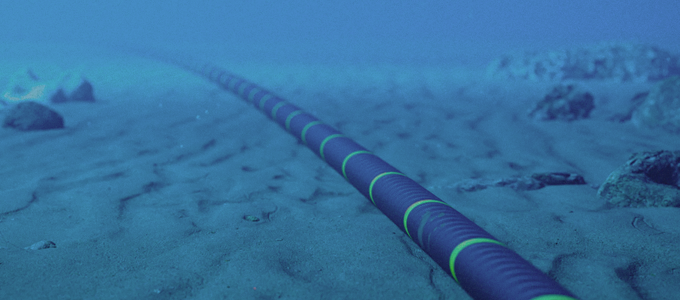
More than 550 undersea Internet cables connect continents with their countries, continents with islands, islands with each other, or various points along a coastline. These submarine cables are Internet interconnection sites that have coastlines but do not share land borders, for example between two countries such as Brazil and Portugal, where a direct cable links both countries.
A submarine communications cable is a cable laid on the seabed between land-based stations to carry telecommunications signals across stretches of ocean and sea.
The world’s existing submarine cables are critical telecommunications infrastructure and carry approximately more than $15 trillion in daily transactions. Thus, when a submarine cable arrives in a country, it is usually followed by multiple companies with multinational operations. In subsequent years, the country’s GDP usually increases by 2% or 3%.
(Free access, no subscription required)
Cables originate in every continent, with Singapore, Egypt, Marseille, Tokyo, Fortaleza, Oman, Malaysia, Hong Kong, and Mumbai being the main hubs worldwide.
Submarine cables currently carry around 98% of the world’s intercontinental data traffic.
In the region. The most important submarine cables in Latin America are Curie (Google), Firmina (Google), Giganet-1 (consortium), PAN-AM (Lumen), AMX-1 (Claro), Monet (consortium), Seabras-1 (Seaborn), Tannat (consortium), Junior (Google), SAM-1 (Telxius), Brusa (Telxius), SACS (Angola Cables), Sail (consortium), Malbec (consortium), and EllanLink (EllaLink).
Cables originate in every continent, with Singapore, Egypt, Marseille, Tokyo, Fortaleza, Oman, Malaysia, Hong Kong, and Mumbai being the main hubs worldwide.
Submarine cables currently carry around 98% of the world’s intercontinental data traffic.
In the region. The most important submarine cables in Latin America are Curie (Google), Firmina (Google), Giganet-1 (consortium), PAN-AM (Lumen), AMX-1 (Claro), Monet (consortium), Seabras-1 (Seaborn), Tannat (consortium), Junior (Google), SAM-1 (Telxius), Brusa (Telxius), SACS (Angola Cables), Sail (consortium), Malbec (consortium), and EllanLink (EllaLink).
The size and length of these cables depend on whether they are regional or intercontinental. An example of a regional cable is JUNIOR, a Google-owned 390-km subsea cable connecting Rio de Janeiro to São Paulo in Brazil, while an example of an intercontinental cable is 2Afric, a cable stretching 37,000 kilometers. Major cables in the region include Tannat, a 2,000-km cable co-owned by Antel and Google connecting Maldonado (Uruguay) with Praia Grande (São Paulo).
Complex installation. Submarine cables are technically complex. They are comprised of multiple high-tech components that require engineering expertise for their design, testing, operation, and maintenance. They also involve a great deal of administrative complexity, including multinational restrictions, long-term supplier relationships, and geopolitical considerations. A successful project requires specific skills in various areas, such as maritime operations, legal, optical engineering, finance, licensing, planning, negotiations, and others. The time scale is also significant.
Typically, six to 24 months go by from conception to contract. Construction ranges from 12 to 24 months and a cable can remain in operation for 25 years (technically) and 17 years (commercially).
Modern submarine cables use fiber optics technology. The lasers at one end of a cable dispatch signals at extremely high speeds through thin glass fibers toward receivers at the other end. These glass fibers are wrapped in layers of plastic —and sometimes stranded steel wire— for protection.
For most of their undersea journey, modern cables used to transmit data, voice, and video are as thick as a can of soda and weigh about 1.3 tons per square kilometer. The filaments that carry light signals (optical fiber) are extremely thin, approximately the same diameter as a human hair. These fibers are coated with a few layers of insulation and protection. Cables laid closer to the shore have extra layers of shielding for added protection.
Present and future. At the beginning of 2023, 552 subsea cables and 1,444 cable landing stations (CLS) were active or under construction. The total number of active cables is constantly changing as new cables are brought into service and older cables are retired.
Multiple cables are currently being built with a total global budget of 4 billion dollars.
Do subsea cables break? Most of the damage to submarine cables is caused by human activity, mostly fishing and anchoring. In such cases, the cable recovery process is complex and slow: recovery can take more than 60 days, as it depends on various factors such as the repair permit in a country’s specific exclusive economic zone (EZZ). Remotely operated underwater vehicles (ROV) cannot operate in deep waters due to the increased pressure, so to fix a cable in deep water, the ship must use a cutting grapnel (a small hook) to grab and cut the cable and bring the two loose ends to the surface. If necessary, one end can be hooked to a buoy and the other end pulled on board. The cable is then repaired and placed back into the ocean.
Panel within the framework of LACNIC 40 LACNOG 2023. To learn more about the subject, we look forward to seeing you at the panel on submarine cables that will be held during LACNIC 40 – LACNOG 2023. There, we will exchange knowledge, explore the latest projects, develop strategies, and help promote the industry. Prepare for an inspiring panel with lively and thought-provoking discussions, as well as new ideas and connections available to help you expand your knowledge on the topic.
The views expressed by the authors of this blog are their own and do not necessarily reflect the views of LACNIC.