At the heart of the modern Internet, Internet Exchange Points (IXPs) play a pivotal role in enhancing the efficiency, resilience, and sustainability of global connectivity. Far from being mere technical nodes, IXPs are collaborative platforms where network operators converge to exchange traffic locally. This reduces latency, improves service performance, and significantly lowers transit costs. Yet, the true value of an IXP goes beyond its technological infrastructure: it lies in a delicate equilibrium of competing interests, strategic alignment, and human relationships. The success or failure of an IXP hinges on how well this balance is understood, cultivated, and maintained.
While IXPs are fundamentally technological in nature, their effectiveness depends not only on routing capabilities, through peering platforms or Private Network Interconnects (PNIs), but equally on the ability to engage and retain participating networks. Each operator must perceive clear and tangible benefits in joining a shared infrastructure. In this context, the neutrality of the IXP becomes a cornerstone. As a neutral space where all operators, regardless of size or market influence, can interconnect on equal terms, neutrality fosters trust and levels the playing field. This perceived fairness is critical in attracting and sustaining engagement across a diverse set of actors.
Launching and growing an IXP in a specific geographic area is a nuanced and often challenging process. It requires vision, persistence, and above all, trust-building. The goal is to create a stable environment where operators of all types, from small local ISPs to large international carriers, can find value in participating. Achieving this balance is neither easy nor guaranteed. It depends on reaching a critical mass of participants and managing a well-calibrated balance of interests.
(Free access, no subscription required)
A small ISP, for example, may benefit from improved access to popular content, affordable national or international transit, or simplified network architecture through a single interconnection point. Meanwhile, content providers, CDNs, and broadcasters can deliver their content closer to end users, particularly in underserved regions, optimizing performance and reducing costs. Carriers and transit providers can expand their markets by offering connectivity services to peers. Each participant plays a role that feeds into a broader ecosystem of mutual benefit.
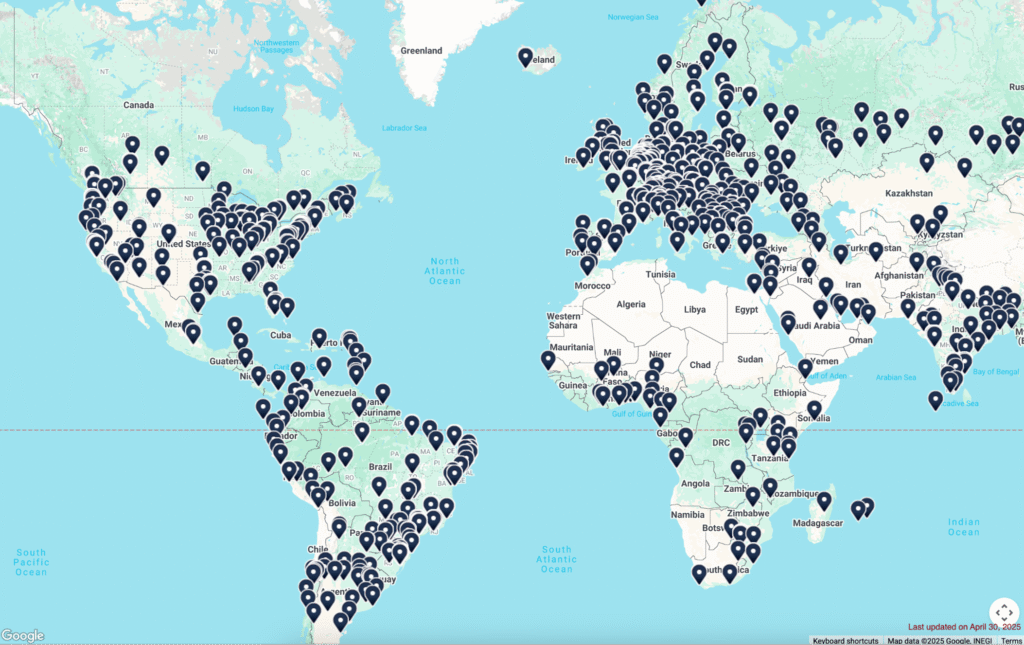
Today, there are over 1,200 active Internet Exchange Points operating across the globe, according to PeeringDB and other industry sources. This widespread presence underscores how IXPs have evolved into critical components of national and regional Internet infrastructure, far beyond their original technical purpose.
A small ISP, for example, may benefit from improved access to popular content, affordable national or international transit, or simplified network architecture through a single interconnection point. Meanwhile, content providers, CDNs, and broadcasters can deliver their content closer to end users, particularly in underserved regions, optimizing performance and reducing costs. Carriers and transit providers can expand their markets by offering connectivity services to peers. Each participant plays a role that feeds into a broader ecosystem of mutual benefit.
Today, there are over 1,200 active Internet Exchange Points operating across the globe, according to PeeringDB and other industry sources. This widespread presence underscores how IXPs have evolved into critical components of national and regional Internet infrastructure, far beyond their original technical purpose.
Another critical success factor is the underlying infrastructure in the region where the IXP is being developed. In areas with limited or outdated network infrastructure, such as insufficient fiber deployment, services remain sparse, and the motivation for operators to join diminishes. In such contexts, the first step must be to build the foundational connectivity services that act as the “roads” leading to the IXP. Without these enabling structures, attracting participation becomes exceedingly difficult. Once established, however, these pathways allow for the efficient flow of services and foster the organic growth of the IXP.
In this ecosystem, functional interdependence becomes a key driver. When the interests of participants are aligned and the platform offers evident value, it becomes easier to attract new networks. But engagement isn’t a one-time milestone, it’s a continuous process. IXPs must work actively to sustain interest, deliver ongoing value, and adapt to evolving needs. This means providing both clear operational advantages, such as cost savings and performance gains, and a dynamic, inclusive environment that promotes innovation and collaboration.
Transparency is essential to this process. IXPs must maintain consistent and open communication with their members, not just about technical developments but also regarding governance and policy changes. This transparency reinforces trust, strengthens community bonds, and helps ensure long-term participation.
In addition, IXPs should proactively facilitate networking opportunities among participants. Beyond exchanging packets, these platforms can become hubs of knowledge exchange and innovation. Organizing events, workshops, and collaborative forums can deepen engagement and open new avenues for business development and partnership.
Supporting smaller or newer operators is another critical facet. By offering technical guidance or fostering strategic partnerships, IXPs can help participants overcome challenges and maximize their capabilities. In doing so, the IXP becomes not just a traffic facilitator, but an enabler of broader ecosystem growth.
Crucially, IXPs must practice active listening. Understanding the evolving needs of the market and adapting service offerings accordingly makes the platform more attractive and responsive. Agility in responding to feedback ensures continued relevance and competitive strength.
Despite best efforts, challenges will always exist. Strategic misalignment, internal policies, or investment priorities may lead some operators to disengage. But through continuous and transparent engagement, built on mutual trust and shared value, these obstacles can be mitigated.
Ultimately, engagement in IXPs is neither linear nor simple. It requires vision, adaptability, and sustained effort. An IXP cannot thrive solely on technical merit, it must also act as a facilitator of collaboration, innovation, and trust. Establishing an IXP is not merely a technical task; it’s not just about deploying a switch and expecting networks to connect. It demands long-term commitment and the ability to align diverse interests. Engagement, infrastructure development, governance, and relationship-building are all essential components. Only by navigating these complexities can an IXP evolve into a true hub of connectivity and value creation, a cornerstone of a more robust, inclusive, and efficient Internet.
The views expressed by the authors of this blog are their own and do not necessarily reflect the views of LACNIC.