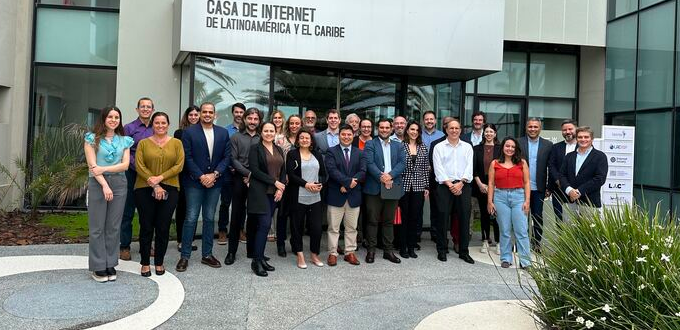
The Technical Community invited the eLAC ECLAC Working Groups on Meaningful Connectivity and Digital Economy to a workshop held at Casa de Internet for Latin America and the Caribbean (CILAC).
This meeting provided the framework for the discussion of topics such as connectivity divides and the unintended consequences of Internet blocks, as well as other topics aligned with the ultimate objective of transforming digital technologies into instruments for sustainable development.
In a theoretical introduction to how the Internet works, we explained that some of the organizations that are part of Casa de Internet for LAC —ICANN, LAC-IX, LACNOG, Internet Society, LACNIC, LACTLD, and RedCLARA— make up the regional Technical Community and are responsible for managing the technical aspects of the Internet, particularly domain names, Internet number resources (IP addresses and autonomous system numbers), and the standards for their interaction.
(Free access, no subscription required)
We stressed our commitment to an active policy of cooperation, promotion and defense of the regional community’s interests and collaborative work to generate the conditions for the Internet to become an effective instrument for social inclusion and economic development.
Christian O’Flaherty and Juan Peirano of the Internet Society explained their “50/50” project, the purpose of which is for 50% of traffic to be exchanged locally, highlighting the role of Internet Exchange Points (IXPs) in this regard. Local traffic exchange is more dynamic, flexible, and faster, all of which reduces latency and ultimately benefits users and attracts an increasing number of providers. Therefore, it is necessary for the public and the technical spheres to generate greater incentives to ensure the creation of more IXPs.
Likewise, Oscar Robles of LACNIC emphasized that premature regulation “inhibits innovation in Internet access,” particularly as it relates to connecting the 40% of the region’s population that is not yet connected. He explained how the TCP/IP protocol was created as an open protocol for multiple forms of connection and technologies, seeking to favor all possible forms of Internet innovation and evolution.
We stressed our commitment to an active policy of cooperation, promotion and defense of the regional community’s interests and collaborative work to generate the conditions for the Internet to become an effective instrument for social inclusion and economic development.
Christian O’Flaherty and Juan Peirano of the Internet Society explained their “50/50” project, the purpose of which is for 50% of traffic to be exchanged locally, highlighting the role of Internet Exchange Points (IXPs) in this regard. Local traffic exchange is more dynamic, flexible, and faster, all of which reduces latency and ultimately benefits users and attracts an increasing number of providers. Therefore, it is necessary for the public and the technical spheres to generate greater incentives to ensure the creation of more IXPs.
Likewise, Oscar Robles of LACNIC emphasized that premature regulation “inhibits innovation in Internet access,” particularly as it relates to connecting the 40% of the region’s population that is not yet connected. He explained how the TCP/IP protocol was created as an open protocol for multiple forms of connection and technologies, seeking to favor all possible forms of Internet innovation and evolution.
Robles noted that the problem is that those who are unconnected are based in difficult-to-access areas not served by major operators. He underlined that “the disconnected are not business cases,” and recalled that, in the early days of access in the 90s, most regulators leaned towards a single business model and left aside other models that today are essential for connecting the unconnected, for example, decentralized models that favor innovation such as community networks, low-Earth orbit satellites, regional Internet access providers, PPPs in Brazil, white TV spaces, and off-grid connectivity.
Finally, he mentioned that it is not about being against regulations but rather about understanding that innovative ideas are needed that often face the double challenge of “staying afloat and demonstrating their viability.” The goal of these models should be to “prioritize human and civil rights over commercial needs, and to involve the various affected stakeholders in decision-making processes.”
In this sense, Christian O’Flaherty cited the work conducted by the Working Group on Access in 2018, which already identified barriers in traditional regulation. Among other things, the document suggests reviewing the administrative barriers that can prevent the development of newcomers and working towards public policies that simplify the creation of infrastructure.
Rodrigo De la Parra of ICANN then explained the three layers of Internet governance —social and economic, logical, and infrastructure—and how solutions or decisions made at the first level can negatively affect the two others, especially the fundamental principles that govern the Internet.
In this regard, Oscar Robles stressed that normalizing website blocks in an attempt to limit an illegal action (except when dealing with crimes where people’s lives and integrity are at risk) means ignoring the consequences of a complex process.
The first reason is that Internet blocks have a significant risk of damaging third-party websites and networks, and they don’t guarantee the elimination of the illegal content or activity, as the content is not removed but rather a single access route is interrupted. This generates a complex and ineffective dynamic of “temporary patches” that creates an enormous administrative burden. In addition, it takes a long time to recover the services of affected third parties. Finally, this practice represents the gateway to the restriction of people’s freedom of expression and right to information.
Recommendations include not using Internet blocks as the first option for removing illegal content, but instead checking with all interested parties. If no other option can be found, only block the resources (the domain or the IP address) temporarily, always with the permanent advice of technical experts throughout the process.
The views expressed by the authors of this blog are their own and do not necessarily reflect the views of LACNIC.