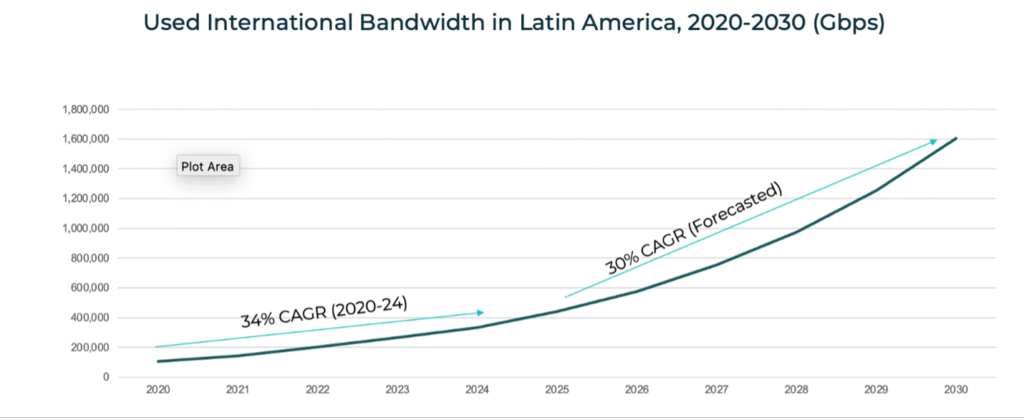
International bandwidth demand in Latin America continues to rise, although growth rates are decelerating steadily. This broadly mirrors international bandwidth demand trends seen at the global level, where annual growth has fallen below 30% in 2024. More localized content in regional hubs, like São Paulo, may have reduced the need for international capacity and thus affected demand growth. We also may be entering a new phase of network buildout in LATAM and, typically, as markets become more mature, we expect growth rates to slow down (as we have seen in Europe, for example). Even as these growth rates have dipped, aggregate demand in Latin America and the Caribbean more than tripled between 2020 and 2024.
Source: TeleGeography’s Transport Networks and Transport Networks Forecast Research Services
(Free access, no subscription required)
Content providers, the driving force for demand
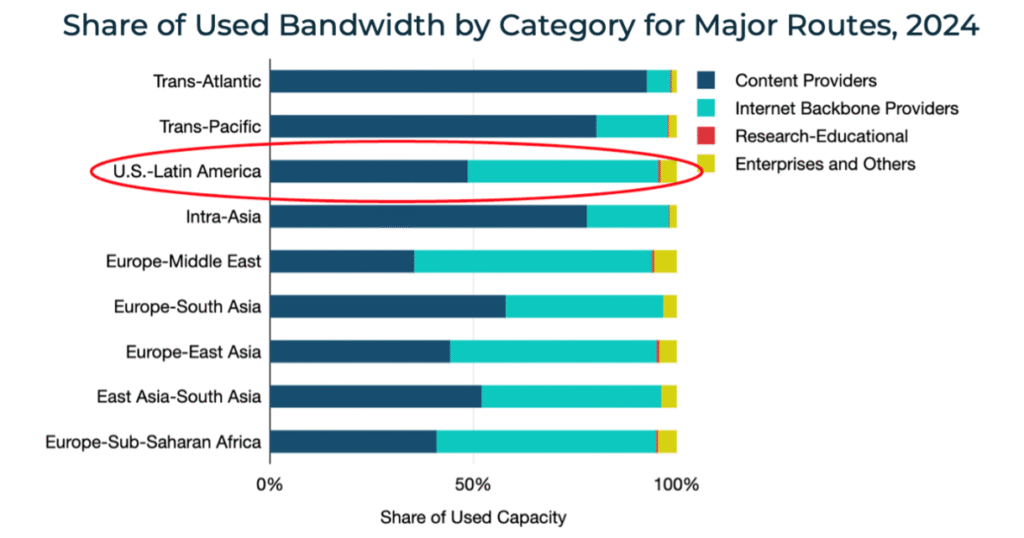
In 2024, content providers finally passed internet backbone providers to become the main source of used bandwidth on the U.S.-Latin America route. Content providers’ demand achieved an impressive 50% compound annual growth rate (CAGR) between 2020-24, reaching over 90 Tbps in 2024. For comparison, internet backbone providers had just a 21% CAGR during this time. Despite all this massive growth from content providers, it is important not to overlook the key role ISPs continue to play in LATAM. As shown in the graphic below, internet backbone providers continue to have a large share of the used bandwidth on the U.S.-Latin America route.
Source: TeleGeography’s Transport Networks Research Service
Content providers, the driving force for demand
In 2024, content providers finally passed internet backbone providers to become the main source of used bandwidth on the U.S.-Latin America route. Content providers’ demand achieved an impressive 50% compound annual growth rate (CAGR) between 2020-24, reaching over 90 Tbps in 2024. For comparison, internet backbone providers had just a 21% CAGR during this time. Despite all this massive growth from content providers, it is important not to overlook the key role ISPs continue to play in LATAM. As shown in the graphic below, internet backbone providers continue to have a large share of the used bandwidth on the U.S.-Latin America route.
Source: TeleGeography’s Transport Networks Research Service
Data Usage continues to soar
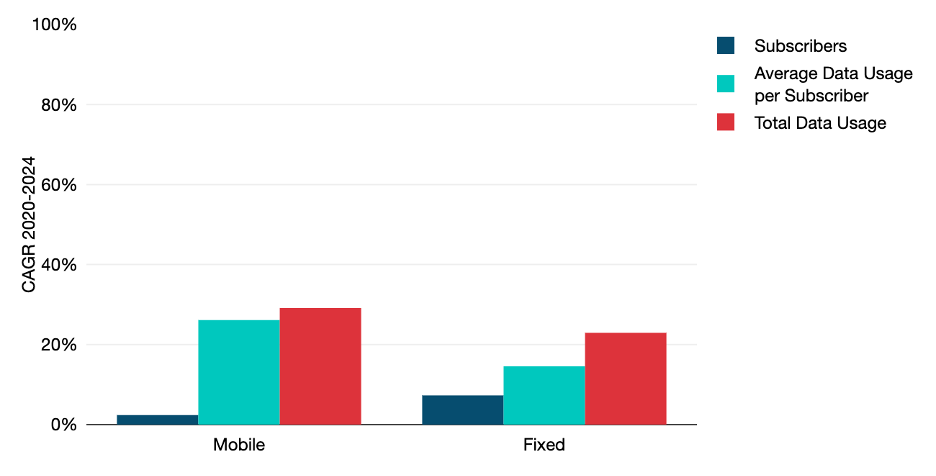
What is really driving bandwidth demand growth in LATAM? In the graph below you can see the growth in subscribers, average data usage per subscriber and total data usage for both fixed and mobile devices. The region continues to gain new subscribers at very modest rates for both fixed and mobile devices. Most of the growth is coming from a boost in the average data usage per subscriber. Mobile devices reached a CAGR of over 25% between 2020 and 2024 for average data usage per subscriber, while fixed devices achieved around a 15% CAGR during this time. As we adopt new technologies and increasingly bandwidth-intensive applications, we can expect total data usage to continue to rise even as the growth of new subscribers dries out.
Source: TeleGeography’s Transport Networks Research Service
New submarine cable projects for LATAM
Following several years of relatively few submarine cable projects in Latin America, the scenario is beginning to shift. Multiple new submarine cable systems are in the planning process, with some cables nearly ready to begin laying cable on the ocean floor.
Most of these projects will continue to provide a direct connection to the United States. TAM-1 and Firmina are the first in line; both projects are expected to enter service in 2025. The CSN-1, CSN-2 and TIKAL-AMX3 cables should be ready in 2026 and the MANTA cable in 2027. This is by no means an exhaustive list of new submarine cables in the region but helps highlight the new and exciting subsea infrastructure coming to Latin America in the near future.
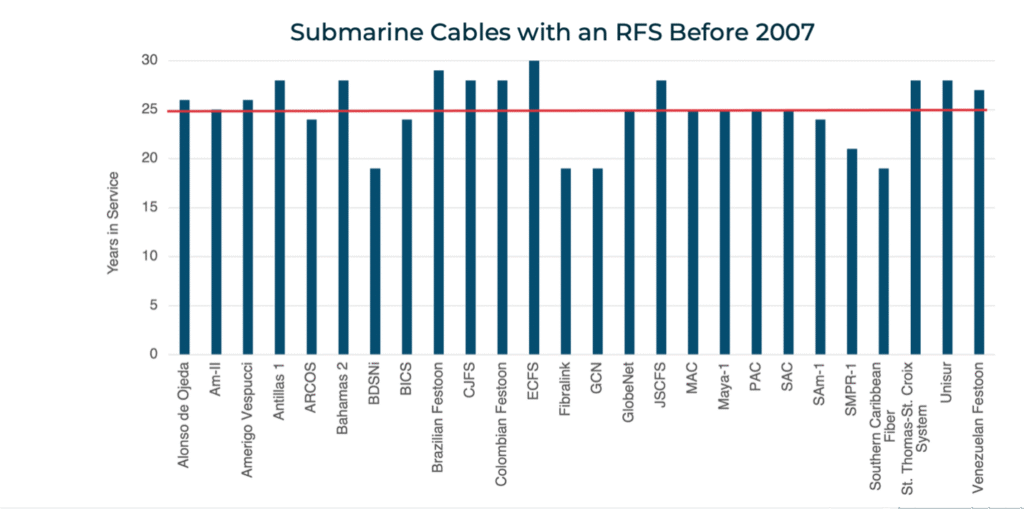
These new cables will help meet the ever-growing bandwidth demand for Latin America while also addressing the need to replace some of the older cable systems in the region. Typically, submarine cables are engineered to have a minimum design life of 25 years. The actual lifespan may differ as it is more closely tied to the cable’s economic life (determined by the cable’s revenues exceeding its costs). Still, it is important to note the number of cables in Latin America and the Caribbean that are nearing or have recently passed this 25-year threshold (see the figure below). This would suggest that by the end of this decade some of these systems will be retired and replaced.
Source: TeleGeography’s Transport Networks Research Service
This info is already making its way into our research. We recommend taking a peek at some of our latest updates to see this intel in action.
The views expressed by the authors of this blog are their own and do not necessarily reflect the views of LACNIC.