LACNIC Blog > Routing > Martians, Bogons, and RPKI Invalids: Why Organizations Should Filter Them
Martians, Bogons, and RPKI Invalids: Why Organizations Should Filter Them
July 28, 2026
Image assisted/created by AI
By Sergio Kleiman, IP Network Architect and Manager at Telefonica
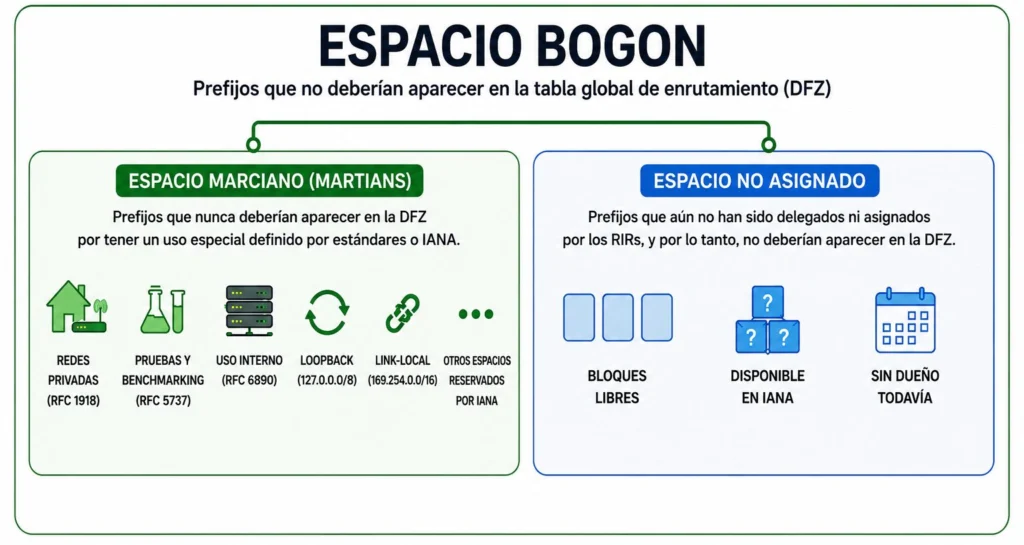
Some prefixes have no place on the public Internet—yet they continue to appear. Private address ranges defined in RFC 1918, including 192.168.0.0/16, 172.16.0.0/12, and 10.0.0.0/8, are well-known examples: they should neither be advertised nor accepted over BGP. But these ranges belong to a much broader category known as bogons—prefixes that should not appear in the Internet’s global routing table, also known as the default-free zone (DFZ).
Bogons include martians, prefixes that should never appear in the DFZ because they have a special-purpose use defined by standards or by IANA. In addition to the RFC 1918 ranges, this category includes the address spaces defined in RFC 6890 and others registered by IANA. LACNIC has an excellent video(in Spanish) explaining the topic in detail.
Other bogons mainly consist of address space that has not yet been delegated or assigned for use on the Internet. Unlike martians, the list of unallocated prefixes changes continuously. Once a Regional Internet Registry (RIR) delegates or assigns a prefix to one of its members, that prefix is no longer considered a bogon and may be legitimately announced. Until that happens, however, the prefix may still be advertised over BGP, either because of a configuration error or as part of malicious activity. Such announcements can cause incidents that undermine the stability of the global routing system.
(Free access, no subscription required)
An announcement classified as RPKI Invalid is different: the prefix exists and has been allocated, and the originating ASN also exists. However, the BGP announcement does not match the authorization published by the resource holder through RPKI in a Route Origin Authorization (ROA). This may be caused by an error when creating the ROA or by an attempted route hijack. In July 2026, the MANRS Observatory detected more than 4,200 invalid prefixes on the Internet.
Example:
Concept
Analogy
Martian
The street address does not exist on the map.
Unallocated
The address exists, but no one should occupy it yet.
RPKI Invalid
The address exists and is occupied, but the occupant’s name does not match the official record.
These concepts may sound theoretical, but they are observed on the Internet every day and are responsible for thousands of operational incidents every year.
An announcement classified as RPKI Invalid is different: the prefix exists and has been allocated, and the originating ASN also exists. However, the BGP announcement does not match the authorization published by the resource holder through RPKI in a Route Origin Authorization (ROA). This may be caused by an error when creating the ROA or by an attempted route hijack. In July 2026, the MANRS Observatory detected more than 4,200 invalid prefixes on the Internet.
Example:
Concept
Analogy
Martian
The street address does not exist on the map.
Unallocated
The address exists, but no one should occupy it yet.
RPKI Invalid
The address exists and is occupied, but the occupant’s name does not match the official record.
These concepts may sound theoretical, but they are observed on the Internet every day and are responsible for thousands of operational incidents every year.
Incidents
A detailed LACNIC study examining routing incidents between October 2023 and October 2024 identified more than 300 bogon announcements in Latin America and the Caribbean. Far from being a problem of the past, bogons continue to appear regularly. During the first half of 2026, the MANRS Observatory identified more than 800 incidents related to this type of announcement.
A bogon route can send traffic toward unreachable destinations, divert traffic from its intended path, disrupt network operations, and create opportunities for malicious activity. Its presence is often a sign of configuration errors or inadequate routing hygiene.
RIRs and Their Reserved Prefixes
RIRs do not directly publish a list of bogons. Instead, they periodically publish information on delegated, allocated, reserved, and available resources. These data can be used to identify prefixes that have not yet been delegated or assigned and that, therefore, should not appear in the global routing table. Tools such as Team Cymru Fullbogons build dynamic lists from this information and make them available to the community.
AS0 ROAs are also being used by some RIRs as a mechanism to protect resources that must not be originated on the Internet. LACNIC and APNIC publish resources protected through AS0 within their respective RPKI infrastructures.
AFRINIC has also adopted a policy governing the use of AS0 for unallocated resources. The policy was ratified in 2022 but, at the time of writing, had not yet been implemented.
Operational Best Practices
Filtering unwanted BGP prefixes can be challenging because the underlying datasets change constantly. Filtering should therefore be applied in both directions: inbound and outbound. Inbound filtering prevents martians, unallocated address space, and RPKI-invalid routes from entering the network through transit providers, peers, or customers. Outbound filtering prevents internal configuration errors—or errors originating in customer networks—from being propagated to the rest of the Internet.
Both are equally important: inbound filters protect the organization’s infrastructure, while outbound filters protect the rest of the Internet from errors originating internally or in customer networks.
When a bogon, an RPKI-invalid route, or another incident is detected, promptly contacting the responsible operator helps accelerate its resolution. Contact information in WHOIS and IRR should therefore be kept up to date, the information published in PeeringDB should be verified, and published email addresses should be actively monitored. Many incidents are resolved within minutes when the communication channel is clear.
Five Basic Recommendations
The following are basic recommendations for protecting the network from improper prefixes:
1. Statically filter martian prefixes using IANA’s special-purpose address registries, and apply filters to announcements received from customers and peers, allowing only authorized prefixes.
2. Use RPKI validation—for example, with FORT—to filter RPKI Invalid announcements and prefixes covered by AS0 ROAs.
3. Optionally, use services such as Team Cymru Fullbogons to receive dynamic updates on bogon prefixes and automate their filtering.
4. Keep contact information in WHOIS, IRR, and PeeringDB up to date and validate it periodically.
5. Participate in the MANRS initiative and use its Observatory to monitor the security and compliance status of the organization’s ASNs.
Conclusion
Bogons and RPKI-invalid routes continue to appear in global routing tables every day. Although most of these incidents are caused by operational mistakes rather than deliberate attacks, their impact can extend far beyond the network in which they originate.
Prefix filtering, RPKI origin validation, AS0 ROAs, and reliable, up-to-date bogon data are relatively straightforward measures that can substantially improve global routing hygiene. A prefix that should never be propagated on the Internet should never be advertised in the first place.
Whether the problematic route is a bogon or an RPKI-invalid announcement, the most effective way to prevent an incident is to stop the route from propagating at its source.
The views expressed by the authors of this blog are their own and do not necessarily reflect the views of LACNIC.